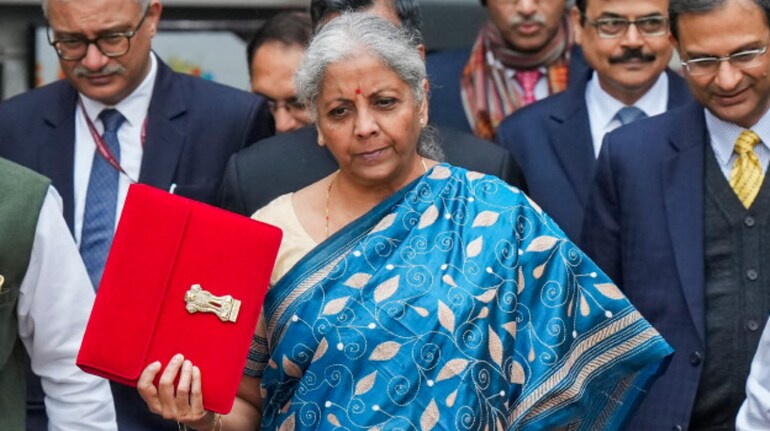
As the Union Budget 2025-26 draws closer, expectations are growing for income tax sops from Finance Minister Nirmala Sitharaman on February 1.
There is a clamour for lowering the burden on income taxpayers by liberalising tax slabs, reducing tax rates and hiking standard deduction, among other measures.
Will FM raise the basic exemption limit, introduce a new 25 percent tax slab?
Reports suggest that Finance Minister Nirmala Sitharaman could announce major changes to the new tax regime by raising the basic exemption limit from Rs 3 lakh to Rs 10 lakh, besides introducing a new tax slab of 25 percent for incomes of between Rs 15 lakh and Rs 20 lakh.
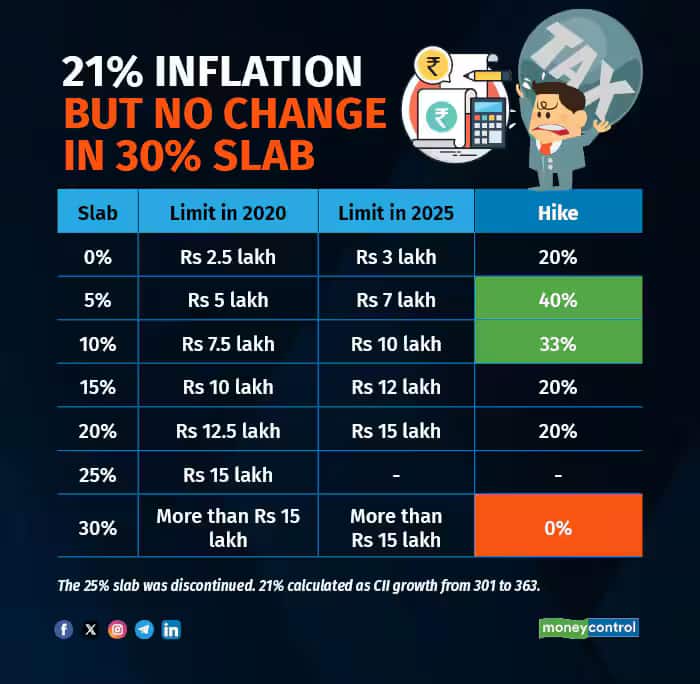
At present, those with incomes of over Rs 15 lakh have to pay tax at the slab rate of 30 percent. If Budget 2025 indeed introduces a new slab, the tax rate of 30 percent will be applicable to incomes of over Rs 20 lakh.
"We are evaluating both options. If our budget allows, we may implement both measures – making income up to Rs 10 lakh tax-free and introducing a 25 percent slab for income between Rs 15 lakh and Rs 20 lakh," said unnamed government officials quoted in a Business Standard report. In such a case, the government might have to be prepared to absorb the revenue loss of Rs 50,000 crore to Rs 1 lakh crore as an impact of such income tax relief.
"The new regime was introduced in 2020. Since then, the Cost Inflation Index (CII) is up 20.59 percent. Most new regime brackets have been enhanced by at least 20 percent, except the 30 percent slab, which is stuck at the Rs 15-lakh level. If we update it by 20 percent, it needs to be at Rs 18 lakh. Without this update, taxpayers with higher income get burdened with a disproportionately higher share of the taxes,” says Adhil Shetty, CEO, Bankbazaar.com.
Old tax regime to be retained?
With the central government making the new, minimal exemptions tax regime more attractive for taxpayers over the years, many have moved away from the old tax regime that provides a host of tax benefits on taxsaver investments, health insurance premiums, house rent allowance (HRA) and so on. According to finance ministry data, 72 percent of taxpayers switched to the new tax regime in the financial year 2023-24.
Budget 2024 sweetened the deal further in July 2024, when Union finance minister Nirmala Sitharaman rejigged the income tax slabs under the new, minimal exemptions tax regime and increased the standard deduction from Rs 50,000 to Rs 75,000. In contrast, the tax slabs, rates and standard deduction under the old tax regime were left unchanged.
While the government does want to incentivise a switch to the new regime, it is unlikely that the old regime will be scrapped, say experts. “I do not believe the government will scrap the old tax regime in Budget 2025. For most taxpayers, the new regime will result in lower tax outgo, especially post the Budget changes announced in July 2024. However, a section of taxpayers might still find that their tax outgo is lower under the old regime. The government will not tinker with the old regime keeping such taxpayers’ interests in mind,” says Karan Batra, founder of tax consultancy firm Chartered Club.
Also read: Budget 2025: How the old and new income tax regime slabs, rates stack up
Why a hike in standard deduction is necessary
Rising inflation and growing household expenses call for an increase in standard deduction, feel tax consultants. “While standard deduction under the new regime was hiked from Rs 50,000 to Rs 75,000 in July 2024, that was too little. It should go up to at least Rs 1 lakh as expenses have surged. A salaried person who earns, say, Rs 15 lakh, could be spending Rs 7-9 lakh a year. He or she is already paying tax on these expenses in the form of goods and services tax (GST) or value-added tax (VAT) — on fuel, children’s school fees, household expenses, and so on. So, a higher standard deduction is required,” says Abhishek Soni, Co-Founder, Tax2Win, a tax consultancy and return-filing portal.
Also read: Old vs new (simplified): Which income tax regime will help you save more on tax outgo?
A boost to retirement planning through NPS
Budget 2024 made the National Pension System (NPS) more attractive for individuals by hiking the tax deduction on employers’ contributions to employees’ NPS from 10 percent of basic pay to 14 percent under the new regime. However, this tax break, offered under section 80CCD(2) is available only to salaried taxpayers.
“There is no tax benefit for the self-employed individuals in the new regime. So, we hope that the separate deduction limit of Rs 50,000 [section 80CCD(1B)] available under the old tax regime will be incorporated in the new tax structure as well,” says Sumit Shukla, CEO, Axis Pension Fund.
For employers, their contribution is treated as a business expense and allowed as a deduction from their profit and loss account.
Health insurance tax break in the new regime
Given the rising healthcare inflation – 12-15 percent as per industry estimates – health insurance cover is a basic necessity. This calls for an increase in the section 80D deduction limit for health insurance premiums paid, which is available under the old regime, feel industry players. “India last witnessed an enhancement in the deduction limit in 2015-16. It is best if the limit for medical insurance is linked to inflation and gets revised automatically every year or once in a couple of years. Also, the benefits need to be extended to the new tax regime as well since increasing health insurance penetration is critical,” says Anup Rau, MD and CEO, Future Generali India Insurance.

Discover the latest Business News, Sensex, and Nifty updates. Obtain Personal Finance insights, tax queries, and expert opinions on Moneycontrol or download the Moneycontrol App to stay updated!
Find the best of Al News in one place, specially curated for you every weekend.
Stay on top of the latest tech trends and biggest startup news.