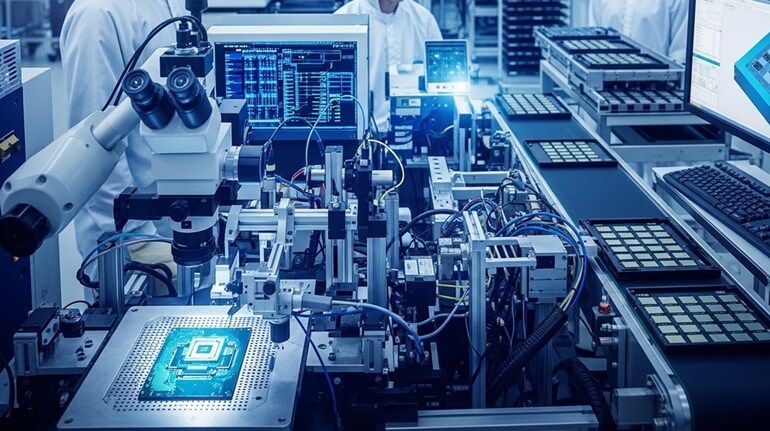
India’s semiconductor sector enters Union Budget 2026 at a crucial stage, with industry leaders calling for a sharper focus on execution, timely incentives and value creation rather than just capacity build-up. While the government has committed significant public capital to semiconductor fabs, assembly and testing units under the India Semiconductor Mission, experts say the next phase must ensure these projects translate into real chip production and deeper domestic supply chains.
The sector’s immediate priority is the continuation of key schemes such as India Semiconductor Mission (ISM) 2.0 and the Design Linked Incentive (DLI) programme, according to experts. The industry is also seeking higher budgetary allocations for projects that have already received approval.
Big Trends
Push for timely incentives: Semiconductor fabs and OSAT (outsourced semiconductor assembly and test) units are capital-intensive projects with long gestation periods. Industry players say delays in incentive disbursement can strain cash flows during construction and early ramp-up phases.
Rising focus on value creation: While India has made progress in electronics assembly, the industry wants a shift from volume-led manufacturing to higher domestic value addition, including the use of locally designed chips and components.
Growing domestic demand: Demand for semiconductors is rising rapidly from sectors such as electric vehicles, renewable energy, power electronics and industrial automation—areas where India can realistically scale mature-node, analogue and power semiconductor manufacturing.
Major Issues and Challenges
Imports still dominate: Despite policy support, India continues to import nearly all the chips it consumes, making the economy vulnerable to global supply disruptions.
Assembly-heavy ecosystem: Industry leaders warned that focusing only on assembly without strengthening local components, chip design and manufacturing could limit long-term gains.
Testing and certification gaps: Limited access to affordable testing and certification infrastructure remains a key bottleneck, especially for startups and MSMEs working on advanced electronics and semiconductor products.
What Happened in the Last Budget
What the Industry Expects from Budget 2026
Timely disbursement of incentives: Industry bodies are urging the government to ensure faster release of committed incentives to ease financial pressure on large fab and OSAT projects.
Tax and depreciation relief: Industry has proposed extending the 15 percent concessional manufacturing tax regime to semiconductor fabs, electronics components and advanced manufacturing units, with a longer eligibility window aligned to project timelines.
Shift towards higher value addition: Export incentives and PLI benefits should be linked to the level of value added in India, rather than shipment volumes alone. Industry leaders say this would encourage the use of Made-in-India components and semiconductors.
Stronger testing and infrastructure support: The budget is expected to prioritise expanding government-supported testing centres, reducing certification costs, and developing integrated semiconductor and electronics parks with plug-and-play infrastructure to speed up project execution.
Discover the latest Business News, Sensex, and Nifty updates. Obtain Personal Finance insights, tax queries, and expert opinions on Moneycontrol or download the Moneycontrol App to stay updated!
Find the best of Al News in one place, specially curated for you every weekend.
Stay on top of the latest tech trends and biggest startup news.