








Small-cap funds have always carried a reputation: exciting when markets rise, nerve-wracking when they fall. For many investors, they’re seen as a tactical add-on, something you hold in small doses because volatility can be intense. Yet every market correction tends to reopen the same debate: does volatility signal danger or opportunity?
Recent market moves have brought that question back into focus. Over the past several months, small-cap stocks have seen a meaningful reset after an extended period of exuberance.
A study by Abakkus Mutual Fund highlights how deep this reset has been: nearly half of small-cap companies, those with market capitalisations roughly between Rs 2,000 crore and Rs 34,700 crore, are trading about 40 percent below their all-time highs. In simple market-cycle terms, this valuation compression phase tends to shake out excesses while allowing stronger businesses to stand out.
So the real issue isn’t whether small caps are volatile, they always are. The real question is whether this is a rational window to gradually build exposure.
Why small caps grow faster but swing more
Small caps represent companies that are earlier in their growth journey. Many operate in emerging or underrepresented sectors where strong execution can translate into meaningful expansion. Simply put, these are businesses still scaling up, which is why their growth potential and price swings tend to be higher.
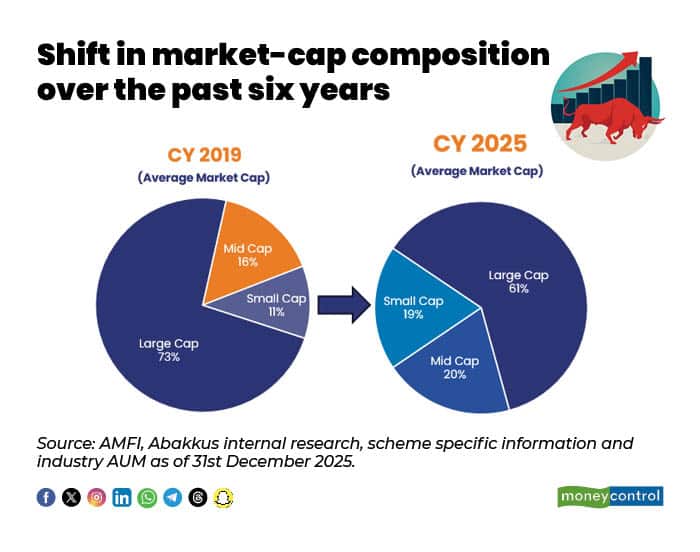
Between CY2019 and CY2025, the total market capitalisation of small-cap companies rose from roughly Rs 16 trillion to Rs 83 trillion, a 5.3 times expansion. That growth outpaced mid caps and large caps, and the segment’s share in India’s equity market universe climbed from 11 percent to nearly 19 percent.
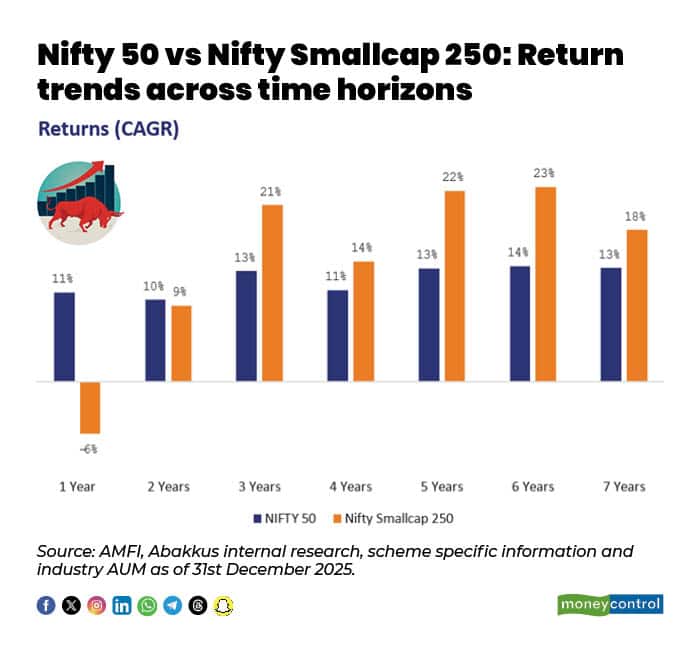
Return data tells a similar long-term story. Systematic investments tracking the Nifty Smallcap 250 have delivered roughly 17 percent CAGR since 2016, stronger than comparable SIP returns from the Nifty 50, which are closer to 12 percent. The trade-off is simple: higher long-term return potential comes with sharper ups and downs along the way.
This dual nature is why small caps require a mindset shift. As Lt Col Rochak Bakshi, CFP, Trunor Enterprises, puts it, “Small caps are a side dish, not the main meal. Investors aren’t buying stability; they’re buying participation in early-stage expansion.”
Why the current phase looks different
Industry experts caution that market corrections don’t automatically equal opportunity, but context matters. According to Gautam Kalia, Chief Investment Solutions Officer, Mirae Asset Sharekhan, “the recent environment reflects both time and price correction, a combination investors rarely see together.”
He further adds, “The small-cap space has not really moved for about one to one-and-a-half years. From October-November onwards, prices started correcting. Market breadth is weak, but earnings outcomes are still encouraging. From a relative pricing perspective, valuations now look fairly placed, not undervalued, but no longer stretched.”
Experts says that shift has prompted measured portfolio adjustments rather than aggressive positioning. “Allocation has moved from about 15 percent to 25 percent, but it’s still not a dominant share. This is an opportunity to rebuild exposure gradually because more corrections are possible,” adds Kalia.
In other words, the idea is not to rush in, but to re-enter thoughtfully.
A similar point of view comes from Vaibhav Chugh, CEO of Abakkus Mutual Fund. He explains, “Many sunrise sectors such as aerospace, electronics manufacturing, EV ecosystems, renewables and advanced pharma are more accessible in the small-cap universe. For long-horizon investors, corrections may allow entry into these themes at more reasonable valuations.”
How to think about small-cap volatility
Small-cap investing is less about predicting short-term market direction and more about managing your reaction to fluctuations. Historically, experts say small caps see deeper and more frequent declines than large caps. Yet over longer holding periods, patient investors have often been rewarded.
Bakshi, explains, “If your goals are nine to ten years away, they deserve a place. But if a 30 percent drawdown disturbs your sleep, this category isn’t for you.”
In practical terms, volatility is part of how small caps behave. Prices will swing more, but investing regularly through SIPs can help average purchase costs and reduce the pressure of trying to time entries perfectly.
Vijay Maheshwari, CWM and Founder, Stocktick Capital, adds “disciplined SIP investing helps investors stay consistent instead of reacting emotionally to market moves.”
How much small-cap exposure is sensible?
Small caps can boost growth, but only when they are balanced with steadier parts of the portfolio.
Maheshwari explains, “A commonly suggested allocation framework could look like this: large caps provide stability during downturns; mid caps support growth; small caps add return potential without dominating the portfolio; flexi-cap funds offer flexibility, while debt provides liquidity and a buffer during volatility”.
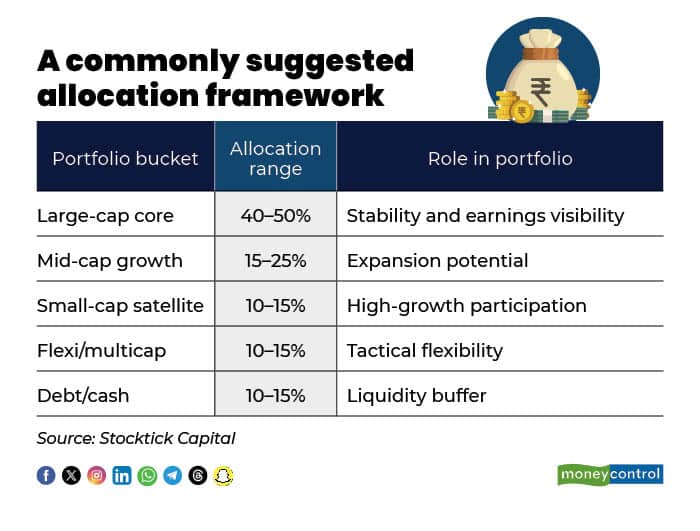
Younger investors with longer horizons may tilt toward the higher end of the small-cap band, while those closer to financial goals may stay conservative.
Bakshi adds, “Rebalancing every 12 to 18 months helps keep allocations in check so no single segment becomes too large.”
So, should you increase exposure now?
Industry experts say, the current environment resembles a reset phase rather than a structural breakdown. Valuations have moderated, market breadth has weakened, and selective opportunities are emerging.
Kalia emphasizes, “Re-entry should be gradual, as volatility may persist.” So for investors with a long time horizon and the ability to handle volatility, gradually increasing exposure can be reasonable.
However, timing should never override suitability. Small caps reward patience and discipline more than aggressive short-term bets. Maheshwari suggests, “A staggered SIP-based approach may help capture long-term growth while managing entry risk. If not, staying conservative is equally rational.”
Here are some points to keep in mind before you increase allocation:
Discover the latest Business News, Sensex, and Nifty updates. Obtain Personal Finance insights, tax queries, and expert opinions on Moneycontrol or download the Moneycontrol App to stay updated!
Find the best of Al News in one place, specially curated for you every weekend.
Stay on top of the latest tech trends and biggest startup news.





