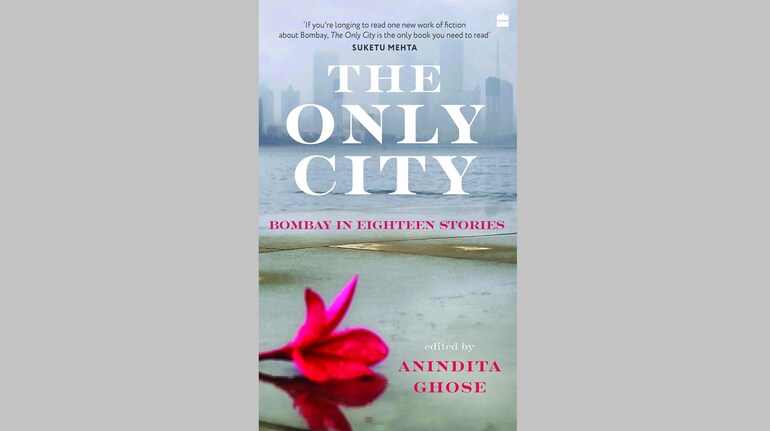
The Only City: Bombay in Eighteen Stories (published by HarperCollins India, 2025) is an anthology of contemporary short stories edited by Anindita Ghose. Its contributors are the crème de la crème of contemporary Indian writers in English — Raghu Karnad, Amrita Mahale, Diksha Basu, Prathyush Parasuraman, Shanta Gokhale, Tejaswini Apte-Rahm, Jairaj Singh, Lindsay Pereira, Dharini Bhaskar, Prayaag Akbar, Kersi Khambatta, Namita Devidayal, Manu Jospeh, Shubhangi Swarup, Jeet Thayil, Yogesh Maitreya, and Ranjit Hoskote.
The stories are interspersed with the black and white photographs of the par excellence chronicler of Mumbai, Chirodeep Chaudhuri. It is an interesting mix of stories with every single one of them offering a perspective on the metropolis that is utterly absorbing. They range from the nurse hired as a caregiver for an old man living alone, couples in a gated community, and travellers in a crowded local train. The stories cut across socio-economic classes. There are plenty of diverse writing styles on display.
For example, there is the traditional writing of prose in the short form by focussing on the story to tell. Or there are writers weaving deftly short stories that are about Bombay while nestled in these stories are references to past literature, displaying a familiarity while at the same time exhibiting their individual talent by sprinkling recognisable literary references in their texts, almost as if genuflecting to the fact that they are standing upon the shoulders of giants. A humble acknowledgement. Who knows, it may prompt you, the reader, to walk around this magnificent city in wide-eyed wonder, reflecting upon the stories that every individual carries within them. By the end of the book, the city as the focus of the short stories becomes an excuse to revel in good and varied literary craftsmanship.
Read it. Decide for yourself.
Anindita Ghose is a writer and editor based in Bombay, where she arrived as a newborn and still lives. She is the author of the novel The Illuminated, which was named among the best books of 2021 in the Indian press by Times of India, The Telegraph, Vogue and others. BBC Radio 4 said it gives voice to a new generation.
Anindita has conceived and editedI, a landmark anthology of new short stories featuring some of the best names in Indian fiction, which also features a story by her. It is published by Fourth Estate, an imprint of HarperCollins India.
The following interview was conducted via email.
Where and how did the idea of this anthology germinate?So many seeds planted over the years. I remember I carried a copy of Bombay, Meri Jaan when I first left the city at age 25. It was an anthology edited by Jerry Pinto and Naresh Fernandes, spanning Manto to Rushdie. I suppose I’ve always been drawn to the idea of a book on my city.
Green shoots sprouted a few years ago when I started thinking about a short story set in a Bombay housing complex. The idea was to observe the social behaviour of a group of people confined during the pandemic. By the time I got around to writing it, covid was a memory I didn’t want to revisit. So it just became a Bombay story, not a Bombay covid story. I was looking for a home for it.
Around this time, I met a Peruvian writer who was researching his next novel in Bombay. He told me his short story collection about his city was translated from Spanish to English and inadvertently become what bookshops recommended to travellers who wanted to go beyond a history-geography kind of introduction. And I thought, where is that contemporary book about Bombay with stories by different voices that speak of the city as it is today?
Please elaborate upon the title "The ONLY City" particularly the use of the definite article. Also, why did you choose to use "Bombay" instead of "Mumbai" as the city is known today?I have to credit Manu Joseph for coming up with the title. He’s one of the anthology contributors and someone whose fiction I think highly of—I believe The Illicit Happiness of Other People to be one of the best Indian contemporary novels. We had met for a meal and I was running a few working titles by him. He didn’t say much then but texted me The Only City (with no context) several weeks later. It felt immediately and instinctively right. It’s a statement. A poetic one. Historian friends animatedly told me it’s factually fallacious—but this is a book of fiction! I learnt after publication that Khushwant Singh had called Bombay “the only city” as well (“Bombay, you will be told, is the only city India has, in the sense that the word city is understood in the West…”). But he was coming at it from a different place. For me—and I write about this in the book’s introduction—the title acquired more meaning as I worked through the book. I conceived the book as a cast of Bombay characters. And asked the writers to see Bombay as “the only city” where the characters in the book could exist in their full dimension.
I gave each writer the freedom to use Bombay or Mumbai in their story. Some use both. For me it is Bombay because that is what I call the city in my dreams and in my phone calls. I don’t say, “I’m landing in Mumbai tomorrow.” I wanted to be honest: I live in Bombay.
What was the principle of commissioning you had in mind? What was the brief that you gave the contributors?I sought writers for whom Bombay was a defining feature, either in their life or in their oeuvre. I was interested in the quality of each writer’s relationship with the city rather than their biographical ties.
I asked writers to anchor on a quintessential Bombay character rather than nostalgia about geographies and hidden gullies. Though some stories move between timelines, the intention is to be a time capsule or a reflection from now and here.
You have experimented with finesse in persuading nonfiction writers/poets to write fiction. What prompted you to consider this crossover?Four writers make their fiction debut in this anthology—Ranjit Hoskote, Raghu Karnad, Jairaj Singh and Prathyush Parasuraman—but they’re all writers whose writing in other formats I admire and am familiar with. I’ve followed Ranjit’s art writing and poetry for a while. I love Raghu and Jairaj’s journalistic writing. Prathyush, who I’d never met with until I reached out for the book, is a young critic whose writing on art and cinema is outstanding. With Prathyush, I reached out to him after reading one of his columns, asking if he was working on any fiction, because his writing has a novelist’s pause. He said he was, and he sent me the first few chapters. And I asked him to write something from the same psycho-social world. I thank all four of them for trusting me with publishing their first works of fiction.
What do you seek in an anthology as a reader? What is it like to be the commissioning editor of an anthology? Are you able to explore questions that you may have had while reading other anthologies?Just what I seek on the radio—a mix of the familiar and the unfamiliar. I’ve edited weekly and monthly magazines as a journalistic editor for close to a decade, but this was not only my first time editing an anthology, it was also my first time editing fiction. The ambition ballooned with each writer who said yes. It’s another thing that I mistakenly thought it’ll be a “quick thing” to put together an anthology with 10-12 writers while I was marinating in my second novel. It took longer than I anticipated, it was also more admin work than I anticipated. But it was definitely a learning experience working with seventeen other virtuoso writers of great individual merit.
I didn’t have much else to compare this to as I don’t know of any other Bombay anthology of new, commissioned writing by a chorus of writers. There are of course anthologies by single writers such as Rohinton Mistry, Murzban F. Shroff, Vikram Chandra, Jayant Kaikini and others. When I think about it, it was quite a leap of faith. Of course we did push several stories into multiple edits, and worked on tonality and length, but you can’t change the core of a story once it is written.
Why did you focus only upon English writers and not include stories in translation?I thought about this deeply. I had started out wanting to include translations, that’s how the Kannada writer Jayant Kaikini’s blurb made its way to the book. In fact, Jerry Pinto even shared a translation of a Bhau Padhye story, but it turned out it had been previously published.
If this was a retrospective anthology, where existing works were being included, I would not have proceeded without a translated work, no matter how long the wait for permissions. But I didn’t believe I was the right person to commission a new story in Marathi and have it translated because I do not read Marathi literature. I also thought there was a fair amount of tonal discordance already among the early stories coming in, and while adding a translated work in that mix would be a good statement, I didn’t want to do something just to make a statement.
And I want to say something which might make several people unhappy, but there is something to be said about Indian writing in English. While celebrating translations is great and much needed, I don’t think we serve either category well by lumping them together—even in literature awards!
What was the principle of selection of the writers? Many of them have been associated with the city at some point, not all are natives. Yet, remarkably, some of the stories evoke a strong sense of the city.
Indeed, some of the writers are “born and raised” here. For instance, Ranjit Hoskote, Shanta Gokhale and Namita Devidayal have set their stories in the neighbourhoods they are familiar with. But that is not true for all. What is in common between all the writers in this anthology is that each has an almost alchemic relationship with the city. The city changed them in some way. Diksha Basu went from being an actor to a writer here; Prayaag Akbar wrote his first novel here; Yogesh Maitreya had an epiphany about his future as a scholar and writer here.
Did you nurture these stories from the kernel? Or were these already works in progress that were then developed for The Only City?Only Raghu’s story was a work in progress, though he rewrote considerably over several drafts and a full year. The others were all born for the book, which I’m chuffed about, though I cannot guarantee the full veracity of this statement because writers carry kernels in their heart, heads and bodies for years. But yes, this is an anthology of new and previously unpublished stories. They were written on commission. If I were to use previously published work, it would be a very different anthology. That would be more of a scholarly exercise. I turned down the offer to use a previously published work by a beloved Bombay writer as I thought it would not be fair to the others.
Many of these stories are focussed upon the individual (s). Whereas contemporary Indian literature set in Mumbai --- in translation and original English --- convey the hustle-bustle and chaos of the city. Was it a conscious decision of the author and yours to keep the individual in the foreground and relegate the chaos to the background?I’m glad you noticed that. In my recent work in the social impact communications space, we always say that projects are better when they have people at the heart of it. Since the brief was for the writers to focus on a quintessential Bombay character, it is natural that the close lensing on individuals followed from there. I truly believe that 18 close-up portraits give a better insight into a city and a culture rather than 18 sweeping landscape shots. Of course there are things the anthology has missed. Checking every box would have been an impossible, and somewhat inauthentic, task.
Are these stories for readers or are these primarily stories written by people who are voracious and eclectic readers? If it were the former, then there would be more of an effort made to engage the reader with the fictional landscape and its details. If it were the latter then there would be more of an inward-looking style with many more references to other literary offerings. So, which is it to be?
I do not understand this question. It is both, though you may argue that the writers have written for readers who are possibly like them. It would be dangerous to assume that writers talk down to readers, or that they manufacture a voice for the sake of their readership, and I do not want to make this assumption on behalf of the writers.
Discover the latest Business News, Sensex, and Nifty updates. Obtain Personal Finance insights, tax queries, and expert opinions on Moneycontrol or download the Moneycontrol App to stay updated!
Find the best of Al News in one place, specially curated for you every weekend.
Stay on top of the latest tech trends and biggest startup news.