






*******
In 2010, barrister Philippe Sands was invited by the law faculty of a university in the city now known as Lviv, Ukraine, to deliver a public lecture on his work on crimes against humanity and genocide. Lemberg, Lviv, Lvov, and Lwów as it has been known through history are the same place. The name changed according to who commanded the city. It changed hands, no fewer than eight times in the years between 1914 and 1945. Sands had been asked to talk about the cases in which he had been involved, about his academic work on the Nuremberg trials, and about the trials’ consequences for the modern world.
The Nuremberg trials which laid the groundwork for the human rights movement continues to fascinate Sands.
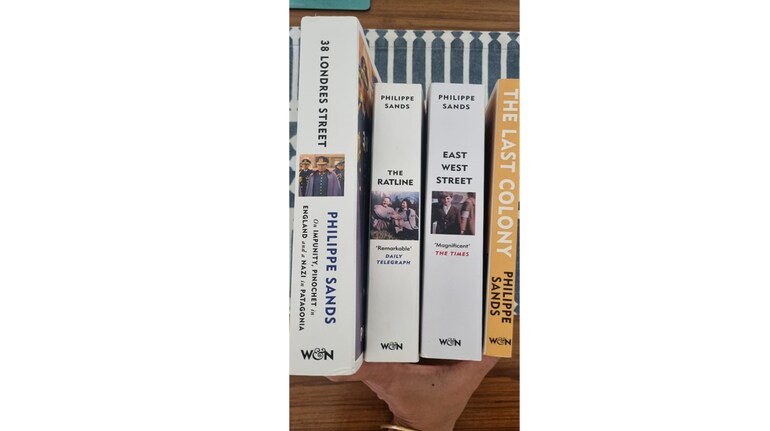
Philippe Sands KC is Professor of Law at University College London and Visiting Professor of Law at Harvard. He is a practising barrister at 11 Kings Bench Walk (KBW), appears as counsel before the International Court of Justice and other international courts and tribunals and sits as an international arbitrator. He has written multiple books but it is his bestselling oral histories that are considered exceptional. These are: East West Street, The Ratline, and 38, Londres Street.
Some of these have won awards such as the Baillie Gifford Prize 2016 for East West Street, The Ratline was converted into a BBC podcast series, and now 38 Londres Street has been optioned for a film by Felipe Gálvez with Marvel actor Sebastian Stan in the lead. His books have been translated into more than 30 languages.
East West Street is a fascinating investigative narrative about two prominent jurists of the Nuremberg trials — Hersch Lauterpacht and Raphael Lemkin. These international criminal trials held by France, the Soviet Union, the United Kingdom, and the United States against leaders of the defeated Nazi Germany for plotting and carrying out invasions of several countries across Europe and committing atrocities against their citizens in the Second World War. Eighty years ago, on 20 November 1945 and 1 October 1946, the International Military Tribunal (IMT) tried 22 of the most important surviving leaders of Nazi Germany in the political, military, and economic spheres, as well as six German organizations. The purpose of the trials was not only to try the defendants but also to assemble irrefutable evidence of Nazi war crimes. Sands blends history with his memoir, his quest to discover the origins of his maternal family, particularly about his grandfather, Leon Buchholz, who never spoke about his past. This is a book about justice being delivered.
The Ratline is an investigation into unearthing the truth behind what happened to leading Nazi Baron Otto Gustav von Wächter who died in Rome in 1949. He was a high-ranking Nazi official, an SS officer who participated in the Final Solution extermination of Jews in Europe. During the occupation of Poland by the Germans, he was Governor of Krakow and responsible for the killing of Polish Jews. In The Ratline, Sands meets with Otto van Wächter’s son, Horst. The book is about them, Horst’s favourable stance of his antisemitic parents and engaging in many conversations with Sands over some years including giving him access to his mother, Charlotte Wächter’s papers. It is an extraordinary achievement given that Sands and Wächter did not shift from their stances but continued to maintain a dialogue. This is a book about trying to comprehend why a Nazi criminal escaped justice and why his son continues to be sympathetic for the evil his father unleashed.
38, Londres Street is the concluding part of the trilogy wherein Sands explores the question of another Nazi, Walther Rauff, and his close proximity to the Chilean dictator Augusto Pinochet. Rauff was the SS Commander who was responsible for the infamous Nazi mobile gas vans and later under the Pinochet regime, was associated with the equally dark “refrigerated trucks” that were linked to the disappearance of people who were vocal against the dictator. In this book, Sands in his trademark style, investigates, travels, and unearths evidence regarding this dark period of Chilean and Nazi Germany histories. But it is also Sands documentation of the impunity with which these criminals can get away with justice. Pinochet, for instance, who on medical grounds was granted pardon by the then British Home Secretary Jack Straw, returns to his homeland instead of being deported to Spain as had been requested and whose first act upon reaching the airport tarmac was to stand up from his wheelchair and walk!
These books designed to be standalone narratives, have inadvertently come to be referred as a “trilogy”. Presumably because the narrative arc governing these three texts is Sands’ preoccupation with impact of the Nuremberg trials on international justice. More significantly, how did the two definitions coined at this time — “genocide” and “crimes against humanity” — impact contemporary global politics. These are ideas that continue to haunt international law in the twent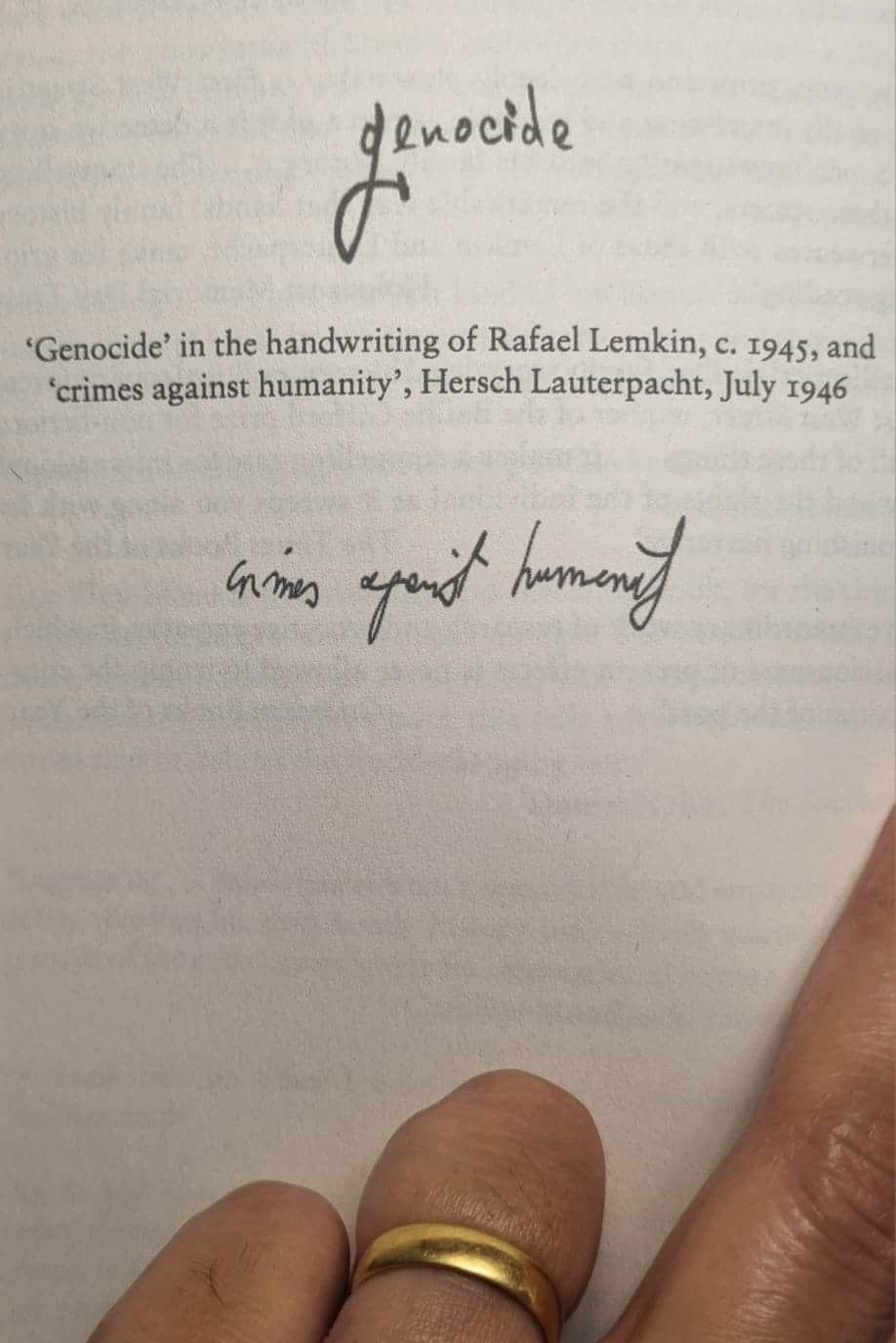
In each book, he explores, questions, and investigates key figures such as Lauterpacht and Lemkin in East West Street, Horst von Wächter in The Ratline and Walther Rauff and Augusto Pinochet in 38 Londres Street. In the texts, Sands uses his legal expertise to present evidence about criminals, jurists, ordinary citizens who are affected by these horrific acts and the idea of justice. The latter is a complicated space to inhabit as Sands narrative determines. For example, justice is meted out to a Nazi criminal like Hans Frank in the Nuremberg trials. Yet, there are those who with impunity escape justice as in the case of Augusto Pinochet and his aide Walther Rauff. Or there are those who inhabit the grey space of not seeing any wrong in acts of genocide particularly in those individuals who perpetrated this. All this despite there being plenty of hard evidence to suggest that these people not only participated but orchestrated the extermination of others. For example, like Otto von Wächter, whose son, Horst von Wächter (Financial Times profile, 2013) who firmly believes that ‘I must find the good in my father. My father was a good man, a liberal who did his best. Others would have been worse’. This is quite unlike Niklas Frank, who when he accompanied Sands to courtroom 600 in Nuremberg, spoke gently and firmly. “This is a happy room, for me, and for the world”. In principle Niklas was against the death penalty but not when it came to his father. And yet, Niklas Frank is the one who introduced Sands to Horst von Wächter. Later, Sands accompanied these two sons of the senior Nazi war criminals as they travelled through Europe to confront the past sins of their fathers. It has been documented in the film called What Our Fathers Did: A Nazi Legacy (2015).
In the summer of 1998, Sands had been peripherally involved in the negotiations that led to the creation of the International Criminal Court (ICC), at a meeting in Rome, and a few months later he worked on the Pinochet case in London. The former president of Chile had claimed immunity from the English courts for charges of genocide and crimes against humanity laid against him by a Spanish prosecutor, and he had lost. In the years that followed, other cases requiring the courts of international justice, like from the former Yugoslavia and Rwanda soon landed on his desk in London. Others followed, relating to allegations in the Congo, Libya, Afghanistan, Chechnya, Iran, Syria and Lebanon, Sierra Leone, Guantánamo, and Iraq. According to Sands, “The long and sad list reflected the failure of good intentions aired in Nuremberg’s courtroom 600.” He continues:
I became involved in several cases of mass killing. Some were argued as crimes against humanity, the killings of individuals on a large scale, and others gave rise to allegations of genocide, the destruction of groups. These two distinct crimes, with their different emphases on the individual and the group, grew side by side, yet over time genocide emerged in the eyes of many as the crime of crimes, a hierarchy that left a suggestion that the killing of large numbers of people as individuals was somehow less terrible. Occasionally, I would pick up hints about the origins and purposes of the two terms and the connection to arguments first made in courtroom 600. Yet I never inquired too deeply as to what had happened at Nuremberg. I knew how these new crimes had come into being, and how they subsequently developed, but little about the personal stories involved, or how they came to be argued in the case against Hans Frank. Nor did I know the personal circumstances in which Hersch Lauterpacht and Rafael Lemkin developed their distinct ideas.I became involved in several cases of mass killing. Some were argued as crimes against humanity, the killings of individuals on a large scale, and others gave rise to allegations of genocide, the destruction of groups. These two distinct crimes, with their different emphases on the individual and the group, grew side by side, yet over time genocide emerged in the eyes of many as the crime of crimes, a hierarchy that left a suggestion that the killing of large numbers of people as individuals was somehow less terrible. Occasionally, I would pick up hints about the origins and purposes of the two terms and the connection to arguments first made in courtroom 600. Yet I never inquired too deeply as to what had happened at Nuremberg. I knew how these new crimes had come into being, and how they subsequently developed, but little about the personal stories involved, or how they came to be argued in the case against Hans Frank. Nor did I know the personal circumstances in which Hersch Lauterpacht and Rafael Lemkin developed their distinct ideas.
East West Street: On the Origins of Genocide and the Crimes Against Humanity is an intricately told story. It is packed with information, as Sands digs deeper and deeper into official and personal archives. Surprisingly, he gets ready access and converses regularly even with the descendants of the Nazis. For example, Niklas Frank, whose father, Hans Frank (“The Butcher of Warsaw”) was one of those on trial at Nuremberg and ultimately sentenced to death. To Philippe Sands amazement as he delved deep into research, it became clear that the Nuremberg jurists, his legal hero Hersch Lauterpacht and Raphael Lemkin, whose work was foundational to the discipline of international criminal law, were from the same city as Leon Buchholz. The lawyers coined and defined “genocide” and “crimes against humanity”. This is a thrilling fact for a barrister to discover; to personally be at the intersection of his legal interests and his family history. It allowed Sands to write an incredible memoir. He masterfully interweaves the biographies of Lauterpacht and Lemkin’s with his Jewish lineage. The result is as spy thriller writer, John le Carré called it: "A monumental achievement: profoundly personal, told with love, anger and great precision.”
In fact, there is this brilliant section (Chapter 119) wherein Sands analyses “genocide” and “crimes against humanity” — the fundamental principles of human rights in international law.
Lauterpacht’s draft made no reference to genocide, or to the Nazis, or Germans as a group, or crimes against Jews or Poles, or indeed crimes against any other groups. Lauterpacht set his back against group identity in the law, whether as victim or perpetrator. Why this approach? He never fully explained it, but it struck me as being connected to what he experienced in Lemberg, on the barricades, observing for himself how one group turned against another. Later he saw firsthand how the law’s desire to protect some groups—as reflected in the Polish Minorities Treaty—could create a sharp backlash. Poorly crafted laws could have unintended consequences, provoking the very wrongs they sought to prevent. I was instinctively sympathetic to Lauterpacht’s view, which was motivated by a desire to reinforce the protection of each individual, irrespective of which group he or she happened to belong to, to limit the potent force of tribalism, not reinforce it. By focusing on the individual, not the group, Lauterpacht wanted to diminish the force of intergroup conflict. It was a rational, enlightened view, and also an idealistic one.The counterargument was put most strongly by Lemkin. Not opposed to individual rights, he nevertheless believed that an excessive focus on individuals was naive, that it ignored the reality of conflict and violence: individuals were targeted because they were members of a particular group, not because of their individual qualities. For Lemkin, the law must reflect true motive and real intent, the forces that explained why certain individuals —from certain targeted groups—were killed. For Lemkin, the focus on groups was the practical approach.Despite their common origins, and the shared desire for an effective approach, Lauterpacht and Lemkin were sharply divided as to the solutions they proposed to a big question: How could the law help to prevent mass killing? Protect the individual, says Lauterpacht. Protect the group, says Lemkin.Unsurprisingly as happens in many family histories, there are many twists and turns. Horst von Wächter’s only child, Magdalena, brought up as a firm Catholic, for many years believed her father’s account of her grandfather and sympathised. But recently married, she was trying to understand the family’s past. Then she heard Philippe Sands podcast series The Ratline (BBC, 2018) and wrote to him saying that she concluded that her grandparents “were very aware of what they did and somehow never regretted it”. It is a burdensome family heritage that she was trying to recover from. She complimented Sands on his podcast series and believed that he had portrayed her father Horst “fairly”. Walter Rauff’s grandson had a similar reaction upon reading 38 Londres Street and wrote to Sands appreciating his profile of his grandfather. There seem to have been no familial repercussions there but a rift has been created between Magdalena and Horst. After coming to terms with her family’s Nazi past, she wrote on her social media page, “My grandfather was a mass murderer”. Her father ordered her to remove it but she refused.
The three books are very similar in structure that they posit two individuals in a setting with Sands being very much in the centre of the action. It is almost as if the lines are blurred between the authorial narrator and the litigator. In every text, Sands presents evidence to the reader as he would be expected to present it in the court before the judges and jurors. This could be in the form of texts, personal correspondence, photographs, archival material, documents, or oral testimonies of the survivors and their descendants. Astonishingly, even though he establishes fairly early on in the trilogy that silence is an act of self-preservation amongst the victims/relatives of genocide such as in the case of his own grandfather; even so, he manages to exhibit immense patience and maintain a dialogue with the individuals he interviews. His professionalism can be gauged in the manner in which he continues his conversations even if he does not agree with the interlocutor as becomes obvious in his discussions with Horst von Wächter. He presents his arguments in his narration but leaves it sufficiently open for the reader to come to their own conclusions. It is in all likelihood a challenging balancing act to perform with the written word, but Sands brings his decades of expertise as a barrister to the words on the page. He does tend to explore background details in excruciating minutiae and insists on placing them within the main narrative, but once the reader familiarises themselves with his writing style, it becomes easier and easier to read. It is almost like reading a thriller. It is impossible to put the books down despite the terrifying details that emerge. It is the truth.
The trilogy tackles subjects that are full of alarmingly violent details that were perpetrated by individuals who firmly believed in their acts. For instance, Rudolf Höss, the commandant of Auschwitz, privately told the US army psychologist Dr. Gilbert at the Nuremberg trials that the dominant attitude at Auschwitz was of total indifference. Any other sentiment “never even occurred to us”. This attitude is apparent in all the Nazis profiled in these books. It is immaterial that Sands is discussing facts from the past as disconcertingly these continue to have ramifications upon the present, in the twenty-first century. Most obviously being that of international law debating on “genocide” and “crimes against humanity”. So, despite 38 Londres Street concluding with an ambiguity that is frustrating, at least in the previous two books — East West Street and The Ratline — the younger generation, Niklas Frank and Magdalena provide hope by acknowledging and rejecting the criminal acts perpetrated by their forbears.
It is magnificent research and methodology that are on display. These compactly told narratives will appeal to younger generations of readers as they wish to know more about these despicable moments in history. More so, for the grey areas that exist in bringing the criminals to justice or for that matter how are these stories inherited, preserved — in memory, family histories, and archives.
Given the short lifespan of books, these bestselling oral histories by Philippe Sands will stand the test of time and sell. They are a must read.
Discover the latest Business News, Sensex, and Nifty updates. Obtain Personal Finance insights, tax queries, and expert opinions on Moneycontrol or download the Moneycontrol App to stay updated!
Find the best of Al News in one place, specially curated for you every weekend.
Stay on top of the latest tech trends and biggest startup news.









