But I’m Not a Writer
Why everyone stands to benefit from a personal writing practice
When I travel and speak about the power of words to trans- form your life, I always start by asking two questions. It doesn’t matter who I’m speaking to, the size of the room, or who is in it. It could be the C-Suite of a massive organization looking to increase market share or grow its revenue. It could be a room of moms and dads in the thick of parenting. It could be an audi- torium full of creatives looking to feel inspired. Either way, I start by asking, “How many of you in here would consider yourself a writer?”
I usually go on by saying, “What I mean by this is how many of you would be mingling at a cocktail party and when someone turns to you to say, ‘Tell me about yourself,’ you’d say, perhaps among other things, “I’m a writer.” No matter where I am, the response is nearly the same. Usually it’s a measly five or six hands that slowly and self-consciously make their way into the air.
Immediately, I ask the second question. “Okay then, how many of you write, compose, and send at least three emails or text messages every day?” There’s usually a murmur of laughter in the room as every single hand reluctantly but inevitably goes up. The point is clear. Like it or not, writing is not an optional activity in our modern lives. You are a writer because you write— all the time.
You write for all kinds of reasons. You write to communicate a message, to encourage a friend, to ask someone a favor, to ask a question, to deliver information, so that you don’t forget some- thing (like an item on the grocery list, for example). Maybe you write in a journal where you can fully process your thoughts or feelings about a subject, or maybe you write down your goals as a regular practice. Maybe you write down a few things you’re grateful for each morning. Or maybe you have to write a “report” for work. Either way, we’re all drawn to the process of writing for one reason or another.
There are a host of reasons you hesitate to act on these impulses, which I’ll get to later in the chapter. But if you’ve ever had the impulse at all, take a minute and acknowledge yourself. Writing is an incredibly human instinct—and a great one at that. Intuitively, we know writing clarifies our thinking, gets us in touch with a higher wisdom, connects us to other people, calms our nerves, and helps us make something usable from even the most horrific situations. You won’t meet many people who don’t have the impulse to write. We reject the identity of “writer,” hide our urges to write, act like it’s no big deal or that it doesn’t matter. But we secretly dream of finding a way to be seen and heard and understood, even by ourselves—something which writing readily helps us do. The urge to write is almost completely universal.
I was at the service center of my car dealership the other day, and John, who’s been repairing BMWs for years, told me he’s been harboring a secret idea for a screenplay. Aaron, my Lyft driver, told me he used to keep journals hidden under the mattress of his bed until one day, when his mom found them and read what he had written, out loud, to his friends. Aaron hasn’t written since. Go figure.
Participants who come to our Find Your Voice one-day work- shops or Prepare to Publish meetups say things like, “I’ve had this story burning inside me for years now. I have to get it out.” I recently spoke to a pastor who called because his publisher is breathing down his neck, demanding a book proposal. He’s the leader of a big church, and the publisher wants to help him package some of his sermon material. But what he said to me at the end of that call got to the heart of the matter: “I know the book they want me to write, but it’s not the book I need to write. I need your help.”
The need to write. Yes. That’s what I’m getting at here. Writing to publish is one thing, and it can be a great thing. But the urge to write can’t always be satisfied by the act of publishing. Because writing is not just writing. Writing is prayer, spirituality, self-discovery, communication, therapy, connection. The invita- tion and impulse to write is not just an invitation and impulse to put a few words down on the page. It’s an invitation to take own- ership of our lives. Writing helps us gain confidence in ourselves, our ideas, and how we move through the world. The invitation to write is an invitation to find your voice.
Somewhere along the way, we were sold the idea that writing is only a commodity. But what if writing could also be a lifeline?
The Evolution of the Written Word
The problem is, we have dozens of deeply embedded cultural misunderstandings about writing that make it harder than it needs to be. These misconceptions talk most of us out of the kind of writing that is likely to have an impact on our lives and in the world. They make even the most talented and trained among us write flat and uninteresting stories. They short-circuit the miracle of the writing process, period.
Let’s go back several centuries and talk about how the written word came into being. I won’t walk you through a long history lesson here, but for the sake of this book, keep in mind that the written word hasn’t always existed. Ancient Egyptian hieroglyphs were considered the first true writing system, and coherent texts didn’t appear on the scene until about 2600 BC.
In lieu of writing, human beings spent a good portion of their history observing an oral tradition, which involved passing on stories, wisdom, family traditions, and tribal rituals by word of mouth. Think of the last time you spent a few hours around a campfire, telling stories for hours with your family or friends. Recall how bonded you felt to those people. How settled you were as you spoke. How much you enjoyed that time. Also recall how those stories become legends over time, making their way into your psyche as fact as much as myth.
This is the power words can have in our lives.
But the limitations of the spoken word are numerous. First, we have to remember everything that was said. With the spoken word, we don’t have a way to go back and revisit it later. For centuries, spoken word axioms proved effective at transmitting necessary data from generation to generation—like how to prop- erly clean an elk or how to use the stars to find your way home. But our brains are not limitless. At some point, they reach capac- ity and are not able to store anything more.
In addition to this obvious limitation, in order for the spoken word to be effective, you have to have a direct and present listener right in front of you—and, I would argue, a receptive listener at that. Have you ever tried to tell a five-year-old to go brush his teeth and tie his shoes? Or how about telling someone who is scrolling Instagram about what just happened to you? You might as well be talking to a cardboard box. If you don’t have a captive audience the spoken word is rendered useless.
Finally, the spoken word is often misunderstood and mis- interpreted. This can happen with the written word, too, but with the written word you have the benefit (as the communicator) of refining your words until they’re exactly what you mean. You have the great luxury (as the reader) of combing back through the words over and over again to triple check that they said what you think it did. You don’t get these advantages with the spoken word. Whatever comes out of your mouth comes out of your mouth. Even if you correct yourself, what you said first was still said.
What happens if your spoken words get twisted and misused and remembered in a way you did not mean them? What hap- pens if the words are forgotten?
Over time, human beings began to take some of the stories they had already told thousands of times and write them down. Some of the earliest texts included ancient Egyptian religious texts, Greek and Roman literature, and the Judeo-Christian Scriptures. Then came Buddhist religious texts, Chinese reli- gious texts, and eventually (skipping centuries) Old English texts—Beowulf, for example, which you may have read in a high school or college English class.
Again, my intention here isn’t to subject you to a long his- tory lesson. My intention is to help you see that the written word evolved as human consciousness evolved. As we began to put words on the page, we also began (however slowly) to under- stand those who are different from us, to have a reliable way to remember details, to clarify our thoughts and ideas about things by expanding our vocabulary, and to pass our cultural and reli- gious identity to the generations that followed.
This all sounds like a good thing, right? There’s only one problem. Even as the written word became more and more common, writing was still a distinctly elite activity. In order to write, you had to have access to education, money, resources, and power. This is why history books are generally slanted, conven- iently leaving out whole groups of marginalized people and their perspectives. Because those people didn’t write the history books.
Are you beginning to see how the written word gives us power?
I’ve heard a handful of times that city developers make decisions about how many prisons to build in the next decade based on the literacy rates of second graders. When I sought to corroborate that claim before sharing it with you, I found there were very mixed reviews on the subject. Some people swear this is cat- categorically untrue. Others stand by it. Here’s what I could verify.
According to a study done by the Annie E. Casey Foundation in 2013, students who are not reading at grade level by the end of third grade are four times more likely not to graduate high school. An additional study done by Northwestern University in 2009 showed that students who didn’t graduate high school were 63 percent more likely to be incarcerated than college graduates. So whether that first piece of data I shared is true or a well-circulated rumor, you can see where the conclusion might have come from. The reading, comprehension, and writing skills of seven- and eight-year-olds tell us valuable information about how future genera- tions will contribute to society. Some of today’s second graders will be constructive members of our community, able to metabolize the details of their lives in a positive way. When I say metabolize, what I mean is that writing offers us a powerful way to ingest what takes place in our lives—whatever that may be—to break it down into pieces, to absorb the parts that are nutritious and good for us, and to discard what doesn’t serve our growth. Like a digestion process, this gives us the ability to assimilate all kinds of experiences (not just positive ones) and use them for our benefit.
I’ll say more about this idea of metabolizing our lives in [later chapters], but for now what you need to know is this: an ability to metabolize will allow some kids to metabolize their particular set of life experiences in order to create new legislation, capture ideas that serve people in compelling ways, speak up in situations where their words may not be well-received, and pass on wisdom from their missions and mistakes to the next generation. They’ll be able to use their experiences and their voices as powerful tools to solve complicated problems.
Others will struggle, not because they don’t have something priceless to contribute, but because they don’t have the mental constructs that written words bring. These mental constructs, among other things, help us lift ourselves out of our current circumstances, no matter how dire, and see them from a new perspective. Writing helps us choose a different vantage point than we’ve ever taken before; it helps us persuade an audience toward an action or set of actions; it affords us the ability to make a way where there wasn’t a way before. Writing gives us power. Shouldn’t this power be available to everyone?
Writers create something where there was nothing. Still think you aren’t a “writer”? Maybe you should become one.
If this all sounds like a big stretch to you—that the written word could have an impact on issues like mental health and sui- cide, the opioid crisis, mass shootings, or the gap in education, consider this research a friend of mine is doing at Vanderbilt University in Nashville. According to him, early data is showing a link between the words a person uses (in this case, spoken word) and the level of depression or suicidality of that person. I asked my friend what the team of researchers is watching for when they listen to their subjects speak. He said they’re paying attention to intonation, volume, pacing, and even the pauses between words. But one aspect he mentioned stuck out to me more than any other. As they’re evaluating a speaker’s mental health and level of suicide risk, he said they are listening for word choice.
I asked him to explain to me what a variance in word choice might have to do with someone’s mental or emotional state. He said the words a person chooses to describe an experience can tell you quite a bit about how they feel about it. This much might seem obvious. If you describe an event as being “the worst day of my life,” it’s obviously more distressing to you than if you say it was “not my favorite.”
But here’s where things really get interesting. The researchers are concluding, based on early data, that the fewer words a person uses to describe an event, the smaller their range for understand- ing and appropriately categorizing that event.
So, to oversimplify this a bit, if a participant uses the same word or phrase (i.e.: “that sucks”) for two diverse circumstances (like, “my friend died” and “my pizza has olives on it”), this shows that their ability to regulate their emotions regarding those two experiences is as limited as their vocabulary. In short, the pizza problem is measured in their brain as a tragedy equal to losing a beloved friend.
Researchers are starting to see that these patterns show up in written words as well as spoken words.
What if writing things down could do more than just predict your emotional state? What if it could actually help regulate it?
Obviously, we all know that a pizza arriving with an unfavorable topping is not the same as a friend’s death. But the tentative conclusion, given this in-process research, is that when we don’t have a vocabulary that reflects that understanding, our brains actually don’t know the difference. The words we use mat- ter deeply. Writing helps us not only see the words we’re already using but then change the words we’re using so that we can in turn change our lives.
There is something about naming our experience—giving it the words it deserves—that helps keep us from over-inflating an experience, or from undervaluing it. The words we use help us see and honestly evaluate the problem more clearly so we can potentially find a solution. Not just any words will do, though. They have to be the right words. Have you ever had an experi- ence when you couldn’t think of the right word for a certain topic and you felt stuck until you finally figured it out? When you can finally put the exact right words to something you’ve been feeling or living through, a deep relief comes.
Mark Twain is quoted as saying, “the difference between the almost right word and the right word is . . . the difference between a lightning bug and lightning.” This is the invitation writing gives us—to find the exact right words.
Take a minute and think of someone or something you’d like to better understand. If you feel like you have things pretty well figured out, and you don’t spend any time wrestling through the deeper questions of life—who we are and what we’re doing here— then this probably won’t make any sense to you. But if you find yourself confused, lost, questioning your purpose, wondering where evil comes from or why it persists, wondering if and how you might contribute to the evil of this world and if there’s more for you to learn, then consider how writing things down might become your most valuable resource. Writing gives us space to work through our biggest questions.
Maybe, for now, it’s just the questions you write down. No answers at all. Maybe, over time, answers begin to come. Either way, I wonder if articulating the questions with the exact right words might help you feel a little more settled, a little more empowered, a little more confident in who you are and why you matter. I wonder if you might come away having left some of your stress, some of your pain, on the page. I wonder if you might find a way to express what you came here to express. I wonder if this might help you find your voice.
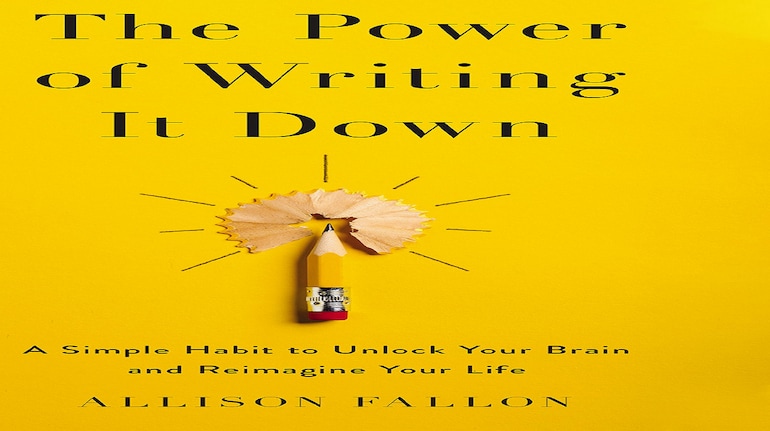
Allison Fallon The Power of Writing It Down: A Simple Habit to Unlock Your Brain and Reimagine Your Life Zondervan Books, HarperCollins Christian Publishing, Inc., 2021. Pb. Pp.224
For anyone who's trying to make sense of their life, who wants to get unstuck from the patterns that hold them back, hear this incredible news: everything you need for the freedom you want is entirely within reach. This practice and pathway is free, it's readily available every day of your life, it takes just minutes of your time, and anyone can do it.
Author, writing coach, and speaker Allison Fallon's life transformed when she discovered the power of a daily writing practice. As it turns out, using your words is one of the most powerful means you have for unlocking your life. The Power of Writing It Down is your guide to this transformative tool available to us all. In as little as five to twenty minutes a day, scientific research shows this daily practice can help you:
•Identify your ruts and create new neurological grooves toward better habits
•Find fresh motivation and take ownership of your life
•Heal from past pain and trauma
•Relieve anxiety and depression
•Contextualize life's setbacks and minor frustrations
•Live a more confident, balanced, and healthy life
…and so much more
Drawing from years of coaching hundreds through the writing process–from first-timers to New York Times bestselling authors–Allison shares tried and tested practices for getting started, staying inspired, and using this simple habit to shift how you feel and show up to your life. Pen and paper is simply the method, but the reward is the real magic: new depths of self-discovery, creativity, and intentionality for living.
The passion with which Allison Fallon writes in her book is truly inspirational. It may sound like a self-help guru mantra but those who engage with words professionally and on a daily basis will see the wisdom in her words. What she says is very true.
Writing to publish is one thing, and it can be a great thing. But the urge to write can’t always be satisfied by the act of publishing. Because writing is not just writing. Writing is prayer, spirituality, self-discovery, communication, therapy, connection. The invitation and impulse to write is not just an invitation and impulse to put a few words down on the page. It’s an invitation to take ownership of our lives. Writing helps us gain confidence in ourselves, our ideas, and how we move through the world. The write is an invitation to find your voice.
Part of the reason writing seems so impossible in the modern world is the same reason it can heal us; because it is a task that requires our full focus. When we write —when we give into that nagging impulse that’s pulling at us to put some words on paper —we are invited into a world where our attention is directed to one thing, one train of thought that we can follow from beginning to end. There can be no interruptions by screaming children or pinging cell phones or well-meaning coworkers who come around the corner of your office every five minutes. Just focussed attention on the task of hearing your own inner voice.
Allison Fallon is so very true in what she says. It is important to put words down and write. In the Indian sub-continent, we have a tradition of writing that can be traced to the Indus Valley Civilisation (3300 BC). It existed before the Ancient Egyptian hieroglyphs (2600 BC) that Fallon mentions. We should not lose this skill; instead use it to our advantage. This is even more critical in the information age that is rapidly being overtaken by AI.
Allison Fallon is an author, speaker, and founder of Find Your Voice, a community that supports anyone who wants to write anything. In addition to her books Packing Light and Indestructible, she has helped leaders of multi-national corporations, stay-at-home moms, Olympic gold medalists, recovering addicts, political figures, CEOs, and prison inmates use the Find Your Voice method as a powerful tool to generate positive change in their lives. She has lived all over the country in the past decade but now lives in Pasadena, California, with her husband. You can follow Ally at allisonfallon.com.
Discover the latest Business News, Sensex, and Nifty updates. Obtain Personal Finance insights, tax queries, and expert opinions on Moneycontrol or download the Moneycontrol App to stay updated!
Find the best of Al News in one place, specially curated for you every weekend.
Stay on top of the latest tech trends and biggest startup news.