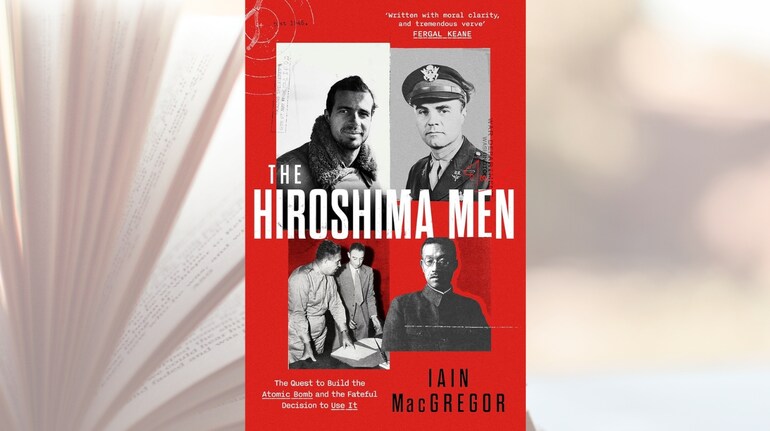
Excerpted with permission from the publisher The Hiroshima Men: The Quest to Build the Atomic Bomb, and the Fateful Decision to Use It, Iain MacGregor, published by Constable / Hachette India.
***
Okinawa, the fifth-largest island of Japan, lies over 350 nautical miles from the southern tip of Kyushu and had been an outlier of Imperial Japan for centuries. It is the largest island within the great sweeping curve of the Ryukyu island chain, spanning the East China Sea toward Formosa. As an isolated community, its history since the sixth century had been scarred by raiding parties from China, Korea, and Japan, but by 1853, it was occupied by American Navy commodore Matthew C. Perry as his “black ships” made their way to Japan, to open the country up from the end of his naval cannon. Admiral Nimitz viewed Okinawa in the same way his naval predecessor had; the island was “the very door of the Empire.” Once Japan had embraced modernity, Okinawa was annexed formally in 1874, with Tokyo dispatching a governor to oversee it five years later. In 1920, it had been granted prefecture status, and two years into the Pacific war with the United States, it was officially absorbed into the mainland district of Kyushu.
The topography of the island mirrored Japan itself. It was a contrast in geography and climate. The south, where the capital Shuri was located, was a series of rolling hills and rich pastural land where the bulk of the island’s 450,000-strong community resided.4 They lived primarily in the hundreds of small towns, villages, and hamlets, and worked in farming and the fisheries dotted along the coast. Actual roads to navigate the island were mainly single-track, made of crushed coral, which cut up fairly easily once American armor and heavy vehicles ran over it. When US Marines and Army units began their advance into the interior after April 1, 1945, they could not believe such a beautiful landscape, crisscrossed by well-manicured terraces, could be the site of a climactic battle. They failed to appreciate that this picture-perfect landscape was honeycombed with caves formed over hundreds of years by streams that ran down to the sea.
The island’s prefecture capital and commercial hub was Naha, with a population of sixty thousand, many of Japanese origin, of whom hundreds served in the government civil service, healthcare, and police. Shuri was the historico-cultural capital of the island, although slightly smaller in size and population. Shuri was dominated by the ridge running through southern Okinawa. Overlooking the city was Shuri Castle, the military headquarters of the Imperial Army and historically the ancient throne of the original kings of Ryukyuan. Key to American strategists was the capture of the two primary airfields in the center of the island: Yontan and Kadena.
To the north, running off a rugged, mountainous spine approximately twenty miles in length, lay a series of ridges—some as high as fifteen hundred feet. At the northern tip, a small peninsula, covered in dense forests and brush, would prove to be one of the best natural defensive positions on the island and result in countless casualties toward the end of the campaign. As the battle raged over the coming weeks, hundreds of caves, gullies, and ravines would be viciously contested by fanatical Japanese soldiers and militia. Fenced in from the sea by high limestone cliffs, for many Okinawans, brainwashed to fear American brutality, they would be the platform from which hundreds would jump to their deaths rather than be taken prisoner.
The defense of the island was given to Lieutenant General Mitsuru Ushijima—nicknamed the “Demon General,” who left his position as commandant of the Military Academy in Tokyo to take up command of the Thirty-Second Army on August 8, 1944. While Ushijima was renowned and respected for his calm decision-making, his choice for chief of staff was certainly quite the opposite. Major General Isamu Cho reminds one of the heroes from Akira Kurosawa’s epic postwar samurai film Seven Samurai. “Butcher” Cho was a throwback to the ancient warrior class, totally without fear but equally lacking any mercy toward the enemy—whether military or civilian. Though his military prowess was never in question, his politics were to the far right, having been involved in several coup attempts in the 1930s, as well as being at the forefront of the Imperial Army’s many atrocities fighting in mainland China. He had played a pivotal role in the infamous “Rape of Nanjing” in 1937. Now he would oversee the construction of the island’s tunnel defenses, as well as ensuring all support was given to his troops, even at the cost of the Okinawans: “The Army’s mission is to win, and it will not allow itself to be defeated by helping starving civilians.” They would all soon find themselves in the eye of the storm once the fighting got underway.
The Thirty-Second Army had originally been 120,000 strong, but with reinforcements required for the fighting in the Philippines, it had fallen to seventy-seven thousand men—a combination of frontline combat units, augmented by various logistical, engineering, and signals troops. Korean laborers, as well as local civilian militia (Boeitai) and student volunteers (“Iron and Blood” Corps), bulked up the defensive force by a further twenty thousand. The Imperial Japanese Navy supplied 3,825 personnel who would man the island’s fifteen coastal batteries—backed up by a six-thousand-strong civilian/ combat force. They, too, counted on a civilian levee of Korean laborers and Okinawan conscripts press-ganged into service. The Thirty-Second Army could fall back on a wealth of artillery, mortar, antiaircraft, and automatic weapons due to an excess that had been previously meant for units fighting in the Philippines. The tightening of the American naval blockade on Japanese shipping had proved a boon for Ushijima’s garrison. His men would also be able to defend their positions with copious amounts of satchel charges, grenades, mines, and bullets.
**********
Iain MacGregor, The Hiroshima Men: The Quest to Build the Atomic Bomb, and the Fateful Decision to Use It, Constable/ Hachette India, 2025 Pb. Pp448
At 8:15 a.m. on August 6th, 1945, the Japanese port city of Hiroshima was struck by the world's first atomic bomb. Built in the US by the top-secret Manhattan Project and delivered by a B-29 Superfortress, a revolutionary long-range bomber, the weapon destroyed large swaths of the city, instantly killing tens of thousands. The world would never be the same again.The Hiroshima Men's unique narrative recounts the decade-long journey towards this first atomic attack. It charts the race for nuclear technology before, and during the Second World War, as the allies fought the axis powers in Europe, North Africa, China, and across the vastness of the Pacific, and is seen through the experiences of several key characters: General Leslie Groves, leader of the Manhattan Project alongside Robert Oppenheimer; pioneering Army Air Force bomber pilot Colonel Paul Tibbets II; the mayor of Hiroshima, Senkichi Awaya, who would die alongside over eighty-thousand of his fellow citizens; and Pulitzer Prize-winning novelist John Hersey, who travelled to post-war Japan to expose the devastation the bomb had inflicted upon the city, and in a historic New Yorker article, described in unflinching detail the dangers posed by its deadly after-effect, radiation poisoning.This thrilling account takes the reader from the corridors of the White House to the laboratories and test sites of New Mexico; from the air war above Nazi Germany and the savage reconquest of the Pacific to the deadly firebombing air raids across the Japanese Home Islands. The Hiroshima Men also includes Japanese perspectives - a vital aspect often missing from Western narratives - to complete MacGregor's nuanced, deeply human account of the bombing's meaning and aftermath.
Fergal Keane, award-winning BBC foreign correspondent and author of Road of Bones: The Siege of Kohima 1944 writes, “I can think of no more important book for our time. Written with moral clarity, tremendous verve, and the ability of a truly great historian to render the immensity of a moment through the smaller voices as well as being faithful to the facts. I recommend this magisterial, haunting book to all generations.” Giles Milton, author of The Stalin Affair adds further praise for the book saying, “The nuclear destruction of Hiroshima and Nagasaki was one of the most iconic moments of the twentieth century. Yet little has been written about the individuals whose actions led to Japan's unconditional surrender. Iain MacGregor's The Hiroshima Men is epic in scale yet intimate in detail, its pages filled with mavericks and geniuses who forever changed our world. A meticulously researched and compellingly written tour-de-force.”
Iain MacGregor has been an editor and publisher of nonfiction for thirty years working with esteemed historians such as Simon Schama, Michael Wood and James Barr. He is himself the author of the acclaimed oral history of Cold War Berlin: Checkpoint Charlie and his writing has appeared in the Guardian, the Express, as well as the Spectator and BBC History magazines. As a history student he has visited East Germany, the Baltic and the Soviet Union in the early 1980s and has been captivated by modern history ever since. He has published books on every aspect of the Second World War. Iain is a Fellow of the Royal Historical Society and lives with his wife and two children in London.
Discover the latest Business News, Sensex, and Nifty updates. Obtain Personal Finance insights, tax queries, and expert opinions on Moneycontrol or download the Moneycontrol App to stay updated!





Find the best of Al News in one place, specially curated for you every weekend.
Stay on top of the latest tech trends and biggest startup news.