






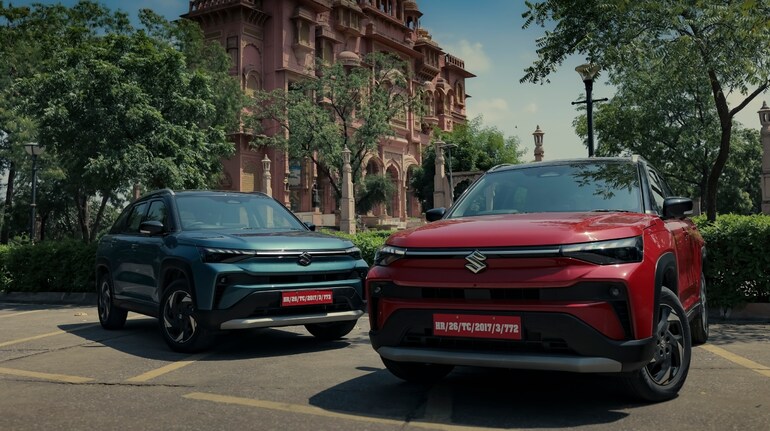

The country's largest carmaker, Maruti Suzuki India, has remained below the 40% mark in domestic passenger vehicle (PV) wholesale market share in FY26 so far, marking a structural moderation from the near-51% dominance it held six years ago.
According to data from the industry body Society of Indian Automobile Manufacturers (SIAM), the company's wholesale share stood at 38.89% in April-June FY26, 38.78% in April-September, improved to 39.71% in April-December and eased to 39.61% in April-January. In none of these periods has it crossed 40%.
This compares with 50.99% in FY20.
| Year | Domestic PV wholesales | Market share |
| FY20 | 14,14,346 units | 50.99% |
| FY21 | 12,93,840 units | 47.72% |
| FY22 | 13,31,558 units | 43.38% |
| FY23 | 16,06,870 units | 41.31% |
| FY24 | 17,59,881 units | 41.72% |
| FY25 | 17,60,767 units | 40.93% |
*****
| Year | Domestic PV wholesales | Market share |
| FY26 (Apr-Jun) | 3,93,572 units | 38.89% |
| FY26 (Apr-Sep) | 7,95,446 units | 38.78% |
| FY26 (Apr-Dec) | 13,21,381 units | 39.71% |
| FY26 (Apr-Jan) | 14,95,910 units | 39.61% |
Between FY20 and FY25, Maruti Suzuki's wholesale market share declined by 10.06 percentage points, even as its annual domestic wholesale volumes increased by about 3,46,421 units.
The total domestic PV wholesale volumes rose from 27,73,519 units in FY20 to 43,01,848 units in FY25, an expansion of 15,28,329 units. Maruti captured 3,46,421 units of that incremental industry growth.
Between FY20 and FY25, Maruti accounted for roughly 23% of the incremental industry wholesale growth, despite holding a 51% market share base in FY20.
The remaining growth was absorbed by competitors, leading to a structural moderation in its overall market dominance.
For context, Mahindra & Mahindra increased its PV wholesale share from 6.74% in FY20 (1,86,942 units) to 12.82% in FY25 (5,51,487 units). Tata Motors Passenger Vehicles expanded its share from 4.98% in FY20 (1,38,238 units) to 13.23% in FY25 (5,69,245 units).
Combined, the two homegrown auto giants accounted for 11.72% of the domestic PV wholesale market in FY20. By FY25, their combined share had risen to 26.05%, during the same period that Maruti Suzuki's share declined by about 10 percentage points.
Despite the moderation in wholesale market share, demand for Maruti Suzuki vehicles remains strong. The company had close to 1,75,000 pending customer bookings at the beginning of February, with demand spread across hatchbacks, sedans, MPVs and SUVs.
In January, the company's production and supply teams worked on two Sundays and a public holiday to meet elevated demand and reduce backlog. The data indicate that the market share decline is not linked to demand weakness but to industry expansion and competitive shifts.
Maruti Suzuki sells its PVs through two channels -- Arena and Nexa. The Arena network comprises over 3,400 outlets across nearly 2,900 cities. Nexa, positioned as the premium retail channel, operates more than 740 outlets across over 530 cities.
Arena models include the Alto K10, S-Presso, Celerio, WagonR, Eeco, Swift, Dzire, Ertiga, Brezza and Victoris. Models sold through Nexa include the Ignis, Baleno, Fronx, Grand Vitara, Jimny, XL6, Invicto and the newly introduced e Vitara.
Maruti Suzuki maintained that its retail performance remains stronger and that corrective measures are underway.
"In the Vahan market share, we are over 40%. We have a robust plan to go back to 50%. It had more to do with the SUV sales that increased. We did not have adequate products. Now, we have already launched the Victoris in the mid-size SUV segment. Our market share has doubled in the mid-size SUV segment with the launch of the Victoris. We have more plans," Partho Banerjee, Senior Executive Officer, Marketing and Sales, Maruti Suzuki, told Moneycontrol.
"We had some products which were not in line with the market demand. Now we are introducing them and witnessing traction," he added.
In FY20, Maruti Suzuki's SUV portfolio comprised the Vitara Brezza and the S-Cross. At present, its SUV line-up includes the Fronx, Brezza, Jimny, Grand Vitara and Victoris. It has also launched the e Vitara electric SUV.
Gaurav Vangaal, Associate Director, Light Vehicle Production Forecasting at S&P Global Mobility, attributed the divergence between rising volumes and falling share to structural portfolio decisions and changing consumer preferences.
"Maruti Suzuki's exit from the diesel portfolio has clearly hurt its competitive positioning. While CNG volumes have compensated for the volume loss, diesel still accounts for nearly 18-20% of the PV market. The company's dominance in the non-diesel space translates into roughly 50% share of that 82% segment, but the post-Covid consumer shift toward feature-rich SUVs from Tata and Mahindra has eroded its edge," Vangaal said.
"Crucially, Tata set the benchmark for 5-star safety as early as 2018 (Nexon), followed by Mahindra in 2020 (XUV300), whereas Maruti Suzuki only entered the 5-star safety space in 2024 (Dzire). This late response meant rivals had already captured consumer trust in the 'safe car' narrative, further strengthening their SUV-led momentum at Maruti Suzuki's expense," he added.

Discover the latest Business News, Sensex, and Nifty updates. Obtain Personal Finance insights, tax queries, and expert opinions on Moneycontrol or download the Moneycontrol App to stay updated!
Find the best of Al News in one place, specially curated for you every weekend.
Stay on top of the latest tech trends and biggest startup news.





