






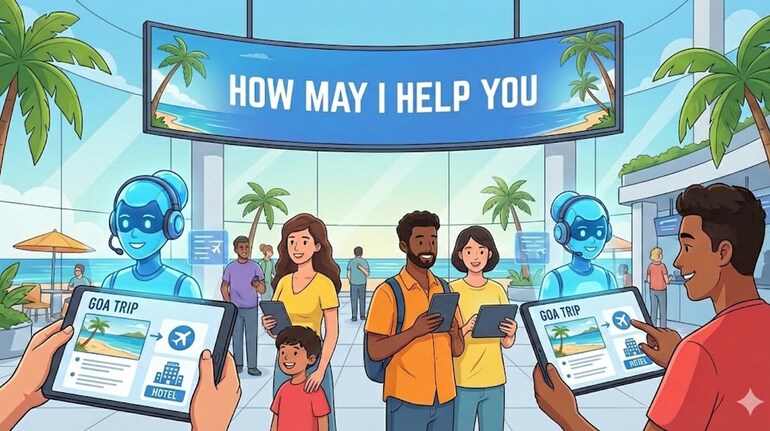

A quick chat with Myra threw up more than just standard travel suggestions-it delivered a curated list of serene beach escapes in Goa and even an insider tip to book a sunset cruise on the Mandovi.
Myra is not a well-travelled friend or a seasoned travel agent, but an Artificial Intelligence (AI) chatbot built by MakeMyTrip, quietly reshaping how travellers plan trips, resolve flight queries and make booking decisions—signalling how artificial intelligence is fast becoming the new front desk of the travel business.
That shift is not limited to India’s metros. According to Rajesh Magow, co-founder and group CEO of MakeMyTrip, Tier II cities now account for over 50,000 AI-led conversations daily and more than 45% of overall usage.
Voice-based interactions are especially popular in non-metro regions, reflecting how users prefer to engage. “For many users, speaking is more natural than typing, and listening is more intuitive than navigating screens,” Magow told Moneycontrol.
In times of crisis as well, AI has come to the rescue. Aloke Bajpai, Chairman, Managing Director & Group Chief Executive Officer (CEO), ixigo, recalled how their AI agent TARA at the peak of the IndiGo flight disruption had called up all the impacted customers about refunds, cancellations.
“We proactively deployed AI voice calling to inform customers and also give them status on their refunds because the issue was that people didn't even know the fate of their flights,” he said.
Also read: How ixigo's decade-old AI bet paid off during Indigo crisis
Magow also outlined the specific use cases of AI’s role across the travel journey.
For international flyers, the chatbot helps address queries around layovers, transit visa requirements and baggage allowances. In the hotels funnel, Myra offers concise two-line summaries of reviews from travellers with similar travel profiles.
For users unsure about their destination but clear about the kind of experience they want, Myra follows a conversational flow to aid destination discovery and trip planning. Within support centres, Myra is also assisting agents by identifying customer intent, suggesting next steps and summarising entire calls before support tickets are closed.
Why are travel platforms using AI?
Cost is a big factor.
AI is driving profitability by allowing Yatra to do more with the same resources, said its Chief Architect and Data Scientist, Dr. Shakti Goel.
"Automation of repetitive and routine tasks has freed up teams to focus on higher-value initiatives that support growth and innovation. This has improved operational efficiency and scalability without requiring a proportional increase in headcount," he said.
Abhishek Daga, Co-founder of Thrillophilia explained how its AI salesperson co-pilot is helping drive profitability.
With overall conversion rates in India at around 5%, every lead carries a cost. So, Daga and his team now rely on the co-pilot which analyses conversations and customer actions, assigns a dynamic lead score and guides salespeople on when to follow up, when to deprioritise a lead, or when to trigger automated nudges instead of calls.
High-intent leads are routed to human sales executives, while low-intent enquiries are handled by AI agents, he added.
Daga said this AI feature has already doubled salesperson productivity over the past six months and aims to make each executive five times more productive over the next year.
Rather than replacing humans, the AI co-pilot is designed to eliminate routine tasks and help the existing 300-plus sales team generate up to five times more revenue, enabling the company to scale significantly over the next two years without expanding headcount.
"This year, we would do around 50 percent more revenue and without adding more people in our team," Daga added.
How are travel platforms using AI?
One of Yatra's key applications of GenAI is within RECAP, Yatra’s expense management solution, said Goel.
"AI-powered vision analytics are used to detect fraud, identify duplicate receipts, and automate receipt recognition. RECAP is also integrated with a voice-enabled AI bot that allows users to create expense entries through natural voice inputs. For instance, a user can simply state a travel expense verbally, and the system will automatically create the expense entry while applying relevant employee policies."
The travel platform has also developed a proprietary AI Agent framework, enabling rapid creation of agentic, orchestrated bots. "Both Yatra’s Business-to-Customer (B2C) and Business-to-Business (B2B) DIYA bots are built on this framework and can handle end-to-end tasks such as flight bookings, itinerary creation, cancellations, and generation of e-tickets, vouchers, and invoices," Goel added.
The platform also has AI-driven email bots that automatically respond to complex customer queries related to flights and hotels, tasks that were previously manual and time-consuming.
On Thrillophilia, Daga has an AI itinerary builder to create personalised travel plans. He said, for instance, if a couple from Chennai is planning a Switzerland holiday, the system leverages insights from dozens of similar traveller profiles to understand preferences and patterns. It draws on data around hotel and apartment availability, activities, weather conditions, guiding services and traveller feedback.
Are Indian travellers happy with AI agents?
ixigo disclosed in its December-quarter earnings that it handled approximately 3.81 million customer queries in Q3 FY26 through AI-powered chat and voice systems. During the peak of the IndiGo-led flight disruptions between December 1 and 9, around 150,000 customer calls were managed by AI.
In December, when the IndiGo flight crisis unfolded, proactive voice calling spiked, with AI handling 90 percent of all calls that month.
Yatra's Goel pointed to high adoption of its AI-powered travel assistant DIYA with 10–15% month-on-month increase in the number of users engaging with the chatbot.
Since its B2C launch in September 2025, DIYA has handled over 30,000 trip-planning requests, with demand increasing month-on-month. Users have raised more than 300,000 queries in the last five months, the majority of which were resolved successfully without requiring human customer support, Goel added.
On the corporate side, over 350 companies and 20,000 employees have used DIYA so far. Around 10,000 trips have been planned in the last three to four months, and the bot has handled approximately 7,500 flight cancellations. Repeat usage among corporate users highlights the stickiness and efficiency of the platform, he added.
Cleartrip's Manoj Awasthi, Chief Product and Technology Officer, is also seeing consistent growth in the use of AI-assisted travel planning. "Travellers are using Trippy (AI trip planner) not just for simple queries but for more layered trip exploration and customization. Also, we’re seeing particularly strong engagement from Gen Z and digitally savvy travellers, who are early adopters of conversational interfaces."
Travel solutions platform ATPI Managing Director Jeet Sawhney has seen client adoption of AI-enabled solutions accelerating significantly over the past 12–18 months.
"We are seeing a clear shift from experimentation to everyday operational reliance on AI-driven tools. A recent example is ATPI’s work with PayPal India. The organization was managing high volumes of offline bookings, leading to compliance gaps and fragmented reporting. ATPI implemented a customized, India-specific AI-enabled online booking solution supported by streamlined approval workflows and targeted training. As a result, online adoption increased from 60% to 90%."
In the pipeline, ATPI is building Avenir: Travel Edition, a next-generation, AI-enabled travel platform scheduled for global rollout across 2025–26. It is designed to address fragmented systems and poor user experiences.
Not full autopilot
While AI is powerful in travel, its biggest limitation is that it optimises for logic, not lived experience, Daga said.
“Travel doesn’t fail in spreadsheets; it fails in the gaps like traveller fatigue, weather shifts, cultural nuance, missed transfers, and on-ground unpredictability. Pure AI can design a perfect-looking itinerary and still deliver a poor journey. The future is not AI replacing humans; it is AI stress-testing thousands of possibilities at scale, while humans make the judgment calls that protect the real experience,” he added.
Even Bajpai noted that while the company’s chatbot TARA currently resolves about 92% of customer queries, that figure is unlikely to rise much further, as there are situations where customers inevitably need to speak to a human.Bottom of Form


Discover the latest Business News, Sensex, and Nifty updates. Obtain Personal Finance insights, tax queries, and expert opinions on Moneycontrol or download the Moneycontrol App to stay updated!
Find the best of Al News in one place, specially curated for you every weekend.
Stay on top of the latest tech trends and biggest startup news.







