Saturday, November 21, 05:37 am IST
| Feedback
Moneycontrol » News Center » General News » World News
US arms sales hits record in 2009
Published on Mon, Nov 09, 2009 at 07:43   |  Updated at Mon, Nov 09, 2009 at 12:31  |  Source : Reuters

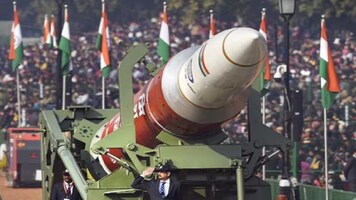
US government-to-government arms sales rose 4.7% to a record USD 38.1 billion last year, and are expected to total almost as much in 2010, the Pentagon agency that administers them said on Friday.

Arms deals, often sensitive because of regional politics, may become even more so for the administration of President Barack Obama, who won the 2009 Nobel Peace Prize last month.

Some critics say Obama should rein in arms transfers, partly to avoid regional arms races. But overseas sales are increasingly important to US contractors seeking to offset Pentagon belt-tightening at home.

Many if not most of the sales pacts signed in fiscal 2009, which ended September 30, are part of a boom in conventional weapons sales that started under former President George W Bush.

The 2009 figures represent over a quadrupling from a sales "low point" in fiscal 1998, according to Vice Admiral Jeffrey Wieringa, head of the Defense Security Cooperation Agency.

The sales are indicative of a drive to strengthen US partners and thus boost U.S. national security, Wieringa said in an October 22 blog posting on his agency's website.

The 2009 tally, revised after that posting, were up from USD 36.4 billion in fiscal 2008 and USD 23.3 billion in 2007, said the security agency. It administers the Pentagon's Foreign Military Sales program, a key part of US alliance-building.

Sales are expected to top USD 37.9 billion in fiscal 2010, which began October 1, Vanessa Murray, an agency spokeswoman, said in a written reply to Reuters.

The top buyers in fiscal 2009 were United Arab Emirates (USD 7.9 billion), Afghanistan (USD 5.4 billion) and Saudi Arabia (USD 3.3 billion), followed by Taiwan (USD 3.2 billion), Egypt (USD 2.1 billion), Iraq (USD 1.6 billion), NATO (USD 924.5 million), Australia (USD 818.7 million) and South Korea (USD 716.6 million).

Sell,Sell, Sell

Rachel Stohl, co-author of a new book, The International Arms Trade, said Obama, who took office on January 20, seems to be sticking with "the Bush administration mantra of sell, sell, sell, rather than a more cautious approach."

William Hartung of the New America Foundation, a Washington-based research group focused on U.S. defense and foreign policy issues, said Obama should pay more attention to regional arms-race dangers, human-rights records and shun sales to countries that can ill-afford them.

Top U.S. arms makers such as Lockheed Martin Corp <LMT.N>, Boeing Co <BA.N>, Northrop Grumman Corp <NOC.N>, General Dynamics Corp <GD.N> and Raytheon Co <RTN.N> are hoping to boost foreign sales to hedge against U.S. budget pressures that could slow big-ticket Pentagon arms purchases.

Overseas sales lower the unit price of US armed forces' weapons and keep components available that would be otherwise hard to find, said Remy Nathan of the Aerospace Industries Association, which lobbies on behalf of U.S. arms makers.

Booming Demand

Demand is booming, fed in part by regional tensions fanned by nuclear and ballistic missile programs in Iran and North Korea.

In September, for instance, the Pentagon told Congress of a possible sale to Turkey of the most modern model of its Patriot anti-missile missile in a package valued at up to USD 7.8 billion.

The Gulf states and Saudi Arabia are "extremely worried about Iran's pursuit of a nuclear weapons capability," Alexander Vershbow, U.S. assistant secretary of defence for international security affairs, told reporters last month.

"They want to buy Patriots or other systems over the coming years. So right now, demand exceeds supply because of the real sense of threat they feel," he said.

Other big sales could come from the "best market in decades" for fighter aircraft, with multibillion competitions under way or planned in India, Brazil, South Korea, Japan, Greece and elsewhere, said Richard Aboulafia of the Teal Group, an aerospace consultancy.

Worldwide arms sales totaled USD 55.2 billion in calendar 2008, a decrease of 7.6% from 2007 and the lowest total since 2005, the nonpartisan Congressional Research Service said in a September report.

The United States accounted for USD 37.8 billion of the total on a calendar year basis, or a lopsided 68.4%, up sharply from USD 25.4 billion in 2007, said the report by Richard Grimmett.

Italy ranked a distant second with USD 3.7 billion in signed weapons deals, or 6.7% of the total, up from USD 1.2 billion in 2007, the study showed, followed by Russia with contracts valued at USD 3.5 billion, down from USD 10.8 billion in 2007.

Important Links Today:  Leadership Wall    Chat Calendar    The 10 List   

What's your Opinion

WHAT OTHERS LIKE
  • Most Read
  • Most Viewed
©Network 18, 2009. All Rights Reserved