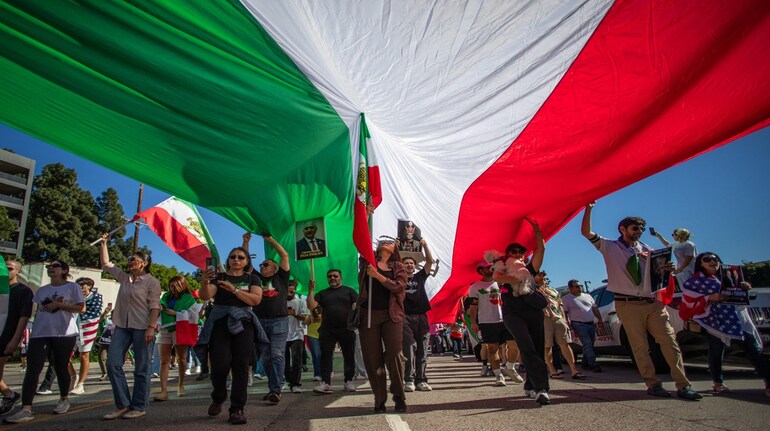

The reported assassination of Iran’s Supreme Leader, Ayatollah Ali Khamenei, following U.S. and Israeli airstrikes on Tehran, has triggered jubilant celebrations across Iran and in the global Iranian diaspora.
Videos circulating on social media show Iranians dancing, waving flags, honking car horns, and setting off fireworks in cities including Tehran, Karaj, Fuladshahr, Borazjan, and Mamasani. From apartment balconies to bustling streets, people cheered as the news spread, with some even celebrating as planes and missiles flew overhead.
"This war is not our war. It’s Trump’s war with the hateful Islamic regime. We pray that Trump wins this war, because if he wins, the people of Iran will be free," said one Iranian citizen in a video shared with Iran International.
Iranian-American journalist Masih Alinejad described the mood to Fox News, noting the irony of celebrations in response to U.S. involvement, “I grew up in a country where I was brainwashed to say ‘Death to America,’ the same country that saved my life three times and is now helping my people in Iran. They’re celebrating out of joy.”
Celebration has extended far beyond Iran.
In Westwood, Los Angeles, home to roughly 140,000 Iranian-Americans—the largest concentration outside Iran, residents took to the streets. Many called for exiled Crown Prince Reza Pahlavi to take leadership of the country.
“Our whole lives we’ve had to navigate our different identities, coming from both Persian and Jewish backgrounds,” one Jewish-Iranian couple told the Los Angeles Times. “Today we see one step forward.”
Why the joy?
Khamenei’s rule, spanning more than three decades, was defined by strict domestic control, suppression of dissent, and confrontational foreign policy. He was a central architect of the Islamic Republic, overseeing the expansion of the Islamic Revolutionary Guard Corps (IRGC) and Iran’s network of state and non-state proxies across Iraq, Syria, Lebanon, Gaza, and Yemen. He repeatedly called for the destruction of Israel and positioned Iran as a staunch opponent of U.S. influence in the Middle East.
At home, his government brutally crushed uprisings, including the Green Movement in 2009 and the December 2025 nationwide protests triggered by economic collapse. Rights groups estimate that thousands were killed in security crackdowns, while many more were imprisoned or forced into exile. For a generation of Iranians, Khamenei represented an unyielding and unchallengeable authority, leaving little hope for political or social reform.
U.S. President Donald Trump, in the wee hours of Sunday, confirmed Khamenei’s death on social media, calling him “one of the most evil people in history” and stating that the strikes were aimed at removing imminent threats. Israel also reportedly targeted Tehran in coordinated airstrikes, killing Khamenei and several senior Iranian officials.
Iran has, meanwhile, declared 40 days of national mourning and seven public holidays.
The strikes have heightened tensions across the Gulf, with missile exchanges reported, airspace closures, and disruptions to international shipping and aviation.
Iranians, however, both inside the country and abroad, are celebrating a moment they perceive as a rare opportunity for change and relief from decades of authoritarian rule.
Despite the celebrations, uncertainty looms over Iran’s political future.
Khamenei’s death leaves a leadership vacuum in a system carefully consolidated over decades. No successor is likely to command the same power and influence he wielded, making the coming weeks critical for both domestic stability and regional geopolitics.
For millions of Iranians, the celebrations are not just about rejoicing in the demise of a feared leader, they are a symbolic release after years of oppression and a tentative step toward imagining a different future.
Khamenei’s death has ignited a mix of jubilation, relief, and cautious hope. As one Iranian-American resident put it in Los Angeles, “Today we see one step forward.”

Discover the latest Business News, Sensex, and Nifty updates. Obtain Personal Finance insights, tax queries, and expert opinions on Moneycontrol or download the Moneycontrol App to stay updated!
Find the best of Al News in one place, specially curated for you every weekend.
Stay on top of the latest tech trends and biggest startup news.