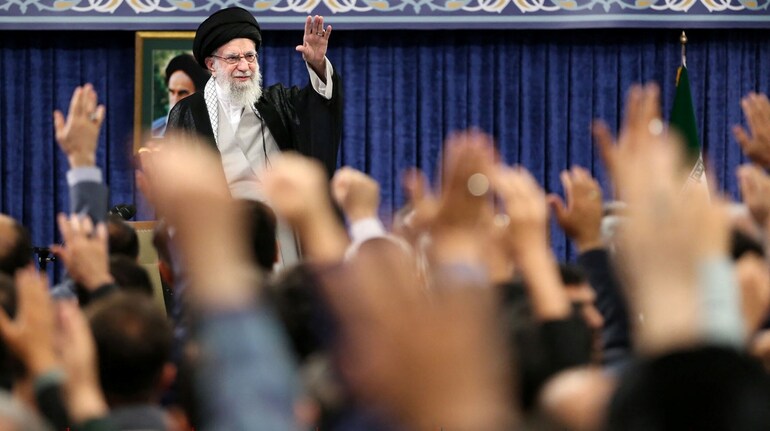

Iran’s state broadcaster, on Sunday, confirmed the death of Supreme Leader Ayatollah Ali Khamenei in an early morning announcement.
A presenter on state television declared at around 5:00 a.m. local time (0130 GMT) that Khamenei had died. The channel aired archival footage of the 86-year-old cleric with a black banner across the screen as a symbol of grief.
The broadcast, however, did not mention earlier reports of a large-scale U.S. and Israeli strike on his residence.
Shortly afterward, the state-linked Fars News Agency reported that the government had declared 40 days of national mourning and announced seven days of public holidays to allow for official ceremonies and religious observances across the country.
Fars said Khamenei was killed at his office in the early hours of Saturday while “performing his assigned duties.”
The Islamic Revolutionary Guard Corps has vowed severe retaliation for Khamenei’s killing, raising fears of a broader regional confrontation.
Khamenei had led the Islamic Republic since 1989, making him one of the region’s longest-serving leaders. His death sets in motion constitutional procedures to appoint a successor, marking a pivotal transition for Iran’s political and religious leadership. The death of the Iranian supreme leader marks the end of one of the most consequential eras in Iran’s modern history, leaving uncertainty over succession and the country’s political future.
The killing of the leader who dominated the Islamic Republic for more than three decades represents a dramatic escalation in the joint U.S.–Israeli military campaign aimed at curbing Iran’s regional power and military capabilities.
Early in the day, in a video posted on Truth Social, U.S. President Donald Trump said the assault was intended to eliminate “imminent threats from the Iranian regime.” Addressing Iranians directly, he added: “When we’re finished, take over your government. It will be yours to take.”
Israeli officials said the operation targeted hundreds of military objectives across Iran. The Israel Defense Forces stated that fighter jets struck roughly 500 sites, including missile launch systems and air defense infrastructure, significantly degrading Iran’s offensive capacity.
Iran responded swiftly, launching missiles at Israel, U.S. military bases, and several Persian Gulf states hosting American forces. Countries reporting attacks included Saudi Arabia, Qatar, the United Arab Emirates, Kuwait and Bahrain.
Saudi Arabia said it intercepted missiles over Riyadh and the kingdom’s eastern oil-producing region. Several Gulf states temporarily closed their airspace amid the escalating exchanges.
U.S. Central Command said American forces defended against hundreds of Iranian missile and drone attacks, reporting no U.S. combat casualties. The campaign reportedly included the first operational use of low-cost, one-way attack drones.
According to U.S. officials, targets included IRGC command centers, air defenses, missile launch sites, drone infrastructure and military airfields.
Iranian media reported extensive damage, including strikes on both military and civilian locations. One report said 64 people were killed at a school in Hormozgan province. Iranian state television later said 201 people had been killed and 747 injured nationwide.
Multiple large explosions were reported in Tehran as the conflict intensified.
The military escalation could prove defining for Trump ahead of U.S. midterm elections in November. A prolonged regional war risks surging energy prices, instability in global shipping lanes and potential American casualties.
With Khamenei gone, Iran now faces a critical transition at home, even as it confronts one of the most dangerous regional escalations in decades.

Discover the latest Business News, Sensex, and Nifty updates. Obtain Personal Finance insights, tax queries, and expert opinions on Moneycontrol or download the Moneycontrol App to stay updated!
Find the best of Al News in one place, specially curated for you every weekend.
Stay on top of the latest tech trends and biggest startup news.