






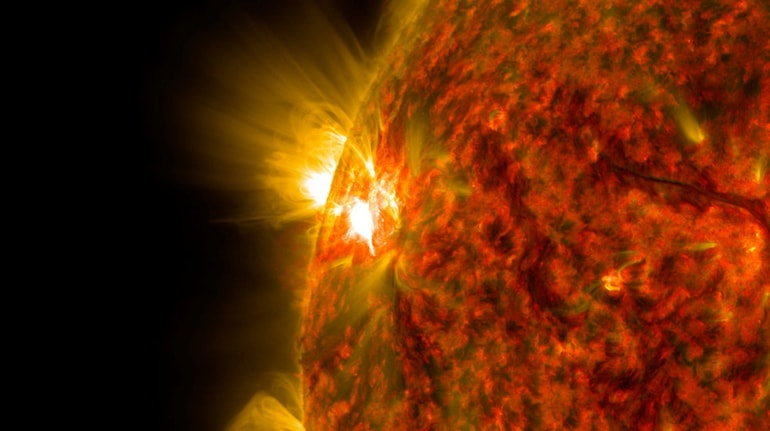

The Sun has released a series of powerful solar flares this week, briefly disrupting radio communications on Earth and prompting warnings from space agencies, including India’s space watchdog.
A strong flare erupted on Wednesday, February 4, peaking at 7:13 am EST or 5:43 pm IST. As intense radiation reached Earth’s upper atmosphere, radio signals were temporarily knocked out across parts of Africa and Europe. In India, Indian Space Research Organisation said it is closely tracking the situation and warned of possible radio blackouts if solar activity continues.
What are solar flares and why do they matter?
Solar flares are sudden, intense bursts of electromagnetic radiation from the Sun. They travel at the speed of light and can reach Earth in just over eight minutes.
Scientists classify flares by strength, starting from A, B and C, then moving up to M and X. Each step represents a tenfold increase in energy. X-class flares are the most powerful and can have direct effects on Earth.
These flares release high-energy radiation such as X-rays, which increase ionisation in Earth’s upper atmosphere. This can disrupt high-frequency radio communications, affect navigation signals, and pose risks to satellites and astronauts.
Flares are sometimes accompanied by coronal mass ejections, or CMEs. These are huge clouds of charged solar plasma that can trigger geomagnetic storms if they strike Earth. Such storms have caused major power outages in the past, including the 1989 blackout in Quebec and the 2003 outages in parts of the United States and Canada.
What caused the latest radio disruptions?
According to Space.com, the Sun unleashed an X4.2-class flare on Wednesday from a volatile sunspot region known as AR4366. This sunspot has been firing off multiple M-class and X-class flares since it formed just days ago.
Earlier this week, the Sun also produced an X1.5 flare, which peaked at 9:08 am ET or 7:38 pm IST on Tuesday, according to NASA. Another earlier flare, rated X8.4, was accompanied by a CME that struck Earth but caused limited impact.
Most of the recent flares have released intense radiation but relatively little solar material into space. Even without a strong CME, the radiation alone is enough to trigger short-lived radio blackouts on the sunlit side of Earth.
Why is the Sun suddenly so active?
The Sun is currently in an active phase of its roughly 11-year solar cycle. During such periods, sunspots become more frequent and more magnetically complex.
Experts say these unstable magnetic regions are capable of releasing repeated bursts of energy in the form of solar flares.
Mathew Owens, professor of space physics at the University of Reading, told Business Insider that heightened solar activity can hamper radio communications and power grids and also affect astronaut health. He explained that flares produce high-energy photons such as X-rays, which directly interfere with Earth’s upper atmosphere.
ISRO raises alert on radio blackouts
India’s space agency has cautioned that the current burst of solar activity could disrupt communication and navigation systems.
“There is a strong possibility of radio blackouts. All Isro satellites are being monitored very closely,” Anil Kumar, Director of the Indian Space Research Organisation’s Telemetry, Tracking and Command Network, told NDTV. “Any communication loss will be attended to immediately.”
Kumar said ground stations have already alerted mission control centres and that contingency plans are in place to respond to any anomalies. India currently operates more than 50 satellites, all of which are being closely tracked during this period of heightened solar activity.
What to expect next?
Scientists say more solar flares are possible in the coming days as the active sunspot region continues to evolve. While most disruptions so far have been brief, stronger flares or a direct CME impact could lead to wider radio outages or increased geomagnetic activity.
For now, space agencies across the world remain on alert, watching the Sun closely as it continues its active spell.
Discover the latest Business News, Sensex, and Nifty updates. Obtain Personal Finance insights, tax queries, and expert opinions on Moneycontrol or download the Moneycontrol App to stay updated!
Find the best of Al News in one place, specially curated for you every weekend.
Stay on top of the latest tech trends and biggest startup news.





