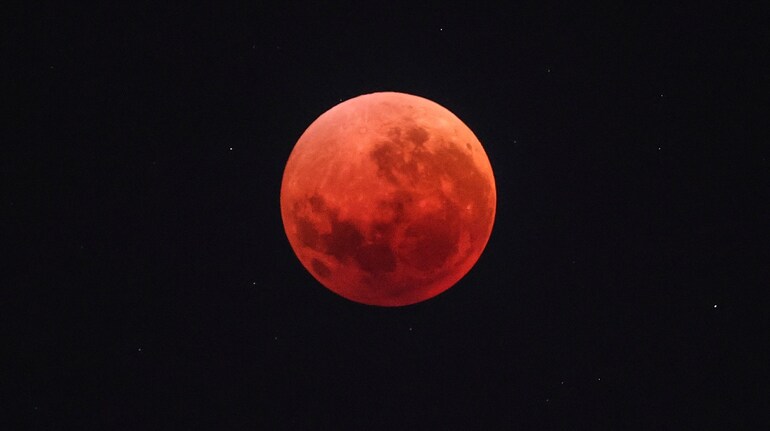
For years, the Moon was seen as a dry, grey, and almost lifeless world. That is why a new discovery has surprised scientists. They have found hematite — a reddish iron oxide better known as rust — on the Moon’s surface. Rust usually forms when iron meets water and oxygen. Both of those are rare on the Moon, so how is this happening?
The Moon has, for long, been seen as a dry and almost lifeless world. However, a new discovery has left scientists both surprised and confused. They have found hematite – a reddish iron oxide better known as rust – on the surface of the Moon. What’s surprising is the fact that it needs iron to meet both water and oxygen for the rust to form. Since both of these are rare on the Moon, how is this actually happening?
A mystery on the lunar surface
Data from India’s Chandrayaan-1 mission showed strange reddish signatures near the lunar poles. When researchers at NASA and the Hawai’i Institute of Geophysics and Planetology took a closer look, they confirmed it was hematite. Ziliang Jin, a planetary scientist at Macau University of Science and Technology, said the findings reveal “more about the close link between Earth and the Moon.” His team shared the results in Geophysical Research Letters.
Scientists believe Earth itself is the missing piece. Our planet has a long “magnetic tail” created by particles trapped in its magnetic field and pushed outward by the solar wind. Around the time of the full Moon, for about six days each month, the Moon drifts through this tail. During that period, some oxygen molecules from Earth may travel to the Moon’s surface. That gives the iron-rich rocks the oxygen they need to start rusting.
Where does the water come from?
Rust also needs water. Although the Moon is mostly dry, it holds small amounts of water ice at its poles. Researchers think the hematite forms in those icy regions, then spreads slowly across the surface by processes still not fully understood.
Normally, streams of charged particles from the Sun bombard both Earth and the Moon. But when the Moon is inside Earth’s magnetic tail, this solar wind is largely blocked. That break may give Earth’s oxygen a better chance to react with iron on the Moon without being stripped away by solar particles. This mix of conditions could explain why hematite is most common at the poles and why it appears during certain phases of the lunar cycle.
To see if their idea held up, Jin’s team simulated “Earth wind” in the laboratory. They fired hydrogen and oxygen ions at high speed into iron-rich mineral crystals similar to those on the Moon. Some crystals turned into hematite when hit with oxygen ions. But when hydrogen ions struck the hematite, part of it changed back into iron. This shows how delicate the process is, with competing forces creating and erasing the rust.
The discovery of hematite shows that the Moon and Earth are not as separate as they appear. Even across 384,000 kilometres of space, Earth’s atmosphere and magnetic field may still shape the lunar surface.
Discover the latest Business News, Sensex, and Nifty updates. Obtain Personal Finance insights, tax queries, and expert opinions on Moneycontrol or download the Moneycontrol App to stay updated!
Find the best of Al News in one place, specially curated for you every weekend.
Stay on top of the latest tech trends and biggest startup news.