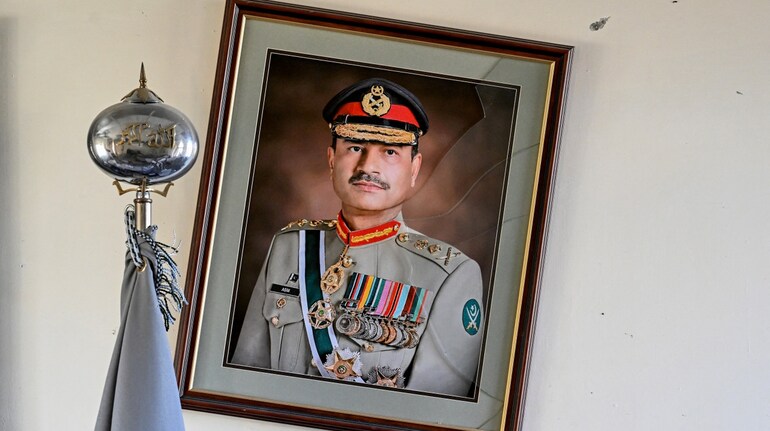

When Pakistan’s army chief Asim Munir speaks of “purpose,” the world would do well to listen carefully. In a recent interaction with The International News, Munir made a cryptic yet foreboding remark about Pakistan moving rapidly toward the “noble purpose for which it was created.” Framed in explicitly religious terms, the statement is less about national development and more about ideological ambition.
Coming from the country’s most powerful man, not an elected leader, the message signals a familiar but dangerous trajectory. It revives Pakistan’s long-standing attempt to cloak its geopolitical failures, economic bankruptcy, and militant past in the language of Islam and global Muslim leadership. Munir’s words are not reassurance. They are a warning that Pakistan’s military establishment is once again leaning into faith, force, and fear to stay relevant.
What Asim Munir said and why it matters
Speaking to The International News, Munir declared, “Pakistan has been bestowed with a historic opportunity by Almighty Allah to achieve the noble purpose for which it was created. The country is moving rapidly towards that destination.”
He went on to underline the ideological basis of the state, saying, “Pakistan was created in the name of Islam and today it enjoys a special status and importance among Islamic countries.”
Munir also claimed that Pakistan knew how to deal with “terrorists” and was doing so “effectively,” while asserting that the country’s global stature and economic position had “strengthened markedly.”
These claims sit uneasily with Pakistan’s reality. The country remains economically fragile, heavily dependent on bailouts, and internationally isolated on issues of terrorism. Yet Munir’s rhetoric deliberately shifts the narrative from accountability to destiny, from governance to theology.
The ‘purpose’ Pakistan keeps referring to
Pakistan’s founding idea has long been distorted by its military rulers into a mission of religious exceptionalism. Munir’s invocation of Islam is not incidental. It is part of a broader effort to rebrand Pakistan as the ideological and military guardian of Muslim causes, regardless of its domestic failures.
Pakistan is the only nuclear-armed country with a Muslim-majority population, a fact its generals frequently weaponise rhetorically. Munir’s remarks reinforce the belief within Rawalpindi that nuclear capability combined with Islamic identity gives Pakistan a special entitlement to lead, threaten, and intervene.
This is not new. What is new is the brazenness with which Pakistan’s army chief is stating it at a time when the country is financially broke and diplomatically constrained.
Islamic NATO and the mirage of Muslim leadership
Munir’s remarks must be read alongside Pakistan’s push for a so-called Islamic NATO. Islamabad has been floating the idea of rallying Muslim nations under a loose military and nuclear umbrella, despite lacking the economic or political credibility to lead such a bloc.
Reports have highlighted Pakistan’s attempts to position itself as a security provider to Muslim countries while offering military hardware instead of repaying debts. From pitching JF-17 fighter jets to African and Middle Eastern nations to leveraging Saudi money and Turkish defence ties, Pakistan is trying to convert ideology into leverage.
The contradiction is stark. A country struggling to pay its own bills is selling itself as a shield for the Muslim world. Munir’s “purpose” rhetoric fits neatly into this fantasy.
Defence deals, nuclear posturing, and economic desperation
Pakistan’s military-led economic model has become increasingly transactional. As detailed in recent analyses, Islamabad has offered arms, training, and security cooperation in place of financial repayments. Defence exports are being marketed as diplomatic currency.
This is where Munir’s confidence rings hollow. Pakistan’s economy has not strengthened. It has been militarised. Civilian institutions are weaker than ever, while the army controls key economic assets.
The attempt to dress this up as strategic resurgence is misleading at best and dangerous at worst. A state that substitutes economic reform with arms sales and ideological grandstanding is not stabilising. It is improvising.
Gaza, optics, and Pakistan’s bid for moral relevance
Pakistan’s reported invitation by the United States to join a Gaza “Board of Peace” has been seized upon by its military leadership as proof of global relevance. But symbolism should not be mistaken for trust.
Pakistan’s record of harbouring extremist groups, its selective counterterrorism, and its fixation on India undermine any claim to moral leadership. Munir’s insistence that Pakistan is effectively dealing with terrorism ignores decades of evidence to the contrary.
Even now, Pakistan continues operations against militants it claims are based in Afghanistan, while denying the ecosystem of radicalisation nurtured within its own borders.
A message aimed as much inward as outward
Munir’s remarks are not just for the world. They are aimed at Pakistan’s domestic audience. By invoking Islam and destiny, the army chief reinforces the military’s dominance at a time when public discontent, economic hardship, and political repression are widespread.
Faith is being used as insulation. Purpose is being used as distraction.
For neighbours like India and for the wider international community, Munir’s words should be read clearly. This is not a nation speaking. It is a military establishment asserting relevance through ideology, arms, and intimidation.
Pakistan’s “purpose,” as defined by its generals, has rarely brought peace to the region. There is little reason to believe this time will be different.
Discover the latest Business News, Sensex, and Nifty updates. Obtain Personal Finance insights, tax queries, and expert opinions on Moneycontrol or download the Moneycontrol App to stay updated!
Find the best of Al News in one place, specially curated for you every weekend.
Stay on top of the latest tech trends and biggest startup news.