Nepal has once again triggered tensions with India after issuing a new Rs 100 currency note that shows disputed Indian territories as part of its national map. The move has irked New Delhi and reopened a sensitive border issue that has remained unresolved for decades.
At the centre of the controversy are three areas. Kalapani, Lipulekh and Limpiyadhura. These regions lie along the western edge of Nepal near Uttarakhand and have long been claimed by India as its sovereign territory. By placing them on its currency, Kathmandu has made what India sees as a political statement through its legal tender.
India has responded firmly, calling the move an attempt at territorial overreach that does not alter ground realities.
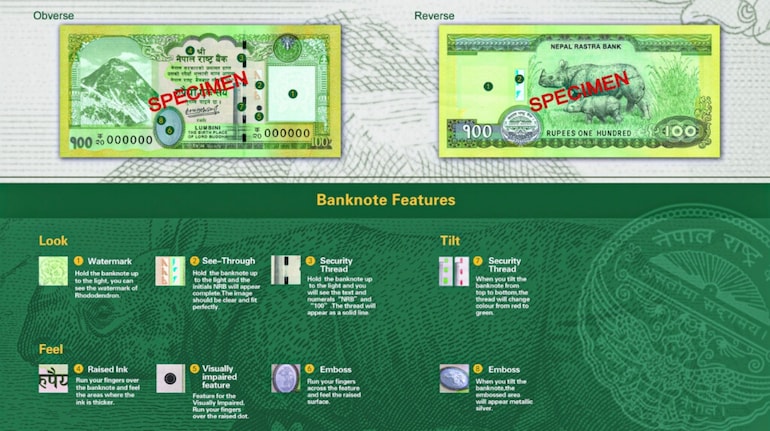
What Nepal’s new Rs 100 note showsThe new Rs 100 note features a revised national map that includes Kalapani, Lipulekh and Limpiyadhura as part of Nepal. The note carries the signature of former Nepal Rastra Bank Governor Maha Prasad Adhikari and is dated 2081 BS, corresponding to 2024.
A Nepal Rastra Bank spokesperson said the map had already appeared on earlier versions and was reworked following a government decision. Under Nepal Rastra Bank Act, design changes require approval from the government.
Apart from the controversial map, the note also features Mount Everest on the left and a watermark of Rhododendron, Nepal’s national flower, on the right. The centre contains the map of Nepal alongside the Ashoka Pillar with the text “Lumbini, the birthplace of Lord Buddha”. On the reverse side is a one-horned rhinoceros with its calf. Security features include a security thread and an embossed dot for the visually impaired.
Among all Nepali denominations, only the Rs 100 note carries the national map.
Why these areas matterKalapaniLocated in Uttarakhand’s Pithoragarh district, Kalapani covers around 35 square kilometres and lies close to the India China Nepal tri-junction. The Indo-Tibetan Border Police has patrolled this region since 1962. Nepal claims it as part of its Darchula district.
The 1816 Treaty of Sugauli defined the Mahakali river as Nepal’s western boundary. India maintains that the river originates at Kalapani. Nepal argues that the source lies further northwest at Limpiyadhura.
Lipulekh PassLipulekh is a strategic Himalayan pass connecting Uttarakhand to Tibet. It has been used for centuries by traders and Hindu pilgrims travelling to Kailash Mansarovar. India controls the pass and built an 80 kilometre road to it in 2020 for what it described as “strategic, religious and trade” reasons.
Nepal objected strongly, calling the construction illegal.
LimpiyadhuraThis is a glacial ridge north west of Kalapani. Nepal claims this is the true origin of the Mahakali river, while India disputes this interpretation. Together, these disputed areas cover around 370 square kilometres.
As one scholar noted, “Nepal has laid claim to all areas east of the Lipu Gad the rivulet that joins the river Kali on its border a tri junction with India and China.”
India’s responseIndia has termed Nepal’s move as unacceptable and politically motivated.
The Ministry of External Affairs said such steps amount to “artificial enlargement” of territory. It reiterated its long standing position that these areas belong to India.
“This unilateral act is not based on historical facts and evidence. It is contrary to the bilateral understanding to resolve the outstanding boundary issues through diplomatic dialogue. Such artificial enlargement of territorial claims will not be accepted by India.”
External affairs minister S Jaishankar also said the depiction does not change the ground reality and reaffirmed that Kalapani, Lipulekh and Limpiyadhura remain Indian territories.
India has maintained that it remains open to “constructive interaction” with Nepal but insists that such unilateral cartographic changes are untenable.
China’s role in printing Nepal’s currencyNepal no longer prints its currency with Indian assistance. For more than a decade, China has been the exclusive printer of Nepali banknotes. Reports suggest Nepal turned to China after Indian printers reportedly refused to depict disputed territories as part of Nepali maps.
The Nepal Rastra Bank commissioned a Chinese firm to print 300 million Rs 100 notes for around US$ 8.99 million. This brings the cost of printing each note to approximately NPR 4.04.
India views this shift and the inclusion of disputed territories as part of a broader geopolitical alignment by Nepal that increasingly leans towards Beijing.
A diplomatic fault line that refuses to fadeFor New Delhi, Nepal’s decision is not a routine design change but a deliberate political signal. By placing territorial claims on its currency, Kathmandu has revived a sensitive dispute that could strain bilateral ties further.
While India continues to advocate dialogue and diplomacy, it has made clear that visual assertions through currency will not rewrite history or geography. The message from India remains firm. Maps on paper cannot alter sovereignty on the ground.
Discover the latest Business News, Sensex, and Nifty updates. Obtain Personal Finance insights, tax queries, and expert opinions on Moneycontrol or download the Moneycontrol App to stay updated!
Find the best of Al News in one place, specially curated for you every weekend.
Stay on top of the latest tech trends and biggest startup news.