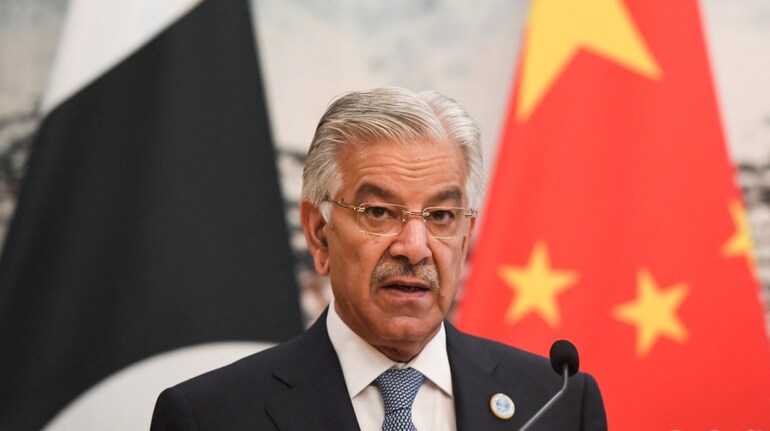

Pakistan’s Defence Minister Khawaja Asif is attempting to sell a familiar story. In Parliament, he accused the United States of exploiting Pakistan for strategic interests and then discarding it “worse than a toilet paper.” It is an emotionally charged claim designed to provoke sympathy at home and deflect scrutiny abroad. But it is also deeply dishonest. Asif is telling only half the truth. The missing half is inconvenient because it exposes Pakistan not as a helpless victim of American power politics, but as a willing, calculating partner that repeatedly used Washington to advance its own objectives, especially its obsession with India.
Pakistan was never dragged into America’s wars. It volunteered. It monetised its geography, militarised ideology and offered jihad as a service. The relationship with Washington was transactional from the very beginning, built on mutual exploitation rather than trust. To now pretend that Pakistan was merely discarded is not an act of candour. It is an act of historical erasure.
Cold War foundations of a transactional alliance
The roots of the US-Pakistan relationship lie in the early Cold War, when Islamabad positioned itself as a frontline state against communism. In return, Pakistan received military aid, economic assistance and diplomatic cover. The arrangement suited both sides. Washington wanted a reliable regional outpost. Pakistan wanted weapons, legitimacy and leverage against India.
This pattern deepened dramatically after the Soviet invasion of Afghanistan in 1979. Pakistan became the main conduit for US and Saudi funding and weapons for the Afghan jihad. Billions of dollars flowed through Pakistan’s military and intelligence establishment. What Asif does not say is that Islamabad used this war to reshape its internal ideology, expand militant infrastructure and embed extremism into state policy. The jihad was not an accident. It was a strategic investment.
The Afghan jihad and the birth of duplicity
Asif now admits that Pakistan’s role in Afghanistan was not religious but geopolitical, and that Pakistanis were mobilised under the false banner of jihad. That admission is important, but incomplete. Pakistan did not simply follow American instructions. It selected which groups to back, protected assets that would be useful later, and ensured long-term leverage over Afghanistan.
Even after the Soviet withdrawal, Pakistan refused to dismantle the militant ecosystem it had built. Instead, it repurposed it. Groups trained for Afghanistan were redirected towards Kashmir and India. This was not American coercion. It was Pakistani strategy.
Post 9/11 cooperation and the double game
After the September 11 attacks, Pakistan once again repositioned itself as indispensable. It offered airbases, supply routes and intelligence support to the US war in Afghanistan. In return, it received billions in aid and political indulgence. But the cooperation was selective.
Caught between Trump and Tehran: Why Asim Munir fears blowback as America keeps Iran option open
While Pakistan assisted US forces tactically, it simultaneously sheltered and supported groups like the Taliban and the Haqqani network to hedge against future outcomes. American officials repeatedly acknowledged this double game. The most damning proof came in 2011, when Osama bin Laden was found living in Abbottabad, near a major Pakistani military facility. This was not a coincidence. It was the logical outcome of Pakistan’s selective counterterrorism.
Yet even this did not bring lasting consequences. Pakistan absorbed the outrage, waited it out, and returned to business as usual.
Pakistan extracted rents, not sympathy
Columnist Ajay Darshan Behera states the reality Pakistan prefers to hide. “Historically, Pakistan has played a ‘frontline state’ and extracted strategic rents for services rendered to the West.” Those rents came in the form of aid, weapons, IMF support and diplomatic silence on issues that would have crippled other countries.
Journalist Vikram Chandra puts it more bluntly. “No country on the planet knows how to play the US better than Pakistan.” He points out the absurdity of the global double standards Pakistan has exploited. Countries are bombed for terror links while Pakistan faces none. Iran is attacked for nuclear ambition while Pakistan builds and proliferates nuclear weapons. India faces penalties for buying Russian oil while Pakistan runs its economy as a Chinese satellite and still enjoys concessions.
“I’m in genuine awe. Pakistan should run management seminars on how to pull this off. It could make billions of dollars,” Chandra writes. The sarcasm lands because it reflects decades of reality.
The Trump era and Pakistan’s latest bargain
Far from breaking away from the US, Pakistan is once again pitching itself as indispensable under Donald Trump. The military establishment, led by Asim Munir, is offering Washington access to minerals, rare earths, crypto ventures and subcontracted security roles in Afghanistan. The language has changed. The hustle has not.
Former US Ambassador to the UN Zalmay Khalilzad lays this bare. He notes that Munir seeks US investment through military-owned companies, legitimacy for his rule, and a renewed security role despite Pakistan’s history of duplicity. Khalilzad’s assessment is devastating. “President Trump knows that the Pakistani military has long played a double game with us.” He recalls how Pakistan took US assistance while aiding those killing American soldiers and selectively helped both the US and al-Qaida. His conclusion is unambiguous. “Bottom line: Gen Asim Munir cannot be trusted.”
Victimhood as policy, not confession
Khawaja Asif’s “toilet paper” remark is not a moment of honesty. It is a tactical narrative shift. Pakistan wants to preserve the benefits of transactional diplomacy while shedding responsibility for its consequences. It wants sympathy without accountability.
The truth is simpler and harsher. Pakistan used America just as much as America used Pakistan. It leveraged wars, monetised extremism and played rival powers against each other. The cost of that strategy is now being paid by Pakistani society itself. Blaming Washington may win applause in Parliament, but it does not change history.
Pakistan is not telling the full truth because the full truth indicts the state. And that is a story Islamabad is still unwilling to confront.
Discover the latest Business News, Sensex, and Nifty updates. Obtain Personal Finance insights, tax queries, and expert opinions on Moneycontrol or download the Moneycontrol App to stay updated!
Find the best of Al News in one place, specially curated for you every weekend.
Stay on top of the latest tech trends and biggest startup news.