






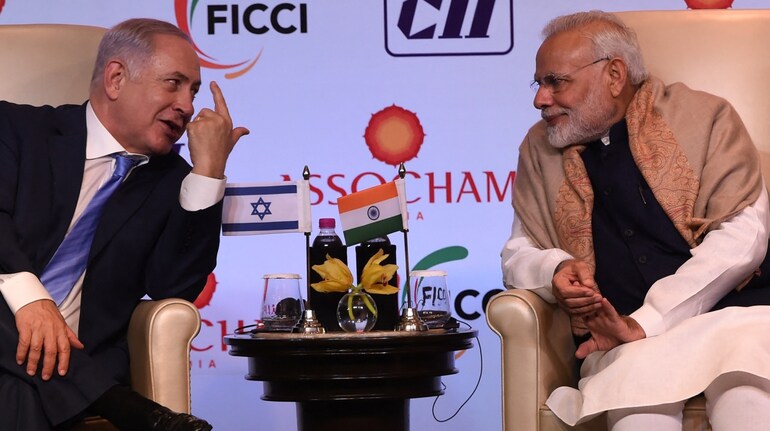

When Israel’s opposition formally urged Prime Minister Benjamin Netanyahu to resolve the ongoing political crisis so they could attend Prime Minister Narendra Modi’s address to the Knesset, it revealed something rare in today’s polarised world.
PM Modi is not seen in Israel through the narrow lens of party politics. He is viewed as a strategic constant. Across Israel’s political spectrum, Modi commands respect as a leader who transformed India-Israel ties, stood firmly with Israel during moments of crisis, and yet retained India’s principled positions on Palestine and humanitarian concerns in Gaza. That balance has given Modi an appeal that goes well beyond any single Israeli government.
Opposition appeal reflects Modi’s cross-party standing
Israel’s Leader of the Opposition wrote to Netanyahu urging him to ensure opposition participation in Modi’s parliamentary address, warning that political paralysis should not undermine a moment of national importance.
“The Knesset must not be deprived of the presence of the opposition during such a historic address,” the letter said.
The appeal was telling. In a deeply divided Israeli polity, Modi’s speech is viewed not as a ruling coalition event, but as a milestone in Israel’s long-term strategic relationship with India.
From quiet engagement to strategic embrace
India recognised Israel in 1950, but engagement remained cautious for decades. That changed decisively under Modi.
PM Modi’s 2017 visit made him the first Indian prime minister to visit Israel, marking a shift from low-profile ties to open strategic partnership. Cooperation has since expanded across defence, intelligence, innovation, agriculture and high technology.
Netanyahu has repeatedly described Modi as a “dear friend” and the India-Israel relationship as a “powerful alliance between two global leaders,” language that resonates across party lines in Israel.
Defence cooperation as the cornerstone
Defence ties have become the backbone of the partnership.
India is exploring Israeli laser-based missile defence systems to build a multi-layered air defence shield. India is also evaluating the Golden Horizon missile system, which analysts say could significantly enhance India’s long-range strike and interception capabilities.
These initiatives reflect a shift toward co-development and strategic trust, not transactional arms purchases. Israel is now among India’s top defence suppliers, and the relationship is increasingly future-oriented.
The Hexagon of Alliances and India’s strategic weight
Modi’s visit also comes amid Netanyahu’s proposal for a Hexagon of Alliances, a new regional security framework aimed at countering what he calls “radical axes” in West Asia.
Netanyahu has named India as a central pillar of this envisioned grouping, alongside Israel, Greece and Cyprus, with other Arab, African and Asian nations potentially involved.
“This includes India, Arab nations, African nations, Mediterranean nations and nations in Asia that I will not detail at the moment,” Netanyahu said, outlining a bloc of countries that “see eye-to-eye on the reality, challenges and goals” posed by extremist forces.
For Israel’s political class, including the opposition, India’s inclusion underscores New Delhi’s growing strategic weight and reliability. For Modi, it reflects India’s emergence as a key security and diplomatic player in West Asia without abandoning its strategic autonomy.
Standing with Israel without abandoning principles
India under Modi has consistently condemned terrorism targeting Israel and affirmed Israel’s right to defend itself. After the October 7 Hamas attacks, Modi said India stands with Israel.
At the same time, India has maintained its long-standing support for a two-state solution and recognition of Palestine.
“This is simply unacceptable,” India said in a statement reported by DD News, condemning the dire humanitarian crisis in Gaza and calling for protection of civilians and unhindered humanitarian access.
Crucially, Modi’s standing in Israel has not suffered because of this. As Middle East Eye notes, Israel increasingly distinguishes between India’s principled humanitarian positions and its unwavering opposition to terrorism.
Netanyahu, Modi and strategic continuity
For Netanyahu, Modi represents continuity in a volatile region. For Israel’s opposition, Modi symbolises a partnership that transcends governments.
That is why opposition leaders want to be present when Modi addresses the Knesset. His speech is seen not as a partisan moment, but as a statement of where Israel’s long-term strategic interests lie.
A relationship bigger than politics
The opposition’s insistence on attending Modi’s address captures a broader reality. Modi’s stature in Israel is not ideological or tactical. It is strategic, built on consistency, trust and delivery.
India has stood with Israel against terrorism, deepened defence and technology cooperation, supported humanitarian principles in Gaza, and upheld Palestinian rights. That rare balance explains why Narendra Modi today is not just a guest of the Israeli government, but a leader welcomed across the political aisle.
Discover the latest Business News, Sensex, and Nifty updates. Obtain Personal Finance insights, tax queries, and expert opinions on Moneycontrol or download the Moneycontrol App to stay updated!
Find the best of Al News in one place, specially curated for you every weekend.
Stay on top of the latest tech trends and biggest startup news.





