
India’s landmark free trade agreement with the European Union, which concluded on January 27, 2026, did not arrive overnight. It is the result of a long economic journey that began more than three decades ago, when India first chose to open its economy to the world.
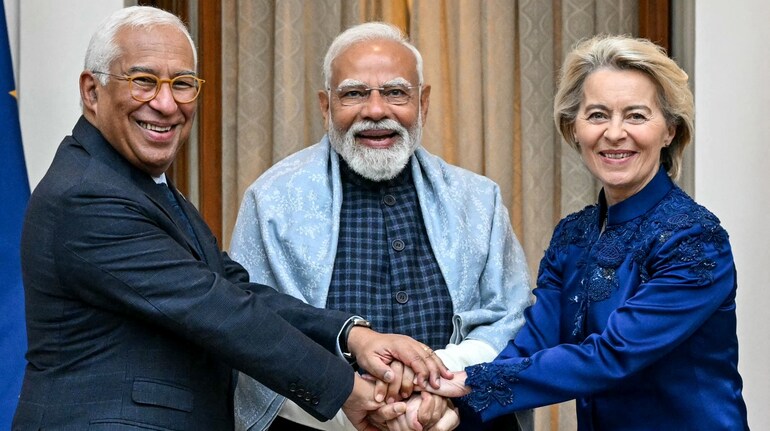
The deal, announced by Prime Minister Narendra Modi and European Commission President Ursula von der Leyen, creates the world’s largest bilateral trade bloc. It covers 2 billion people, represents nearly a quarter of global GDP, and brings together a combined market worth $27 trillion. Both leaders described it as the “Mother of All Deals”.
But to understand how India reached this moment, one must return to 1991.
1991: The turning point
India’s modern trade story begins with the economic crisis of 1991. As Finance Minister, Dr Manmohan Singh dismantled the licence raj, reduced trade barriers, and opened India’s economy to global competition.
These reforms were not just about survival. They fundamentally changed India’s relationship with the world. Indian companies began to look outward, services exports expanded, and foreign investment slowly followed.
That same decade, under Prime Minister P.V. Narasimha Rao, India joined the World Trade Organisation in 1995. This forced India to align with global trade rules and signalled that it was ready to play a larger role in the world economy.
Rao’s Look East Policy also marked a strategic shift, placing trade at the heart of India’s foreign policy.
Late 1990s and early 2000s: Learning bilateral trade
The next phase came under Prime Minister Atal Bihari Vajpayee. His government recognised that multilateral trade alone was not enough and began experimenting with bilateral agreements.
India signed its first-ever bilateral Free Trade Agreement with Sri Lanka in 1998. This was followed by the Framework Agreement with Thailand in 2003. These early deals helped Indian negotiators learn the mechanics of tariff reductions, rules of origin, and services access.
They also built confidence that India could negotiate trade agreements that protected domestic interests while expanding exports.
The Singh years: Building the architecture
When Dr Manmohan Singh became Prime Minister in 2004, India’s trade ambitions expanded sharply. His government focused on integrating India into global value chains.
Under his leadership, India signed the ASEAN goods FTA in 2009, later expanding it to services and investment. Agreements with South Korea in 2009 and Japan in 2011 followed.
Most importantly, in 2007, Dr Singh launched negotiations with the European Union. These talks were ambitious and complex, covering goods, services, investment, intellectual property, and labour mobility.
Negotiations stalled in 2013 over differences on tariffs, intellectual property, and market access. But the foundation had been laid.
The Modi era: Speed, scale and strategy
When Prime Minister Narendra Modi took office in 2014, India’s trade policy shifted from caution to acceleration.
The focus was clear. Use trade agreements to boost manufacturing, attract investment, and secure market access for Indian workers and exporters.
The results came quickly. India operationalised its agreement with Mauritius in 2021. In 2022, the UAE-India CEPA was concluded in just 88 days. The Australia trade pact followed the same year, giving Indian exporters duty-free access to 96 percent of tariff lines.
In July 2025, India signed a comprehensive FTA with the United Kingdom. This was followed by the EFTA agreement in October 2025, bringing $100 billion in investment commitments.
Each deal strengthened India’s credibility as a serious and reliable negotiating partner.
The EU deal comes together
In June 2022, India and the EU formally relaunched talks. After years of groundwork, compromise and persistence, the agreement was finally sealed on January 27, 2026.
The deal eliminates tariffs on over 96 percent of traded goods and opens 144 EU services sub-sectors to Indian firms. It protects India’s sensitive agricultural sectors while giving Indian exports such as textiles, leather, gems and jewellery duty-free access to Europe.
It also includes provisions on technology cooperation, investment protection, and mobility for skilled Indian professionals.
Prime Minister Modi described the agreement as transformative, saying it would create opportunities for 1.4 billion Indians. Ursula von der Leyen called it proof that rules-based cooperation still delivers results.
Why timing matters
The agreement comes at a time of global uncertainty. With rising protectionism and new tariff barriers from the United States under President Donald Trump, India and the EU needed reliable partners.
As PM Modi said, the deal reflects a shared commitment to democracy and the rule of law. It is not just about trade. It is about shaping a stable economic order in a fractured world.
A shared legacy
India’s trade journey from 1991 to 2026 is a story of continuity across governments. Dr Manmohan Singh opened the economy and built the architecture. Prime Minister Modi accelerated the momentum and delivered results.
As Dr Singh once said, quoting Victor Hugo, “No power on earth can stop an idea whose time has come.”
India’s integration with the global economy was that idea. With the India–EU Free Trade Agreement, it has finally arrived.
Discover the latest Business News, Sensex, and Nifty updates. Obtain Personal Finance insights, tax queries, and expert opinions on Moneycontrol or download the Moneycontrol App to stay updated!
Find the best of Al News in one place, specially curated for you every weekend.
Stay on top of the latest tech trends and biggest startup news.