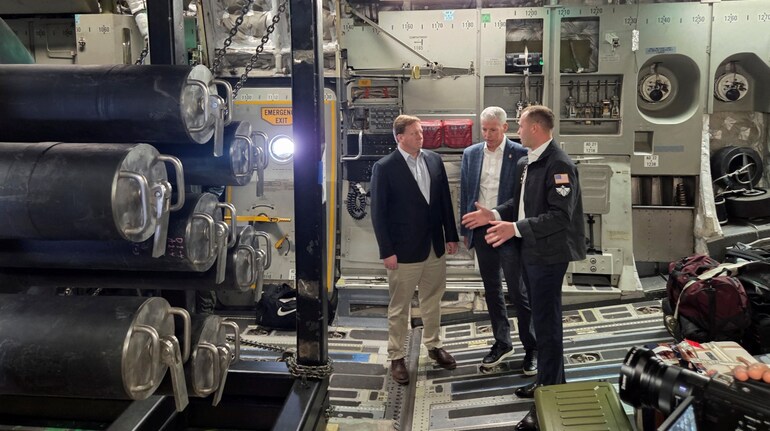

When the US military flew a nuclear reactor across states on cargo planes, it quietly demonstrated something that could reshape how power is generated in extreme environments. In an operation called Operation Windlord, three C-17 Globemaster aircraft transported eight modules of the Ward 250 microreactor from California to Utah. The reactor carried no nuclear fuel, but the message was unmistakable. Nuclear power no longer has to be fixed in one place. It can be moved, deployed, and operated wherever electricity is needed.
The Ward 250, developed by California-based Valar Atomics, is roughly the size of a large van. At full capacity, it is designed to generate around five megawatts of electricity, enough to power about 5,000 homes. The system will begin operations later this year at 100 kilowatts, scale to 250 kilowatts, and eventually reach full output.
What makes it different is its design. The reactor uses TRISO fuel, where uranium kernels are encased in multiple layers of ceramic material. It is cooled by helium instead of water. This makes it safer, more resilient, and capable of operating at higher temperatures than traditional reactors.
Valar plans to start selling power commercially by 2027. The US Department of Energy has said it wants at least three microreactors to reach operational criticality by July 4 this year.
Why microreactors are a military game changer
For the Pentagon, the real value lies in independence. A microreactor does not need a power grid. It can operate for years at a remote base without fuel convoys or constant resupply.
That matters because fuel logistics are one of the biggest vulnerabilities in military operations. Convoys can be targeted. Supply lines can be cut. A microreactor removes that weakness by producing power on site, continuously, regardless of terrain or weather.
This is where the idea becomes especially relevant for India.
India’s geography makes the case on its own
India operates across some of the most difficult terrain in the world. From the icy heights of Siachen and Ladakh to the jungles of the northeast, from the Andaman and Nicobar Islands to remote tribal regions in central India, reliable electricity is not always available.
Even today, around 25,000 villages face unreliable power supply. In many frontier areas, the grid simply does not reach.
The military faces similar challenges. Forward posts along the Line of Actual Control sit above 4,000 metres. Powering them usually means diesel generators, fuel airlifts, or long and fragile power lines. All of these come with high costs and operational risk.
A mobile microreactor, airlifted by aircraft like the C-17 which India already operates, could change this completely. Such a system could power radar installations, communication hubs, surveillance systems, and early warning stations in places where grid connectivity is unrealistic.
India already has strong foundations
India is not starting from scratch. The Bhabha Atomic Research Centre is developing multiple small reactor designs under the Nuclear Energy Mission, which received Rs 20,000 crore in the 2025-26 Union Budget.
These include the BSMR-200, a 200-megawatt reactor for industrial use, the SMR-55 designed for off-grid locations, and a five-megawatt thermal high-temperature gas-cooled reactor aimed at hydrogen production.
The SMR-55 comes closest in intent to microreactors like the Ward 250, but it is still larger and not designed for rapid airlift deployment.
What India does not yet have is a focused microreactor ecosystem driven by startups. The Atomic Energy Act has traditionally limited private participation, although changes to open the sector are under discussion. Large groups such as Reliance and Adani have shown interest in small reactors for industrial power, but the startup-led innovation seen in the US has not fully emerged in India.
A clear opportunity for India
This gap also represents opportunity. India’s public institutions like BARC and DRDO possess deep expertise in nuclear and defence technologies. Pairing that knowledge with private sector speed and innovation could accelerate development dramatically.
A public-private model similar to what the US has adopted could help India move from concept to deployment faster than current timelines, which aim for demonstration reactors in the early 2030s.
Why India should move fast
The strategic case is compelling. A domestically developed microreactor that can be airlifted by the Indian Air Force, deployed in remote terrain, and operated independently would be a powerful national asset.
It would give the armed forces a secure power source that cannot be cut off by adversaries. It would bring electricity to communities that have waited decades for reliable supply. It would reduce dependence on fuel logistics in some of the toughest environments on earth.
The US has shown that the concept works. The reactor fits inside a cargo aircraft. It can be assembled on site. It can operate without a grid.
For India, the question is no longer whether microreactors make sense. The real question is how quickly India can build one of its own.
Discover the latest Business News, Sensex, and Nifty updates. Obtain Personal Finance insights, tax queries, and expert opinions on Moneycontrol or download the Moneycontrol App to stay updated!
Find the best of Al News in one place, specially curated for you every weekend.
Stay on top of the latest tech trends and biggest startup news.