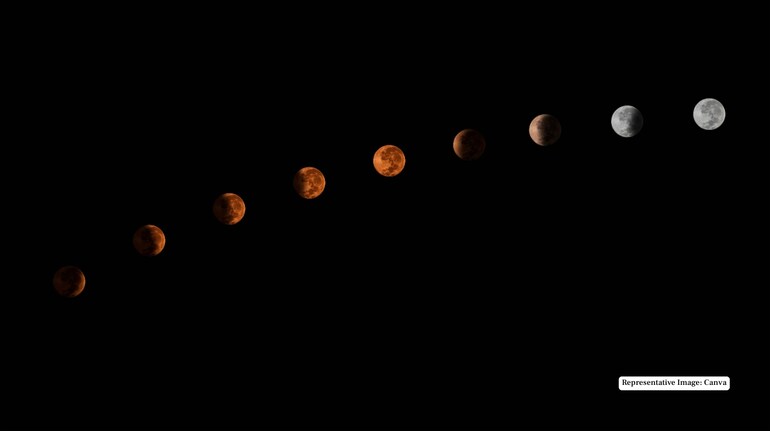

A rare celestial spectacle is set to unfold over India on March 3, 2026. The first total lunar eclipse of the year — popularly known as Chandra Grahan — will briefly turn the Moon a dramatic shade of copper-red, creating what skywatchers call a “Blood Moon”.
Unlike many eclipses that pass unnoticed in the country, this one will be visible across most parts of India, offering a short but striking evening show. And the best part? No telescopes, no special glasses — just clear skies and an unobstructed eastern horizon.
What is a Blood Moon?
A total lunar eclipse occurs when the Earth moves directly between the Sun and the Moon, casting its shadow on the lunar surface. During totality, sunlight passing through Earth’s atmosphere filters out blue light and bends red light toward the Moon, giving it a deep red glow.
This phenomenon is what creates the dramatic “Blood Moon” effect. Unlike solar eclipses, lunar eclipses are completely safe to watch with the naked eye.
Lunar Eclipse March 3, 2026: Date and timings in India
According to data shared by the India Meteorological Department’s Positional Astronomical Centre, Kolkata, the eclipse will occur on 12 Phalguna, 1947 Saka Era.
Key timings (IST):
Eclipse begins: 3:20 PM
Totality begins: 4:34 PM
Maximum phase: Around 5:10 PM to 5:25 PM (varies slightly by city)
Totality ends: 5:33 PM
Eclipse ends: 6:48 PM
The magnitude of the eclipse is 1.155, indicating a complete immersion of the Moon into Earth’s umbral shadow during peak totality.
However, there’s a catch.
In most parts of India, the Moon will rise while the eclipse is already underway. This means many regions will witness only the final stages — typically for 15–25 minutes around moonrise. So there’s no need to stay up late. Simply step outside at dusk and look toward the eastern horizon.
Best places in India to watch the Blood Moon
Northeast India: The most dramatic view
If you want the fullest experience, Northeast India offers the best vantage point. Cities here are expected to witness the end of totality and the most intense red hues at moonrise.
Top cities include:
Dibrugarh
Dispur
Guwahati
Itanagar
Shillong
In these locations, the Moon may rise already glowing red — a rare and unforgettable sight.
Travel tip: Choose elevated hilltops, riverbanks, tea estates, or open landscapes with a clear eastern horizon.Eastern India: A photographer’s delight
Cities such as Kolkata, Bhubaneswar, and Patna, will witness the late total or partial phases. While peak redness may be fading, viewers can watch the Moon gradually brighten as it exits Earth’s shadow — a beautiful transition for long-exposure photography.
Riverfront promenades, terraces, and open parks make ideal viewing spots.
North and Central India: A brief but memorable show
In cities like Delhi, Jaipur, Lucknow, and Bhopal, only the ending partial phase will be visible at moonrise. Even so, watching the shadow slowly lift off the Moon against a twilight sky can be a magical experience — especially from lakefronts or open countryside.
Western and Southern India: Final phase at dusk
Cities including Mumbai, Ahmedabad, Chennai, Bengaluru, and Hyderabad, will see only the closing partial stages. Coastal cities, however, offer a spectacular backdrop — imagine the Moon rising faintly red over the Arabian Sea or Bay of Bengal.
Note: Some extreme western parts of India may have limited visibility.Why this eclipse matters
Not every total lunar eclipse is visible from India. The last one visible here occurred on September 7–8, 2025. The next lunar eclipse visible from India will be on July 6, 2028 — and that will be only a partial eclipse.
Globally, the March 3 event will be visible across eastern Asia, Australia, the Pacific Ocean region, and the Americas. But for Indian skywatchers, this is the only total lunar eclipse of 2026 offering a meaningful view.
How to watch safely
Lunar eclipses are completely safe to observe with the naked eye. No protective filters or glasses are required. For a better experience:
A camera with a tripod can help capture the red glow against city skylines or natural landscapes.
For travellers, this could be the perfect excuse for a short midweek escape — whether to the hills of the Northeast, a riverbank in eastern India, or a quiet beach along the coast.
On March 3, as dusk settles and the Moon rises already tinted red, India will briefly have a front-row seat to one of the sky’s most timeless spectacles.
For detailed timings and visibility updates for your city, click here to check the full blood moon schedule.

Discover the latest Business News, Sensex, and Nifty updates. Obtain Personal Finance insights, tax queries, and expert opinions on Moneycontrol or download the Moneycontrol App to stay updated!
Find the best of Al News in one place, specially curated for you every weekend.
Stay on top of the latest tech trends and biggest startup news.