
The Doomsday Clock is not a real clock, but a symbolic measure of how close humanity is to a global catastrophe. The clock shows “minutes to midnight”, where midnight means global disaster. On January 27, 2026, the Doomsday Clock has been moved to 85 seconds to midnight. A panel of scientists and experts decides the clock’s time each year. This year seems to be the beginning of something disastrous that are scientists so alarmed about.
What Is This Doomsday Clock?
The Doomsday Clock is a symbolic countdown to global catastrophe. Created in 1947 by scientists after World War II, it communicates how close humanity is to existential threats. The clock shows “minutes to midnight”. It is not a real clock, but a metaphor used to spur action and awareness.
The @BulletinAtomic today set the Doomsday Clock at 85 seconds to midnight—the closest it has been to apocalypse.“We are running out of time," said Alexandra Bell, president and CEO of the Bulletin. Learn more and watch the announcement: https://t.co/O2nWAwxincpic.twitter.com/C8npsgIMoM — The University of Chicago (@UChicago) January 27, 2026
Who Decides the Time?
The time is chosen each year by the Science and Security Board of the Bulletin of the Atomic Scientists. These were scientists who had worked on the Manhattan Project, which developed the first atomic bombs.
They consider nuclear threats, climate shifts, biosecurity and disruptive technology in their assessment. The group meets regularly and updates the clock based on evolving global conditions.
Is Midnight the “End of the World”?
Midnight does not signal an actual apocalypse, instead it is metaphorical. It stands for human‑made catastrophe that could drastically damage civilization. The clock’s setting reflects relative risk, not a precise prediction of time left. Scientists emphasise it’s a wake‑up call, not an exact countdown. Whether it moves backward depends on actions to reduce existential threats.
How Has the Clock Changed Over Time?
Since its inception in 1947, the Doomsday Clock has been moved forward and backward more than 25 times. Some historical highlights invlove:
1947: First set at seven minutes to midnight.
1991: Farthest from midnight at 17 minutes after the end of the Cold War.
A steady creep forward: 100 seconds (2020), 90 seconds (2023) and now 85 seconds (2026).
Why Are Scientists Alarmed?
The Doomsday Clock warns humanity about global threats and vulnerabilities today. Nuclear tensions rise among countries, increasing the risk of conflict. Climate change worsens with emissions, heatwaves, storms and food insecurity. AI and biotech progress fast, creating unpredictable risks for society.
Political fragmentation weakens global cooperation, making coordinated action far harder. Scientists stress urgency, but solutions exist through diplomacy, science and awareness.
How Scientists see this?
Scientists believe that the clock is a warning, not a prophecy. It is meant to motivate scientists and the public to act before “midnight” arrives. Experts call for renewed global cooperation on nuclear treaties and climate goals.
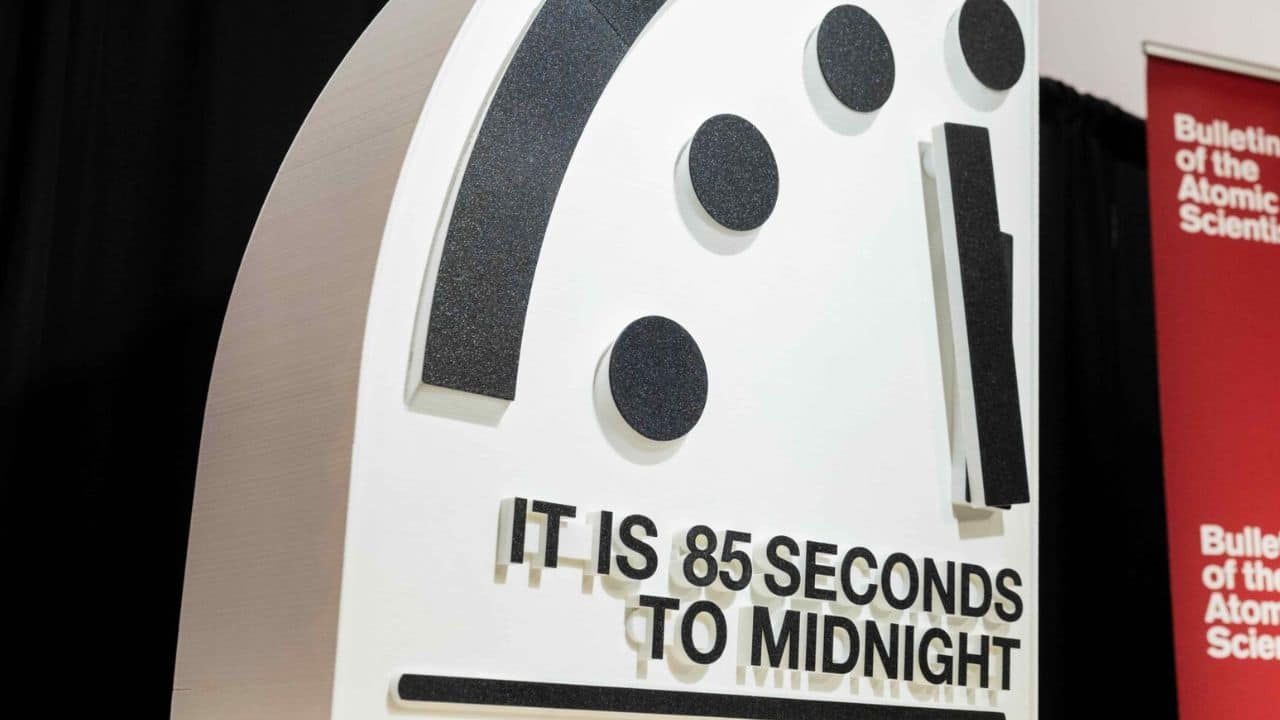 Scientists have just moved the Doomsday Clock to 85 seconds before midnight. (Image: Bulletin of the Atomic Scientists)
Scientists have just moved the Doomsday Clock to 85 seconds before midnight. This is closest it has ever been in its 79-year history. This annual decision was announced on January 27, 2026, alarming scientists.
Discover the latest Business News, Sensex, and Nifty updates. Obtain Personal Finance insights, tax queries, and expert opinions on Moneycontrol or download the Moneycontrol App to stay updated!
Find the best of Al News in one place, specially curated for you every weekend.
Stay on top of the latest tech trends and biggest startup news.