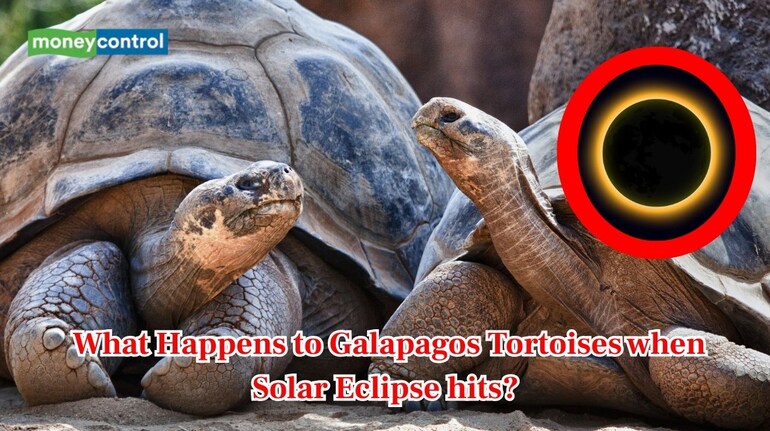

Galapagos tortoises are usually slow and calm. They roam the islands, grazing quietly under the sun. But during a solar eclipse, everything changes. Scientists have observed these gentle giants behaving in remarkably unusual ways. Researchers have watched various animals during solar eclipses, and many show unexpected behaviour. But Galapagos tortoises do something extraordinary.
Galapagos Tortoises: About the Species
Galapagos tortoises are the largest living reptiles on Earth. They can weigh up to 417 kilograms and live over 100 years. Native to the Galapagos Islands in Ecuador, these tortoises are famous for their slow, steady movements. They are herbivores, grazing on grasses, cacti and leaves. Despite their calm nature, they are highly sensitive to environmental changes.
The Strange Behaviour this Tortoise is Famous for?
During a solar eclipse, Galapagos tortoises behave very differently. Observers reported that just before total darkness, the tortoises suddenly began to mate. This is unusual because mating at this time of day is rare.
They also lifted their heads and gazed at the sky, as if watching the eclipse. The behaviour lasted only a few minutes, disappearing as sunlight returned. It was a rare and unexpected reaction from these normally placid giants.
How Scientists React to This?
Researchers were amazed by the tortoises’ behaviour. They noted that such reactions show animals’ sensitivity to cosmic events. Scientists documented the behaviour carefully for future studies.
It confirmed that even slow-moving reptiles respond to sudden environmental changes. Experts say these observations could reveal more about animal instincts and perception.
Any Other Animals React Strange Too During Solar Eclipse?
Tortoises are not the only animals affected by eclipses. In other studies, gorillas and baboons became anxious, pacing and vocalising. Gibbons made unusual calls and giraffes swayed nervously. Birds like lorikeets chirped frantically, then went silent.
Even nocturnal insects, like crickets, started chirping during the day. All of this shows that animals notice sudden changes in light and temperature.
Why Do Animals React This Way?
The eclipse creates sudden darkness and cooler temperatures. Many animals interpret this as nightfall. Crepuscular and nocturnal species become active or cautious. Others, like tortoises, may engage in rare behaviours, including mating. The reactions are driven by circadian rhythms and instincts.
What Makes the Tortoise Reaction Special?
Galapagos tortoises are slow, calm, and predictable most of the time. Seeing them mate and gaze at the sky is extremely rare. It highlights how even giant reptiles are tuned to celestial events. The reaction is brief, unusual, and fascinating to both scientists and observers. It shows that cosmic events can influence behaviour in surprising ways, even for the slowest creatures.
Discover the latest Business News, Sensex, and Nifty updates. Obtain Personal Finance insights, tax queries, and expert opinions on Moneycontrol or download the Moneycontrol App to stay updated!
Find the best of Al News in one place, specially curated for you every weekend.
Stay on top of the latest tech trends and biggest startup news.