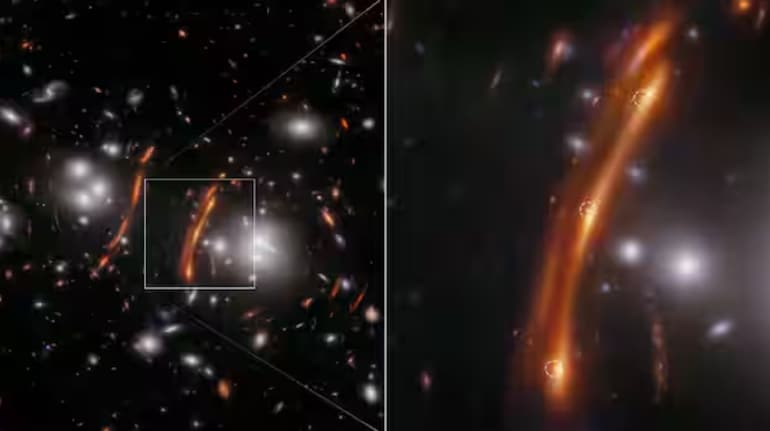
The James Webb Space Telescope has made an incredible discovery, observing a supernova appearing three times in one image due to a fascinating phenomenon in spacetime. This remarkable event is the result of gravitational lensing, where light from distant objects is bent by massive cosmic structures, like galaxy clusters or black holes, allowing us to see them more clearly from Earth.
Gravitational lenses, formed by dense cosmic masses, bend light from far-off celestial bodies. This creates a magnifying effect, making distant objects visible to us. In this instance, a galaxy cluster in the constellation Ursa Major, known as PLCK G165.7+67.0 (or G165), served as the gravitational lens. This phenomenon bent and magnified the light from a supernova, offering three distinct views of the same explosion.
Read Also: Is the moon really ours? Study indicates it may have come from the outer solar system
The supernova, imaged by the James Webb Space Telescope (JWST), appeared three times due to light travelling along three different paths, each with a unique distance. JWST’s Near-Infrared Camera (NIRCam) captured the event between March and May of last year. The light travelled through G165, which is located 3.6 billion light-years away, but the supernova itself is even further and older, making it a glimpse into the past.
Astronomer Brenda Frye likened this phenomenon to a trifold mirror. In her analogy, each “mirror” reflects the supernova at different stages of its explosion. This cosmic display was created by the differing paths light took to reach Earth. As the light was bent, the galaxy cluster’s gravitational heft distorted the supernova into an arc-like shape, displaying three bright specks—each representing the same supernova.
Read Also: NASA to embark on a daring mission to uncover a 'hidden ocean' in space, but where is it?
This study opens doors to better understand both supernovae and gravitational lensing. Only some parts of the research have been published so far, but a detailed paper is forthcoming on the arXiv preprint server. Scientists are eager to explore more about this cosmic event and the insights it provides into the universe’s structure.
Discover the latest Business News, Sensex, and Nifty updates. Obtain Personal Finance insights, tax queries, and expert opinions on Moneycontrol or download the Moneycontrol App to stay updated!
Find the best of Al News in one place, specially curated for you every weekend.
Stay on top of the latest tech trends and biggest startup news.