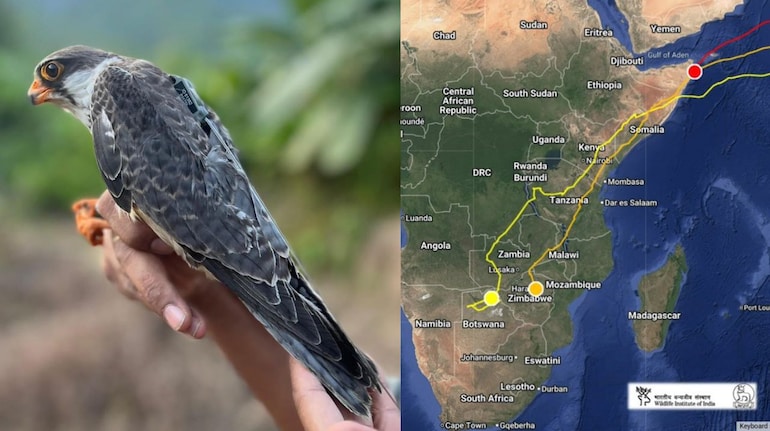
Researchers and wildlife officials this month highlighted remarkable migration journeys of Amur falcons. Satellite tracking shows three birds from Manipur crossed continents within days. The updates were shared publicly by senior officials and scientists. The flights underline how migratory birds connect distant ecosystems worldwide.
What is happening along the Amur falcon migration routes
The Amur falcon is a small raptor known for endurance. Each year it migrates between breeding and wintering grounds. In December, three tagged birds drew renewed global attention. The falcons were named Apapang, Alang and Ahu. All three were tagged earlier in Manipur.
IAS officer Supriya Sahu shared details on social media platform X. She said the movements were explained by WII scientist Suresh Kumar. Satellite data tracked the birds across Asia and Africa. Their journeys coincided with winter across the Indian subcontinent.
Apapang, identified with an orange tag, flew non stop. She covered about 6,100 kilometres in six days. The flight began in India and crossed the Arabian Sea. She passed over the Horn of Africa before landing in Kenya. Scientists say this ranks among longest uninterrupted raptor flights.
Here we go again with our Amurs…Apapang, Alang and Ahu Just when you think their journey can’t surprise you anymore, they do. As Christmas lights spread cheer, Apapang is around the City of Harare in Zimbabwe, reminding us how closely nature and cities can overlap. Alang has… https://t.co/i227Z2ERUZpic.twitter.com/Pwj59b7KSG— Supriya Sahu IAS (@supriyasahuias) December 26, 2025
How Alang and Ahu followed different paths
Alang, the youngest bird with a yellow tag, took a varied route. She travelled roughly 5,600 kilometres to Kenya. Along the way, she paused briefly in Telangana. She later stopped in Maharashtra before resuming migration. Researchers say such halts help replenish energy reserves.
Ahu, marked with a red tag, chose another path. She first paused in Bangladesh during early migration. From there, she crossed the Arabian Sea directly. Her journey covered about 5,100 kilometres before reaching Somalia. Scientists say route choices depend on winds and weather.
Together, these flights reinforce the falcon’s reputation for endurance. The species is often called a tiny long distance voyager. Despite small size, the birds cross oceans and deserts. Their survival depends on favourable winds and safe stopovers.
Why the journeys matter for global conservation
Researchers say the migrations highlight ecosystem interconnectedness. The birds link forests, farmlands, wetlands and coastal regions. Destinations include Botswana’s Okavango Delta and Somalia’s Xaafuun region. Protecting these areas supports countless migratory species.
Conservationists stress the need for international cooperation. Migratory routes cross many national boundaries each year. Habitat loss or hunting anywhere can disrupt the journey. Satellite data helps identify critical resting and feeding sites.
Bird watchers worldwide continue following the falcons’ movements. Their journeys inspire awareness and conservation action globally. Scientists say ongoing research will refine protection strategies. The flights remind policymakers that wildlife protection requires shared responsibility.
Discover the latest Business News, Sensex, and Nifty updates. Obtain Personal Finance insights, tax queries, and expert opinions on Moneycontrol or download the Moneycontrol App to stay updated!
Find the best of Al News in one place, specially curated for you every weekend.
Stay on top of the latest tech trends and biggest startup news.