






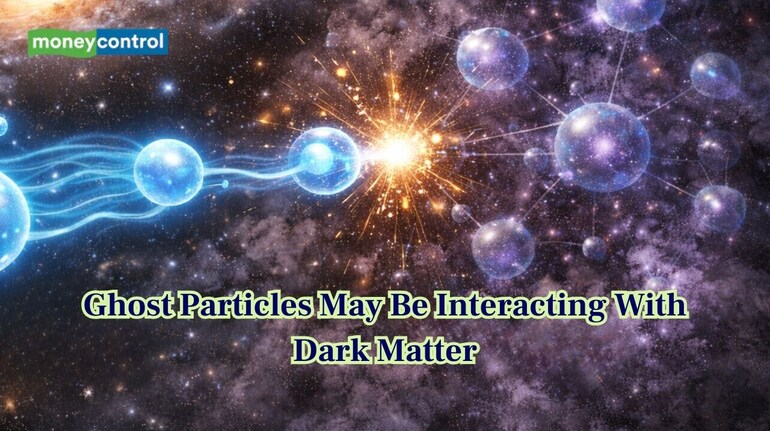

Scientists may have uncovered a surprising connection between two of the Universe’s most mysterious components. They are neutrinos, often called “ghost particles” and dark matter, the invisible substance that shapes galaxies.
A new study suggests these elusive particles might interact more than previously thought. If confirmed, the discovery could help solve long-standing cosmic puzzles about how the Universe evolved.
A Hint from the Deepest Data in the Cosmos
Researchers analysed multiple astronomical datasets, galaxy distributions and large-scale cosmic structures. Their results showed a subtle but consistent signal suggesting that neutrinos may scatter off dark matter particles. The finding reached a “three-sigma” confidence level. While this does not count as definitive proof, scientists say it is strong enough to deserve serious attention.
What Are These ‘Ghost Particles’?
Neutrinos are incredibly light, electrically neutral particles that rarely interact with ordinary matter. Trillions pass through your body every second without you noticing. They are produced in huge numbers by stars, exploding supernovae and nuclear reactions.
Dark matter, meanwhile, makes up around 85 per cent of all matter in the Universe, yet remains invisible. Its presence is known only through its gravitational effects on galaxies and cosmic structures.
Why This Interaction Could Change Everything?
If neutrinos and dark matter do interact, even weakly, it could help explain why some observations of the Universe do not perfectly match theoretical predictions. For example, astronomers have long noticed small differences between how fast the Universe appears to be expanding and how structures such as galaxies formed over time.
A neutrino-dark matter interaction could subtly slow the growth of cosmic structures, bringing theory and observation closer together.
A New Direction for Particle Physics
The discovery also offers fresh clues for particle physicists searching for dark matter in laboratories on Earth. Most experiments assume dark matter barely interacts with anything. But if neutrinos can influence it, scientists may need to rethink how to detect it. Future observatories, more powerful telescopes and advanced particle detectors could test this idea further.
Still a Mystery, But a Promising One
Researchers stress that this is not yet a confirmed discovery. More data is needed to rule out statistical chance or hidden errors in the analysis. However, the consistency of the signal across different datasets makes the idea difficult to ignore. If proven correct, the interaction would mark a major step forward in understanding the hidden forces shaping the cosmos.
Discover the latest Business News, Sensex, and Nifty updates. Obtain Personal Finance insights, tax queries, and expert opinions on Moneycontrol or download the Moneycontrol App to stay updated!
Find the best of Al News in one place, specially curated for you every weekend.
Stay on top of the latest tech trends and biggest startup news.





