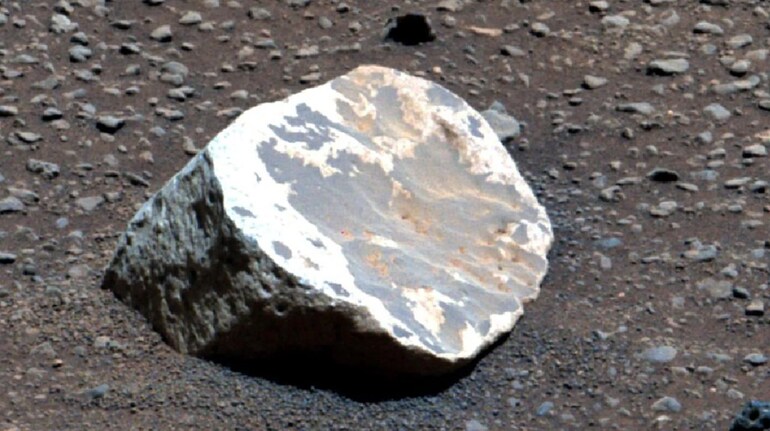

Bright white rocks spotted by NASA’s Perseverance rover are reshaping scientific views about ancient Mars and its climate history, according to new peer reviewed research analysing rare clay minerals found inside Jezero crater.
Small pale stones scattered across Mars’s red surface have drawn intense attention from scientists studying the planet’s past. These rocks stand out sharply and suggest Mars once experienced sustained rainfall and humid conditions. NASA scientists say the discovery challenges long held ideas about Mars being mostly cold and dry. The rover identified the material as kaolinite, an aluminium rich clay rarely formed without extensive water exposure. On Earth, such clay develops after millions of years of rainfall under warm climates. Its presence on Mars points towards long lasting wet conditions.
Kaolinite Clays And Signs Of Rainfall
The findings were published in the journal Communications Earth and Environment. The study was led by Adrian Broz, a postdoctoral researcher at Purdue University. The work involved close collaboration with NASA’s Perseverance science team. Professor Briony Horgan, a planetary scientist at Purdue, is a long term mission planner. Researchers say kaolinite requires intense chemical weathering over long periods. This process strips rocks of many minerals through persistent water exposure. Scientists believe this supports the idea of ancient Martian rainfall lasting millions of years.
Horgan said similar rocks are rare and difficult to form anywhere. She added they strongly indicate a warmer, wetter Mars. Broz explained kaolinite commonly forms in tropical rainforests on Earth. Finding it on Mars suggests far more water existed previously. The clay fragments vary from pebbles to large boulders. Though small, they provide critical evidence about Mars’s environmental evolution.
Rover Instruments Reveal Climate Clues
Perseverance used SuperCam and Mastcam Z instruments for analysis. These tools compared Martian rocks with Earth samples. Scientists also examined similar kaolinite from California and South Africa. The chemical signatures closely matched rainfall formed clays. Researchers ruled out hydrothermal origins through detailed chemical comparisons. This strengthened the rainfall explanation over volcanic processes.
Mystery Of Jezero Crater Origins
Despite the evidence, the rocks’ source remains unclear. Scientists found no nearby formation sites within Jezero crater. The crater once hosted a lake twice Lake Tahoe’s size. Researchers believe the rocks may have travelled through rivers. Others suggest asteroid impacts scattered them across the landscape. Satellite data shows larger kaolinite deposits elsewhere on Mars. Perseverance has not yet reached those regions.
Scientists say these rocks act as ancient time capsules. They preserve conditions from billions of years ago. Broz noted all known life requires water. Rain driven environments would have supported habitability. The discovery adds urgency to future sample return missions. Researchers hope to confirm whether ancient Mars once hosted life friendly conditions.
Discover the latest Business News, Sensex, and Nifty updates. Obtain Personal Finance insights, tax queries, and expert opinions on Moneycontrol or download the Moneycontrol App to stay updated!
Find the best of Al News in one place, specially curated for you every weekend.
Stay on top of the latest tech trends and biggest startup news.