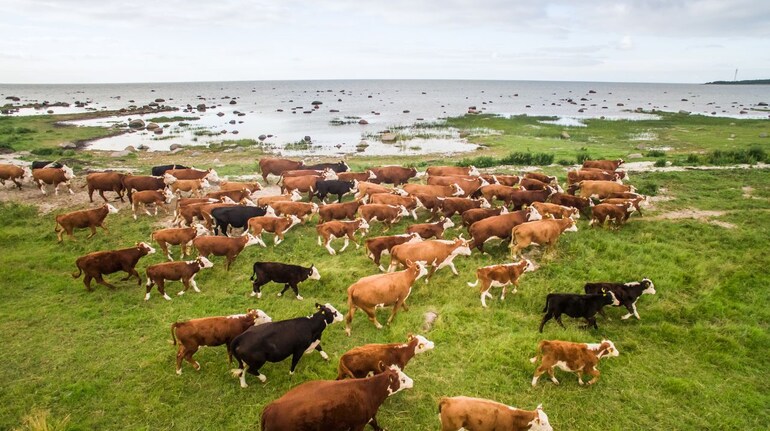

A long forgotten herd of cattle abandoned on Amsterdam Island became an unlikely scientific case, revealing how domestic animals adapted to extreme isolation before their eradication in 2010 sparked ongoing ethical debate.
A Surprising Survival on a Remote Island
In the late 19th century, a small herd of cattle was left behind on Amsterdam Island, a remote subantarctic territory in the southern Indian Ocean located about 4,440 kilometres southeast of Madagascar. The island, similar in size to Noirmoutier, experiences strong winds, heavy rainfall and limited freshwater availability.
Despite these harsh conditions, the cattle survived without human care and gradually adapted to the environment. Over decades, they formed a self sustaining feral population, growing steadily and becoming an unexpected feature of the island’s ecosystem. Their survival challenged assumptions about the limits of domesticated animals in extreme isolation.
What Science Revealed About Their Adaptation
Researchers later turned to genetics to understand how the cattle endured such conditions. Genetic material collected from 18 animals during expeditions in 1992 and 2006 showed the herd descended from European domestic breeds. The study revealed surprising genetic diversity despite prolonged isolation.
Natural selection favoured smaller and more resilient animals, allowing the population to adapt rapidly to limited vegetation, strong winds and water scarcity. Scientists described the process as accelerated feralisation driven by environmental pressure rather than human influence, offering rare insights into evolutionary change within a domestic species.
Why the Herd Was Ultimately Eradicated
Human presence on Amsterdam Island remained minimal, limited mainly to a scientific base established in 1949. In 2006, the island became part of the French Southern and Antarctic Lands nature reserve and later received UNESCO World Heritage status. With protected status came concerns about invasive species and ecosystem damage. Authorities concluded the cattle threatened native flora and decided to remove the herd entirely.
In 2010, nearly 2,000 animals were culled. The decision continues to divide scientists and conservationists, with some viewing it as necessary protection, while others argue a unique genetic lineage was lost. Today, the Amsterdam Island cattle remain a powerful example of the complex balance between conservation goals and preserving unexpected biological heritage.
Discover the latest Business News, Sensex, and Nifty updates. Obtain Personal Finance insights, tax queries, and expert opinions on Moneycontrol or download the Moneycontrol App to stay updated!
Find the best of Al News in one place, specially curated for you every weekend.
Stay on top of the latest tech trends and biggest startup news.