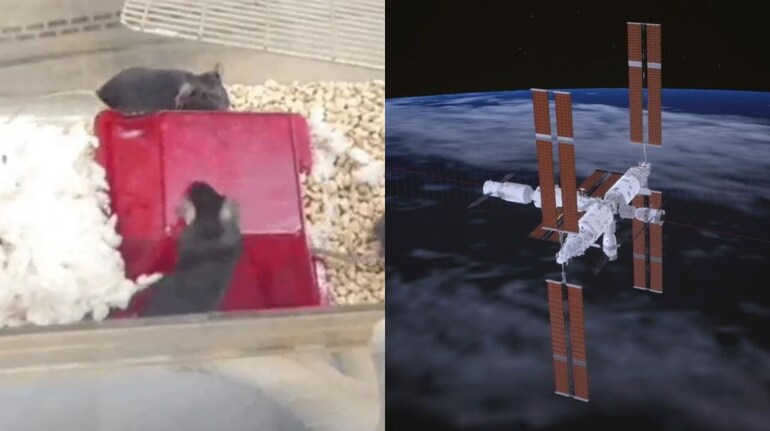

A female mouse that spent nearly 2 weeks aboard China’s Tiangong Space Station has given birth to 28 pups across 3 litters after returning to Earth, raising new questions about how microgravity affects mammalian reproduction. The female rodent was part of the Shenzhou-21 mission and participated in biological experiments in orbit before landing safely in November 2025.
An Unusual Birth Record After Spaceflight
Following her return from orbit, the mouse delivered 9 pups in December 2025, 10 in second litter and 9 more in February 2026. This brought the total to 28 pups. Researchers describe as strikingly high compared with normal reproductive patterns in laboratory mice.
While scientists have not concluded that microgravity directly increased fertility, the data has prompted further investigation into hormonal, genetic and physiological responses triggered by space travel.
What Happened in Orbit?
The mouse was among four rodents sent to the Tiangong station for approximately two weeks of microgravity research. The experiment aimed to study:
1. Muscle and bone changes in space.
2. Effects of weightlessness on organ systems.
3. Reproductive biology under altered gravity conditions.
After returning to Earth, researchers closely monitored the animals to assess long-term health and behavioural adaptation.
This Breakthrough Was Recorded By?
The findings were documented by Chinese space life-science researchers. They are overseeing biological experiments aboard the Tiangong station. The mission was conducted under the China Manned Space Agency, which manages the country’s crewed spaceflight programme.
A female mouse that spent approximately two weeks aboard China's Tiangong space station last year as part of the Shenzhou-21 mission has birthed her third consecutive healthy litter back on Earth, providing scientists with invaluable data on mammalian reproduction after… pic.twitter.com/3GEgXjIxOO— China Science (@ChinaScience) March 2, 2026
New Understanding of Biology in Space
Spaceflight exposes living organisms to microgravity, radiation and altered circadian cycles. Previous research has shown that weightlessness can lead to muscle loss, bone density reduction and immune system changes.
However, reproduction remains one of the least understood areas of space biology. Researchers caution that further controlled studies are required before drawing firm conclusions.
Why This Research Matters?
As nations prepare for long-duration missions to the Moon and Mars, understanding whether mammals can reproduce safely and sustainably in space is critical.
Human deep-space exploration will depend not only on survival, but also on long-term biological stability. Experiments aboard Tiangong are part of broader efforts to determine whether life can thrive beyond Earth for extended periods.
So, What Does This Mean?
While one prolific mouse does not provide definitive answers, it offers a compelling data point in the study of space medicine.
The results suggest that short-term exposure to microgravity may not permanently impair reproductive capability and could even trigger temporary biological shifts.
However, scientists stress that much remains unknown about long-term or multi-generational effects.
Discover the latest Business News, Sensex, and Nifty updates. Obtain Personal Finance insights, tax queries, and expert opinions on Moneycontrol or download the Moneycontrol App to stay updated!
Find the best of Al News in one place, specially curated for you every weekend.
Stay on top of the latest tech trends and biggest startup news.