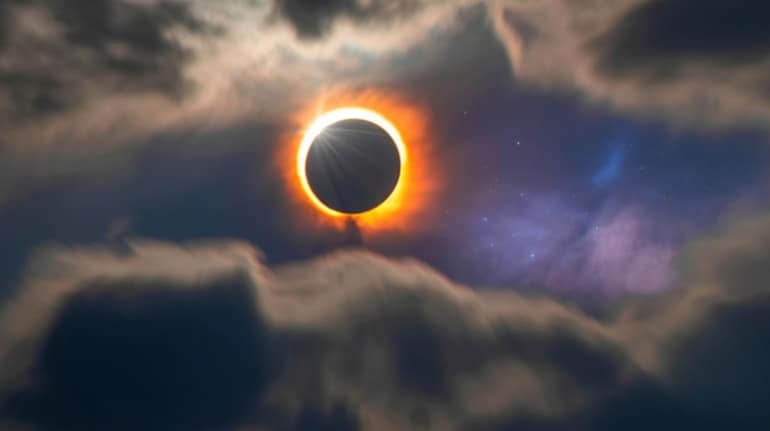
2026 promises two breathtaking solar eclipses, rare opportunities to witness the Moon aligning perfectly with the Sun. Solar eclipses are more than just a spectacle. A rare annular “ring of fire” event and a total solar eclipse will be visible from Europe and the Arctic.
This event will offer scientists a chance to study the Sun’s outer atmosphere and Earth’s changing skies. Here’s everything you need to know about the eclipses of 2026.
| DATE | TYPE | TIMINGS (EST) | VISIBILITY |
| 2026-02-17 | Partial | 02:30 AM – 06:45 AM | Argentina, Chile, South Africa, Antarctica. |
| 2026-08-12 | Total | 05:00 AM – 09:15 AM | Greenland, Iceland, Northern Spain |
| 2026-08-12 | Partial | 04:00 AM – 08:15 AM | Europe, Canada, Portugal |
February 17: Annular Solar Eclipse visibility details
The first eclipse arrives 17 February 2026. It is an annular solar eclipse. The Moon will not fully cover the Sun. A bright ring will remain visible. The path of annularity crosses East Antarctica.
Most regions will see only partial coverage. Partial views extend across southern Argentina and Chile. Southern Africa and surrounding oceans also see partial phases. This eclipse is not visible from North America.
Observers must use certified solar viewing protection. Direct viewing without protection is unsafe. Regular sunglasses are not suitable. Pinhole projection methods are recommended for beginners.
August 12: Total Solar Eclipse path explained
The most anticipated event occurs on 12 August 2026. A total solar eclipse will cross Europe and Arctic regions. The path of totality includes Greenland and Iceland. Northern Spain will also experience total darkness.
Parts of Portugal lie close to the path. Most of Europe will see partial phases. Canada and northern United States get partial views.
This eclipse is not total from North America. Partial viewers must wear ISO-certified eclipse glasses. Totality viewers may observe briefly without protection. Planning tools like eclipse mapping apps are recommended.
How to watch Solar eclipse safely?
Solar eclipses occur during phases of new Moon. The solar events affect limited Earth regions. Never look directly at the Sun, even during partial phases. Solar viewing always requires eye protection. Hence, wearing ISO-certified eclipse glasses are necessary.
Astronomers advise early planning for travel and weather. The next total solar eclipse in the United States occurs on 23 August 2044. Eclipse seasons repeat roughly every six months.
Discover the latest Business News, Sensex, and Nifty updates. Obtain Personal Finance insights, tax queries, and expert opinions on Moneycontrol or download the Moneycontrol App to stay updated!
Find the best of Al News in one place, specially curated for you every weekend.
Stay on top of the latest tech trends and biggest startup news.