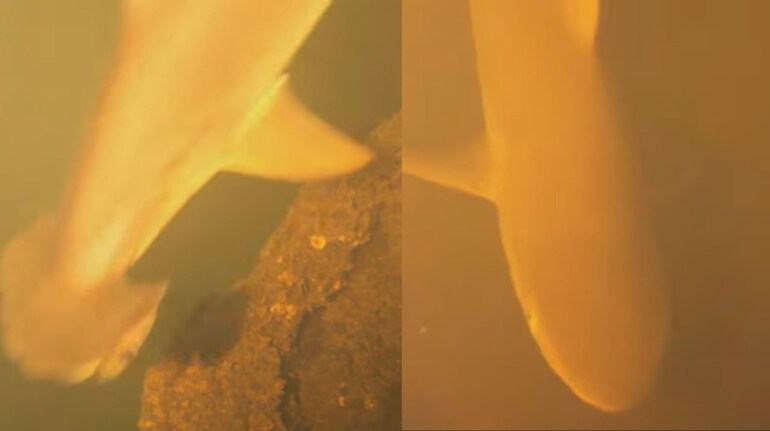
Scientists have reported rare footage showing sharks living inside an active underwater volcano near the Solomon Islands, challenging assumptions about marine survival in extreme volcanic environments.
Sharks found inside Kavachi volcano
The discovery dates back to a 2015 scientific expedition. Researchers were studying Kavachi, among Earth’s most volatile submarine volcanoes. Kavachi lies in the southwest Pacific Ocean region. It frequently erupts lava, ash and acidic water. Such conditions are considered deadly for complex marine life.
Ocean engineer Brennan Phillips led the research expedition. The team arrived during a pause between eruptions. This allowed instruments to be lowered into the crater. A deep sea camera recorded conditions inside the volcano. When footage was reviewed, sharks appeared swimming calmly.
Hammerhead sharks, silky sharks and a stingray were visible. The animals showed no obvious signs of distress. Phillips said the sharks seemed completely unfazed. The stingray appeared to shelter within a caldera cave.
Why the finding surprised scientists
Kavachi’s crater is a volcanic caldera structure. During eruptions, superheated acidic water floods the area. Volcanic gases and rock fragments are also released. Scientists believed only microorganisms could survive there.
Phillips said the presence of large predators raised questions. He explained the volcano erupts frequently and violently. During active eruptions, survival seems impossible. Seeing sharks living there conflicted with existing knowledge. He questioned whether sharks sense eruptions before they occur.
The footage was later released by National Geographic. It quickly attracted global scientific attention. Kavachi became informally known as Sharkcano. The nickname reflected the volcano’s extreme reputation.
What later research revealed
NASA satellites later recorded Kavachi erupting again. The eruption occurred seven years after the expedition. Lava, ash, sulphur and acidic water were released. Similar eruptions were documented in 2007 and 2014. It remains unknown whether the sharks survived.
Due to danger, follow up studies avoided human divers. Phillips returned using robotic research systems instead. He worked with Alistair Grinham and Matthew Dunbabin. The robots were designed to be expendable.
Sensors recorded elevated temperatures and sudden pH drops. The volcano was confirmed as a greenhouse gas source. Dunbabin said fresh volcanic material embedded into robots. This allowed unique rock sample collection.
What scientists still want to know
Phillips said biology suggests fish should not survive there. Kavachi waters are hot, acidic and cloudy. These conditions are harmful for most marine species. Yet sharks were seen moving between plume clouds.
Scientists do not know how sharks tolerate conditions. Possible behavioural or physiological adaptations are being considered. Studying them could inform climate stress research. Understanding such resilience may help future marine science. Phillips said the mystery remains unresolved.
Discover the latest Business News, Sensex, and Nifty updates. Obtain Personal Finance insights, tax queries, and expert opinions on Moneycontrol or download the Moneycontrol App to stay updated!
Find the best of Al News in one place, specially curated for you every weekend.
Stay on top of the latest tech trends and biggest startup news.