






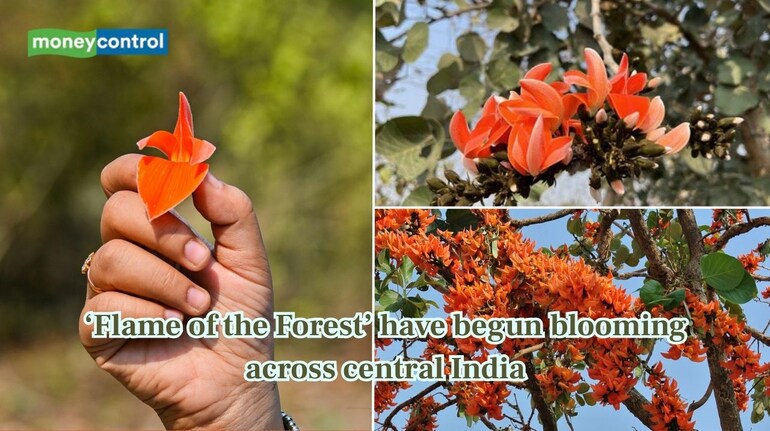

Across the Central Indian highlands and the Deccan plateau, forests are changing colour. What was once muted brown and dusty green has erupted into blazing orange-red. The transformation comes from a single tree species Butea monosperma which is locally known as Dhak or Palash.
Its flowers are bold. Thick clusters of curved petals resemble rising flames. It is no surprise the tree earned the name “Flame of the Forest.” But this bloom is more than a spectacle.
Palash: The Tree with Orange Flowers
Known scientifically as Butea monosperma, Palash is also known as Dhak. It is one of India’s most recognisable native trees. It is a medium-sized deciduous tree that can grow up to 15 metres tall. Its trunk is often twisted, its bark rough and greyish. The branches of this tree spread irregularly.
Yet when it flowers, all structural modesty disappears. Palash is native to the Indian subcontinent and has been present in India for thousands of years. It thrives in dry deciduous forests, open grasslands and scrublands.
Where Does Palash Bloom?
Palash blooms widely across the Central Indian highlands, deccan plateau and deciduous forest. This tree can be seen in open rural landscapes and village. It is scattered across central India, parts of Rajasthan, Uttar Pradesh, Jharkhand and Odisha. This tree is from India and not an imported ornamental species.
Dhak or Palash (Butea monosperma) have started blooming in Central Indian highlands and Deccan plateau with their brilliant orangish red flowers.Its radiant flame-like flowers lit the forest canopy with beaming red colours, giving it the name ‘Flame of the Forest’. pic.twitter.com/UjzKO8PA3a — Ramesh Pandey (@rameshpandeyifs) February 17, 2026
What Is the Mystery Behind Its Orange-Red Transformation?
Perhaps the most striking feature of Palash is that it flowers when nearly leafless. Before blooming, the tree sheds most of its leaves. Then, all of sudden, thick clusters of curved, velvety flowers appear.
Their colour ranges from deep saffron to blazing orange-red. The intense pigment serves as a visual signal in otherwise dry landscapes. This tree have its special visitors. Birds such as sunbirds and mynas can easily spot the nectar-rich flowers from a distance.
Why Is It Called the ‘Flame of the Forest’?
The nickname is not poetic exaggeration. When Palash blooms in clusters across a woodland, the canopy appears to be on fire. From afar, entire hillsides look as though flames are rising through the branches.
The glowing red-orange blossoms against a pale, leafless background create the illusion of burning forests without smoke. This is how it earned the title "flame of the forest".
When Does Palash Bloom?
Palash typically blooms between late winter and early spring, usually from February to April. The flowering coincides with rising temperatures, dry climatic conditions and transition from winter to spring.
This seasonal timing is crucial. It marks ecological change. In fact, flowering cycles are closely observed by scientists studying climate patterns. A shift in bloom timing could signal environmental stress or warming trends.
Is Palash Rare or Common?
Palash is not considered rare. It is fairly common in suitable habitats across India. However, its visibility depends on region and land use. Yet in protected forests and rural belts, the bloom remains a spectacular seasonal event. This tree has mastered the art of burning bright without smoke.
Discover the latest Business News, Sensex, and Nifty updates. Obtain Personal Finance insights, tax queries, and expert opinions on Moneycontrol or download the Moneycontrol App to stay updated!
Find the best of Al News in one place, specially curated for you every weekend.
Stay on top of the latest tech trends and biggest startup news.





