






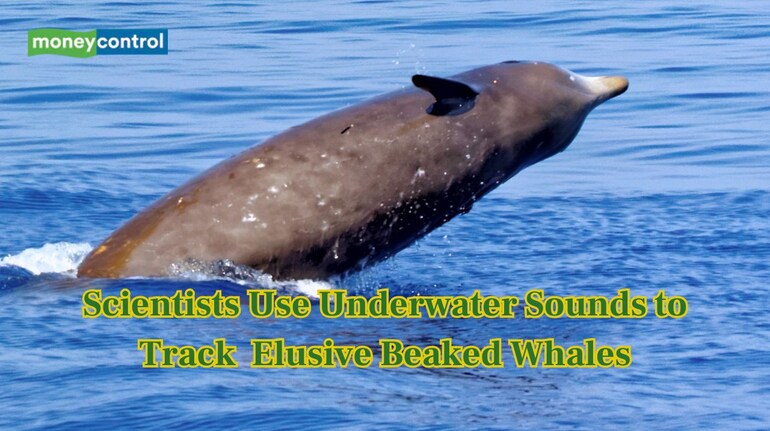

Beaked whales are among the rarest and most mysterious creatures in the ocean. They dive deeper and longer than almost any mammal. Often, scientists know them only from stranded bodies on shore.
Now, researchers are turning to sound to uncover their hidden lives. Underwater microphones, or hydrophones, are capturing unique whale clicks. These sounds reveal location, species and behaviour like never before.
Why Are Beaked Whales So Hard to Find?
These whales spend most of their lives underwater at extreme depths. They surface only briefly, making visual observation nearly impossible. Some species have never been seen alive in the wild.
Even satellite tracking is limited because they dive up to thousands of metres. The traditional fieldwork often yielded only dead specimens washed ashore. Scientists needed a new method to study them without disturbing habitats.
How Are Scientists Using Sound to Track Them?
Beaked whales communicate and navigate through echolocation clicks and squeaks. Each species produces distinct acoustic patterns underwater. Hydrophones can detect these sounds from tens to thousands of metres.
This allows researchers to identify species without seeing them. They can map populations, movements and feeding areas. Sound becomes a tool to explore invisible parts of the ocean.
What Surprising Discoveries Have Been Made?
In one study, a team tracked a rare echolocation pattern called BW43. They discovered a different, live species nearby which goes by the name of ginkgo-toothed beaked whale. This was a first-ever sighting for this species in the wild.
Sound monitoring has revealed previously unknown habitats and behaviours. Some species stay in deep offshore waters for months. Others communicate in ways that hint at social structures.
How Does This Help Conservation Efforts?
Beaked whales are highly vulnerable to human activity. Military sonar has caused mass strandings in multiple oceans. Fishing gear and shipping also pose threats to their survival. By knowing where these whales live and how they behave, scientists can recommend protective measures in key habitats. Sound monitoring becomes a non-invasive conservation tool.
The Role of Genetics in Confirming Species
Sound alone suggests species identity, but genetic sampling confirms it. Tiny biopsies match acoustic signatures to DNA. Once confirmed, scientists can rely mostly on hydrophones for ongoing studies.
This combination reduces disturbance and allows long-term observation. It also helps build a global database of whale sounds. Each recording contributes to understanding these elusive species better.
Why Scientists Are Excited About the Future?
Sound monitoring has opened a new frontier in marine biology. It allows discovery without physical encounters, even in the deepest oceans. Whale behaviours, population trends and migration patterns are finally visible. This method could reveal other unknown deep-sea species in the future. It also strengthens the case for ocean conservation policies worldwide.
Discover the latest Business News, Sensex, and Nifty updates. Obtain Personal Finance insights, tax queries, and expert opinions on Moneycontrol or download the Moneycontrol App to stay updated!
Find the best of Al News in one place, specially curated for you every weekend.
Stay on top of the latest tech trends and biggest startup news.





