






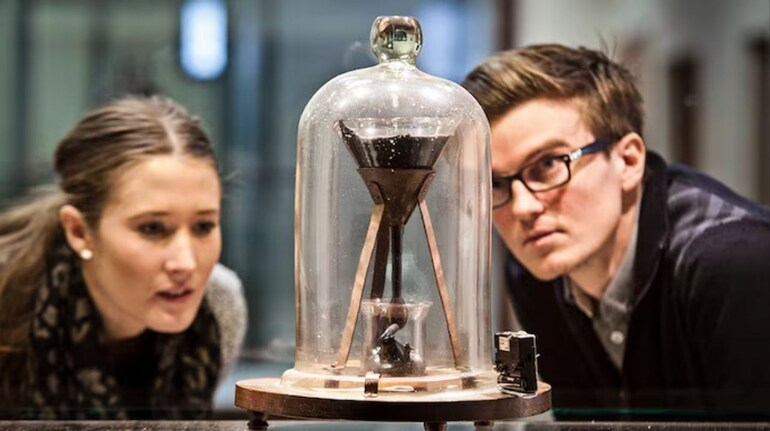

In a quiet laboratory at the University of Queensland, scientists continue observing a century-long experiment that challenges how humans understand solid and liquid matter. Known as the Pitch Drop Experiment, it remains active today, unfolding at a pace so slow that generations of researchers have passed without witnessing its key moment.
How the Pitch Drop Experiment Began and Why It Matters
The experiment began in 1927 when physicist Thomas Parnell aimed to prove that some materials appearing solid can actually flow. He poured pitch, a tar-like substance once used for waterproofing ships, into a sealed glass funnel. Pitch is considered the most viscous fluid known, around 100 billion times thicker than water. In 1930, Parnell cut the funnel’s stem, allowing gravity to slowly pull the pitch downward.
This simple setup launched what later became the world’s longest continuously running laboratory experiment. At room temperature, pitch appears hard and brittle and can shatter when struck. Yet, under constant gravity, it flows at an almost unimaginable pace, revealing hidden fluid behaviour.
Drops Measured in Decades Not Moments
Scientists waited eight years before the first pitch drop finally fell into a beaker below. Afterward, drops formed roughly once every eight years. The pace slowed further during the 1980s after air conditioning cooled the building. As of today, nearly 96 years after the experiment officially began, only nine drops have fallen.
The most recent drop appeared in April 2014. Researchers believe a tenth drop may fall during the 2020s, though no precise prediction exists. Remarkably, no human has ever directly seen a drop fall. Despite cameras and livestreams, every moment has been missed due to technical failures or timing misfortune.
Custodians Watching Time Itself
After Parnell’s death, physicist John Mainstone became the experiment’s custodian in 1961. He monitored it for 52 years without witnessing a drop. In 2000, a thunderstorm disrupted recording equipment, causing him to miss another moment. Mainstone died months before the 2014 drop formed.
Today, physicist Andrew White continues the watch, maintaining the experiment for future generations. Though visually uneventful, the Pitch Drop Experiment holds deep meaning. It demonstrates that nature does not hurry, and scientific truth sometimes unfolds over decades. In a fast-moving world, it stands as a quiet reminder that patience remains essential to discovery.
Discover the latest Business News, Sensex, and Nifty updates. Obtain Personal Finance insights, tax queries, and expert opinions on Moneycontrol or download the Moneycontrol App to stay updated!
Find the best of Al News in one place, specially curated for you every weekend.
Stay on top of the latest tech trends and biggest startup news.





