






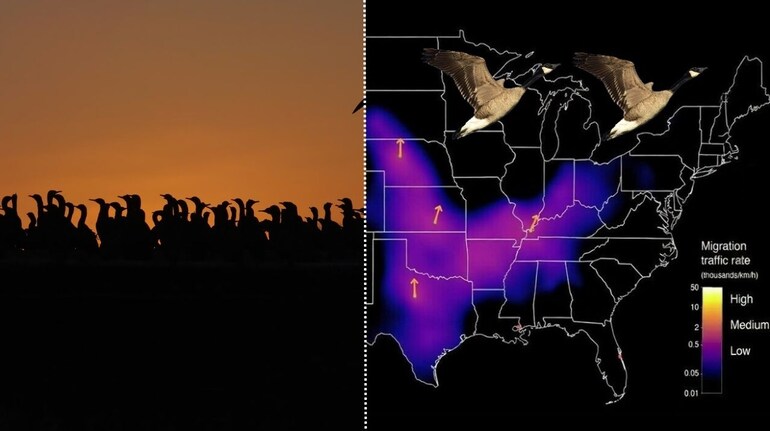

Spring has announced itself in the skies above America. More than 75 million birds were detected flying north in the last week of February. Weather radar systems picked up vast moving clouds after sunset. But these were not storms, these were wings.
Across the United States, migration season has officially begun. Scientists estimate 3 to 4 billion birds migrate north every spring. Most of this movement unfolds between March and May.
What did the Graph Shows?
The data came from weather radar systems across the United States. Instead of storms, scientists saw vast biological echoes moving after sunset. The graph showed dense pulses of migration concentrated at night. More than 75 million birds were detected flying north within one week. A strong migration week often reflects ideal wind conditions.
Does The Number Keep Increasing Every Year?
75 million sounds enormous, and it truly is. However, it represents a weekly snapshot, not the seasonal total. Each spring, an estimated 3 to 4 billion birds migrate northwards across America. Scientists caution that total migration volume does not necessarily mean growth. In fact, North America has lost billions of birds over decades.
Which Radar detected These Birds?
The radar detections come from the U.S. NEXRAD (Next-Generation Weather Radar) network. This is NOAA's nationwide system of ~160 Doppler weather radars. Cornell Lab's BirdCast project processes that data to track and quantify nocturnal bird migration. What radar reveals is intensity of movement, not population recovery. This number does not always signal more birds than previous years.
BIRDS HEADING NORTH! 🦅 Get ready bird watchers, over 75 million have been detected by radar heading north over the past week! Roughly 3 - 4 billion birds migrate in the US each Spring as they travel hundreds or even thousands of miles, especially from March to May. Nearly 70%… pic.twitter.com/ekNFFUvei8— Matt Devitt (@MattDevittWX) February 28, 2026
Which Bird Species Are Seen Most During This Migration?
Spring migration features a remarkable diversity of species. Warblers are the most visible and numerous groups. These tiny insect eating songbirds travel thousands of kilometres. Thrushes, Orioles, Tanagers and Flycatchers also surge northward.
Waterfowl such as ducks and geese migrate in impressive formations. Hawks and Eagles ride thermal currents by day. Many of these species winter in Central or South America. For birdwatchers, April and May are peak observation months.
How Do Scientists Interpret This Wildlife Behaviour?
Researchers view migration as a finely tuned evolutionary strategy. Birds move to exploit seasonal food abundance and breeding opportunities. Longer daylight in northern regions supports chick development.
Radar technology has transformed how scientists study this behaviour. It allows near real time monitoring of millions simultaneously. Patterns can be linked with wind speed, temperature and moon phase. Scientists are also examining climate impacts on migration timing.
Discover the latest Business News, Sensex, and Nifty updates. Obtain Personal Finance insights, tax queries, and expert opinions on Moneycontrol or download the Moneycontrol App to stay updated!
Find the best of Al News in one place, specially curated for you every weekend.
Stay on top of the latest tech trends and biggest startup news.





