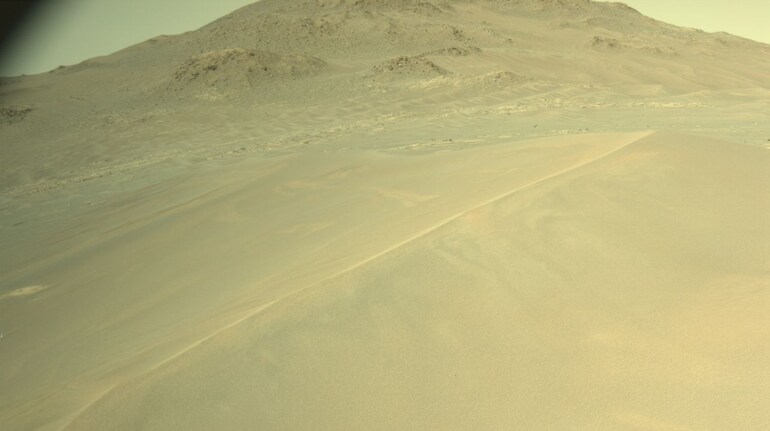
NASA’s Perseverance rover has uncovered a startling Martian surface mystery. The discovery occurred inside Jezero Crater, a once watery ancient basin. Scientists call the structure a giant sand formation, named Hazyview megaripple. It challenges long-held beliefs about Mars being geologically inactive today.
What Exactly Did NASA Discover on Mars?
The rover photographed towering ripples sculpted by powerful ancient winds. These megaripples dwarf normal sand waves seen across Mars. They appear frozen yet describe the activities of violent atmospheric forces. Such formations were thought impossible under modern Martian conditions.
What Are Megaripples and Why Do They Matter?
Megaripples are large, wind-formed sand ridges on Mars. They can reach up to 2 metres (about 6.5 feet) tall. Unlike smaller ripples, megaripples often resist movement today. Salt crusts lock grains, preserving clues about past winds. Studying them reveals Mars’s recent climate and surface activity. These formations guide rover navigation and future human missions.
How Perseverance Investigated the Martian Megaripple Closely?
NASA used over 50 detailed observations at the Hazyview site. Multiple instruments examined texture, chemistry, frost and grain movement. Perseverance used Mastcam-Z and SuperCam to image and analyse Martian sands remotely.
MEDA, PIXL and WATSON measured weather, chemistry, and grain textures in detail. Data revealed salty crusts binding sand, locking ripples in place. These crusts preserve environmental conditions from Mars’s changing past
Why has this Discovery Shocked Scientists?
Mars possesses an atmosphere far thinner than Earth’s today. Moving heavy sand grains should be nearly impossible there. Yet Hazyview shows winds once strong enough to reshape landscapes. This happening let scientists to rethink models of Martian climate behaviour.
What this reveals About Mars’s Climate History?
Megaripples act like climate archives written into the Martian ground. They record shifts in wind strength, moisture and atmospheric density. The scientists believe Mars once endured colder conditions accompanied by stronger winds. Those conditions may have supported environments suitable for ancient life.
The Bigger Question yet to be Solved
Is Mars still subtly changing beneath its silent red surface? Researchers suspect frost, dust and winds still reshape terrain slowly. This discovery challenges assumptions that Mars became dormant long ago. NASA is preparing twin ESCAPADE probes to launch toward Mars in late 2026 to map the planet’s lost atmosphere in 3D.
Discover the latest Business News, Sensex, and Nifty updates. Obtain Personal Finance insights, tax queries, and expert opinions on Moneycontrol or download the Moneycontrol App to stay updated!
Find the best of Al News in one place, specially curated for you every weekend.
Stay on top of the latest tech trends and biggest startup news.