Astronomers using NASA’s James Webb Space Telescope have found the strongest evidence yet of an atmosphere surrounding a rocky planet beyond our solar system. The findings focus on TOI-561 b, an ultra-hot super-Earth orbiting extremely close to its star, researchers reported in The Astrophysical Journal Letters.
What Is Happening on TOI-561 b
TOI-561 b belongs to a rare group of ultra-short period exoplanets. It completes an orbit in less than 11 hours. The planet measures about 1.4 times Earth’s radius. It orbits less than 1 million miles from its star.
Because of this proximity, the planet is tidally locked. One side permanently faces the star. Temperatures there exceed the melting point of rock. Scientists believe the surface hosts a global magma ocean.
Despite this extreme environment, TOI-561 b has an unusually low density. That feature puzzled astronomers for years. “It’s less dense than expected for an Earth-like composition,” said Johanna Teske of Carnegie Science, the study’s lead author.
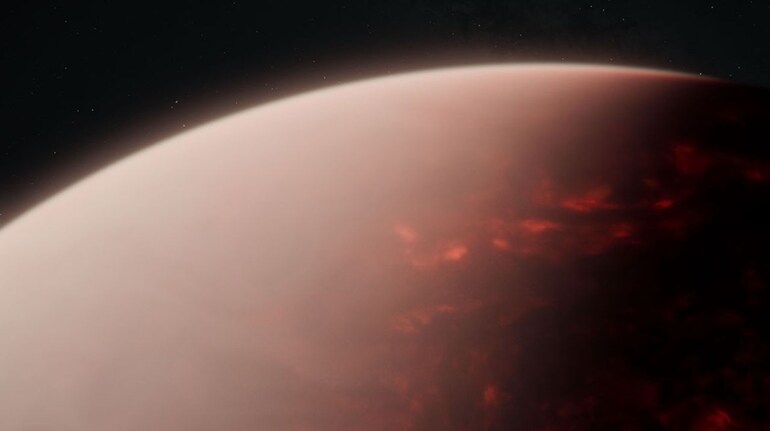
 This artist’s concept shows what the hot super-Earth exoplanet TOI-561 b and its star could look like based on observations from NASA’s James Webb Space Telescope and other observatories. Webb data suggests that the planet is surrounded by a thick atmosphere above a magma ocean. (Image: NASA, ESA, CSA, Ralf Crawford (STScI))
What the Webb Data Reveal
Researchers tested whether an atmosphere could explain the planet’s properties. Using Webb’s Near-Infrared Spectrograph, they measured the planet’s dayside temperature. The method tracks brightness changes as the planet passes behind its star.
If the planet lacked an atmosphere, temperatures should reach about 4,900 degrees Fahrenheit. Instead, Webb measured roughly 3,200 degrees Fahrenheit. The cooler reading suggests heat redistribution across the planet.
Scientists say only a thick atmosphere can explain this effect. “We really need a volatile-rich atmosphere,” said co-author Anjali Piette from the University of Birmingham. Strong winds could move heat to the nightside. Gases may also absorb infrared radiation.
 An emission spectrum recorded by NASA’s James Webb Space Telescope in May 2024 displays the intensity of near-infrared wavelengths emitted by exoplanet TOI-561 b. Comparisons with models indicate the planet is enveloped by a volatile-rich atmosphere. Illustration. (Image: NASA, ESA, CSA, Ralf Crawford (STScI); Science: Johanna Teske (Carnegie Science Earth and Planets Laboratory), Anjali Piette (University of Birmingham), Tim Lichtenberg (Groningen), Nicole Wallack (Carnegie Science Earth and Planets Laboratory))
What This Means for Planetary Science
The discovery challenges long-held assumptions about small planets near stars. Such worlds were thought unable to retain atmospheres after billions of radiation exposure. TOI-561 b suggests otherwise.
The planet may have formed in a different chemical environment. It orbits an iron-poor star twice the Sun’s age. That star lies within the Milky Way’s thick disk. Scientists say the planet could reflect early universe conditions.
Researchers propose an equilibrium between magma and atmosphere. Gases escape into the atmosphere, then dissolve back into molten rock. “It’s really like a wet lava ball,” said co-author Tim Lichtenberg.
The observations came from Webb’s General Observers Program 3860. The telescope monitored the system for over 37 hours. Scientists are now analysing full data to map global temperatures and identify atmospheric composition.
“What’s exciting is how many new questions this raises,” Teske said.
Discover the latest Business News, Sensex, and Nifty updates. Obtain Personal Finance insights, tax queries, and expert opinions on Moneycontrol or download the Moneycontrol App to stay updated!
Find the best of Al News in one place, specially curated for you every weekend.
Stay on top of the latest tech trends and biggest startup news.