






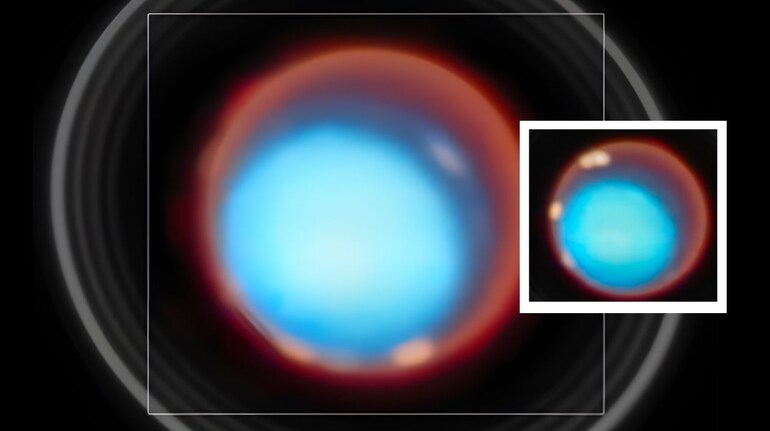

Far beyond Neptune, a distant giant is lighting up in ways scientists never expected. Uranus, the tilted ice giant of our solar system, is showing giant auroras rolling through its atmosphere. This discovery comes courtesy of NASA's James Webb Space Telescope (JWST).
For decades, astronomers have theorised about auroras on Uranus. Now, infrared observations have finally captured these glowing phenomena in stunning detail. The auroras are vast, powerful and mysterious, revealing the planet’s hidden magnetic mystery.
What Was Found on Uranus?
The James Webb Space Telescope has detected giant auroras rolling across Uranus’ atmosphere. These are enormous glowing lights, similar to Earth’s northern and southern lights. But they are far larger and more intense. They appear as bright bands and patches, that spreads across multiple latitudes.
How Did James Webb detect the Auroras?
The telescope used infrared light to peer through Uranus’ cold atmosphere. Infrared is ideal for observing auroras because it reveals heat and energy invisible to human eyes.
Researchers captured the auroras over several observation sessions. Each time, the lights appeared dynamic, moving and shifting across the planet’s upper atmosphere.
What did scientists observe in this case?
Scientists found that Uranus’ auroras reveal the hidden magnetic and atmospheric dynamics of the planet. They marked areas where charged particles interact with the tilted, offset magnetic field.
This field releases energy in the form of glowing light. Scientists also confirm that auroras are not confined to Earth or the gas giants. They can occur wherever a magnetic field meets energetic particles.
Are These Aurora Lights Rare on This Planet?
Yes, the auroras on Uranus are extremely rare and unpredictable. Unlike Earth, Uranus has a magnetic field tilted 60 degrees from its rotation axis and offset from its centre.
This unusual geometry means charged particles from the Sun strike the planet irregularly, producing auroras only under special conditions. New observations show that when these auroras occur, they are much brighter and expansive than scientists expected.
Discover the latest Business News, Sensex, and Nifty updates. Obtain Personal Finance insights, tax queries, and expert opinions on Moneycontrol or download the Moneycontrol App to stay updated!
Find the best of Al News in one place, specially curated for you every weekend.
Stay on top of the latest tech trends and biggest startup news.





