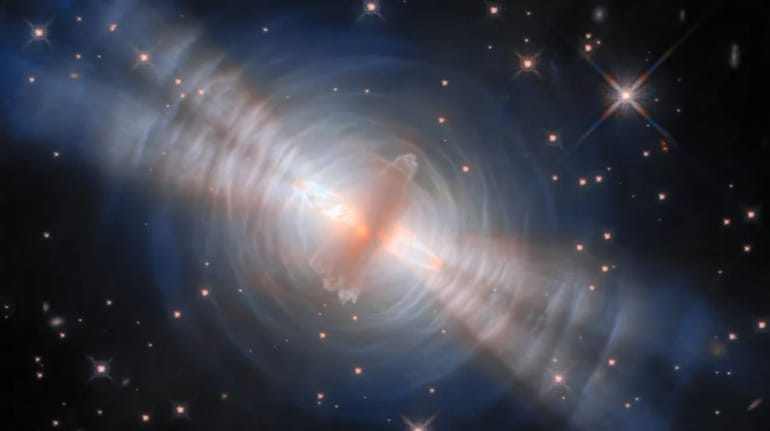

A strange, glowing cloud that looks as though it is cracking open in space has once again captured attention of astronomers. The object, known as the Egg Nebula, is the closest known “baby” nebula to Earth.
This is a fresh composite image from the Hubble Space Telescope has revealed its intricate structure in unprecedented detail. Far from being a quiet cloud, this cosmic formation is a star in the act of transformation.
What is the Image Captured?
The image reveals a star in transition, caught in the act of shedding its outer layers. The Egg Nebula is classified as a pre-planetary nebula. This is a brief stage that occurs when a Sun-like star runs out of nuclear fuel.
It begins expelling vast shells of gas and dust. The gas here has not yet been completely energised by ultraviolet radiation from the exposed stellar core.
Who Captured This Nebula?
The image was captured by the legendary Hubble Space Telescope, a joint mission of NASA and the European Space Agency. Hubble’s long-term observations, spanning decades, allowed scientists to combine multiple datasets into a detailed composite image.
What Makes This Nebula So Special?
The Egg Nebula lies around 3,000 light-years away in the constellation Cygnus, making it the closest known example of a pre-planetary nebula. This proximity allows astronomers to study its structure in exceptional detail.
Pre-planetary nebulae are rare because this stage lasts only a few thousand years, a blink on cosmic timescales.
The Striking Appearance of the Egg Nebula
What makes the image truly captivating is its structure. Concentric arcs ripple outward from the hidden central star. This suggests repeated pulses of mass loss rather than a single explosive event. The twin beams of light bursting from opposite sides of the nebula are easily seen.
These luminous lobes create a symmetrical, almost wing-like form. Thick dust obscures the star itself, but light escapes through polar openings, illuminating the surrounding material.
Why Scientists Are Watching Closely?
Understanding the Egg Nebula is not simply about appreciating a beautiful space photograph. It is about decoding how stars enrich the cosmos. As dying stars shed their outer layers, they release heavy elements.
These elements have carbon, oxygen and other building blocks essential for life into interstellar space. These materials eventually become part of new stars, planets and perhaps even living organisms.
Discover the latest Business News, Sensex, and Nifty updates. Obtain Personal Finance insights, tax queries, and expert opinions on Moneycontrol or download the Moneycontrol App to stay updated!
Find the best of Al News in one place, specially curated for you every weekend.
Stay on top of the latest tech trends and biggest startup news.