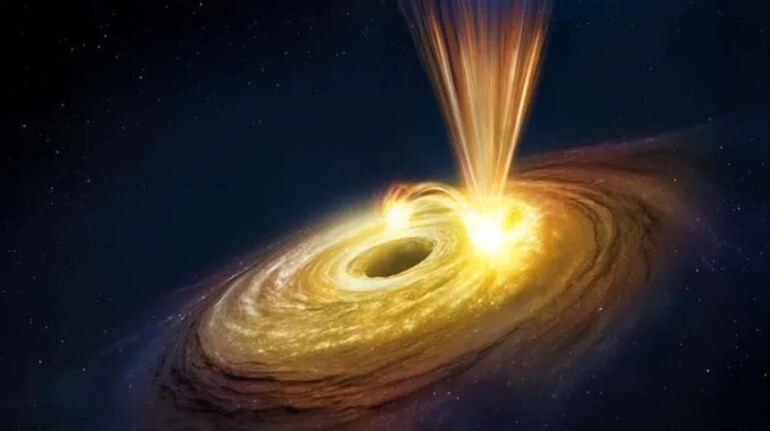
Astronomers reported on 16 December 2025 that a distant supermassive black hole unleashed ultra-fast winds following a powerful X-ray flare, offering rare insight into extreme galactic activity.
The black hole lies within the spiral galaxy NGC 3783. It sits about 135 million light-years from Earth. Scientists detected an unusually intense X-ray flare there. As the flare faded, violent winds swept outward. These winds reached speeds exceeding 37,000 miles per second.
What astronomers observed near the black holeThe black hole anchors NGC 3783’s active galactic nucleus. Active nuclei often flare and eject energetic material. This event stood out for its extreme speed. Lead researcher Liyi Gu described the phenomenon as unprecedented. Gu works at the Space Research Organisation Netherlands.
Researchers believe magnetic forces powered the eruption. Tangled magnetic fields around the black hole suddenly released energy. This release drove the observed X-ray burst. The same process then launched the high-speed winds.
How magnetic fields drive extreme cosmic windsScientists compared the event to solar eruptions. On Earth’s sun, tangled fields cause coronal mass ejections. Those eruptions release plasma into surrounding space. However, this black hole is vastly more massive. It weighs roughly 30 million times our sun.
ESA astronomer Matteo Guainazzi explained the scale difference. He said black hole eruptions dwarf solar equivalents. Typical solar ejections travel far slower. Recent solar storms reached about 930 miles per second. The black hole winds moved at one-fifth light speed.
What it means for galaxy evolution studiesThe discovery relied on two ESA space telescopes. XMM-Newton first detected the flare’s optical signal. XRISM later measured the resulting wind properties. Its Resolve instrument captured precise wind details. Researchers said combining missions proved especially effective.
Scientists plan to study other flaring active galaxies similarly. Understanding such eruptions may clarify galaxy evolution processes. Fast winds can influence star formation and gas distribution. Researchers believe more discoveries could follow soon.
Discover the latest Business News, Sensex, and Nifty updates. Obtain Personal Finance insights, tax queries, and expert opinions on Moneycontrol or download the Moneycontrol App to stay updated!
Find the best of Al News in one place, specially curated for you every weekend.
Stay on top of the latest tech trends and biggest startup news.