






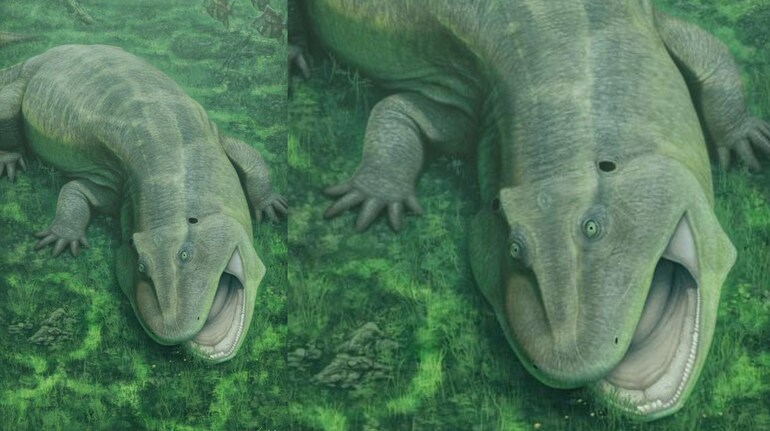

A bizarre prehistoric creature with a twisted jaw and sideways-pointing teeth lived in ancient waters around 275 million years ago. Scientists said it was already considered a “living fossil” even in its own time.
Researchers recently identified the strange animal from fossil remains discovered in northeastern Brazil. This revealed a species unlike most early vertebrates known to science. The creature, named Tanyka amnicola, lived during the Permian period, tens of millions of years before dinosaurs appeared on Earth.
A Twisted Jaw With Sideways Teeth
What is unusual is its distorted lower jaw, where the teeth are positioned sideways instead of pointing upward like in most vertebrates. The inner surface of the jaw was covered with tiny tooth-like structures called denticles. This creates a rough grinding surface.
Instead of biting prey with sharp teeth, the creature likely used this grinding mechanism to crush or scrape food. This type of feeding strategy is extremely rare among early tetrapods.
Who is behind this study?
"Tanyka is from an ancient lineage that we didn't know survived to this time, and it's also just a really strange animal," said Jason Pardo. He is the lead study author. He is also a research associate at the Field Museum in Chicago.
The fossil jaws offer a rare glimpse into a strange and little-known group of early amphibian-like animals that lived in prehistoric freshwater ecosystems.
A Water-Dwelling Animal From Ancient Gondwana
The fossils were discovered in rock layers that were once part of ancient lakes and rivers. At the time, the region was part of the supercontinent Gondwana, which included present-day South America, Africa, Antarctica, Australia and India.
Researchers recovered nine fossilised lower jawbones, each measuring about 15 centimetres (6 inches) in length.
What Did This Creature Likely Eat?
Scientists believe the animal may have fed on small aquatic invertebrates, algae, or plant material. Its sideways teeth and denticle-covered jaw likely worked like a natural grinding plate, allowing it to scrape or crush food rather than bite it.
A “Living Fossil” From Deep Time
Researchers describe the species as a “living fossil” because it belonged to a very ancient evolutionary lineage. This lineage had already existed for millions of years before it lived.
Even during the Permian period, this group was considered rare and primitive compared with newer vertebrates evolving at the time.
Life on Earth 275 Million Years Ago
Around 275 million years ago during the Permian period, Earth looked very different from today. Most of the planet’s land was joined together in the supercontinent Pangaea, while reptiles, amphibians and early relatives of mammals dominated the landscape.
Dinosaurs had not yet evolved, and many strange aquatic creatures including species like Tanyka amnicola thrived in rivers and lakes.
Discover the latest Business News, Sensex, and Nifty updates. Obtain Personal Finance insights, tax queries, and expert opinions on Moneycontrol or download the Moneycontrol App to stay updated!
Find the best of Al News in one place, specially curated for you every weekend.
Stay on top of the latest tech trends and biggest startup news.





