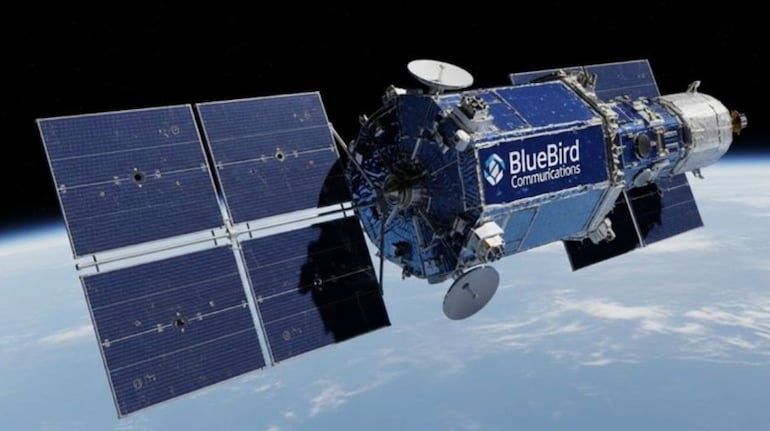
ISRO will launch a large American satellite on 15 Dec. The mission will lift BlueBird-6 from the Sriharikota spaceport. The satellite is among the heaviest commercial payloads carried yet. The launch highlights rising space cooperation between India and the US.
What ISRO Plans With the BlueBird-6 Satellite Launch?
The mission will use ISRO's heavy LVM3 launch vehicle. The rocket will place BlueBird-6 into low-earth orbit. The satellite weighs nearly 6.5 tonnes at liftoff. It is owned by AST SpaceMobile based in Texas. The company builds space-based cellular broadband systems globally. The firm said BlueBird-6 is a US licensed satellite. The launch date was confirmed as 15 Dec by them. It is the first satellite in their next-generation series.
The spacecraft carries a large phased array nearly 2,400 sqft. This size is 3.5 times larger than earlier satellites. It also supports ten times more data capacity now. BlueBird-6 belongs to the Block-2 advanced satellite line. The series aims to offer non-continuous service solutions worldwide. AST plans further launches through 2026 across multiple missions.
What the Mission Means for Global Broadband Coverage?
The network aims to reduce the global digital divide today. It intends to deliver direct-to-device mobile broadband service. The system targets areas lacking strong terrestrial connectivity systems. Each BlueBird unit can provide nearly 10,000 MHz bandwidth. The satellites work with existing licensed mobile network carriers. They help strengthen partner networks in weak coverage zones.
How the Satellite Reached India for Launch Preparation?
BlueBird-6 arrived in India from the US on 19 Oct. The spacecraft then travelled by road to Sriharikota safely. Engineers prepared it for integration with the LVM3 rocket. The process includes fuelling and several detailed pre-launch checks.
What Comes Next for Isro and LVM3 Operations?
The liftoff is managed by NewSpace India Limited today. NSIL handles ISRO’s commercial launch responsibilities globally. The LVM3 earlier launched India’s CMS-3 satellite on 2 Nov. That payload weighed 4.4 tonnes at successful liftoff. LVM3 can lift up to 8,000 kg to LEO. It also carries 4,000 kg to geosynchronous transfer orbit. A human-rated version will fly Indian astronauts soon. This mission forms part of India’s Gaganyaan programme. The crewed launch is planned for 2027 currently.
Discover the latest Business News, Sensex, and Nifty updates. Obtain Personal Finance insights, tax queries, and expert opinions on Moneycontrol or download the Moneycontrol App to stay updated!
Find the best of Al News in one place, specially curated for you every weekend.
Stay on top of the latest tech trends and biggest startup news.