
One of the ocean’s most saline patches is losing its salt. Scientists have found that waters off the west coast of Australia. The long known as one of the saltiest stretches of the sea is becoming significantly less salty, or what scientists call it, “fresher” over time.
A study on what this change means for marine life is going on. The global ocean currents and climate patterns shows something far beyond the Indian Ocean.
What was Found in Southern Indian Ocean?
Historically, the Southern Indian Ocean region has recorded some of the highest salt concentrations on Earth. But long-term data over the past six decades reveal a surprising trend. The salinity levels in this area have dropped by about 30 per cent.
This is considered as major change in a region that was once known for its “briny” waters. Researchers describe the volume of fresh water entering the region as equivalent to adding roughly 60 per cent of Lake Tahoe’s water every year.
Who Is Behind This Ocean Study?
This discovery was led by an international team of ocean scientists. The key came contributions from researchers at the University of Colorado Boulder.
Two researchers, Gengxin Chen (visiting scholar) and Weigqing Han (professor) from Department of Atmospheric and Oceanic Sciences is behind this research.
 Weiqing Han, professor in the Department of Atmospheric and Oceanic Sciences. (Image: University of Colorado)
The study was conducted by experts in climate science and oceanography. They are from CU Boulder’s Cooperative Institute for Research in Environmental Sciences.
What is Causing the Freshening?
The change is not simply due to more rainfall. Instead, it reflects a shift in wind patterns and ocean circulation linked to global warming. As the climate warms, winds over the tropics and subtropics are shifting. This alters how water moves across ocean basins.
In this case, more fresh water from the Indo-Pacific freshwater pool is being pushed south into the Indian Ocean. The result is a net transfer of fresh water from one ocean region to another. This leads a significant drop in salinity where the water to remain stable and salty once.
How Scientists Measured This Change?
For decades scientists tracked oceans using ships buoys sensors satellites. They measured temperature salinity currents across vast remote marine regions. Records from Southern Indian Ocean showed changes over 60 years. Computer models confirmed freshening revealing oceans changing faster than expected.
This Change can Affect India as Well as Other Countries
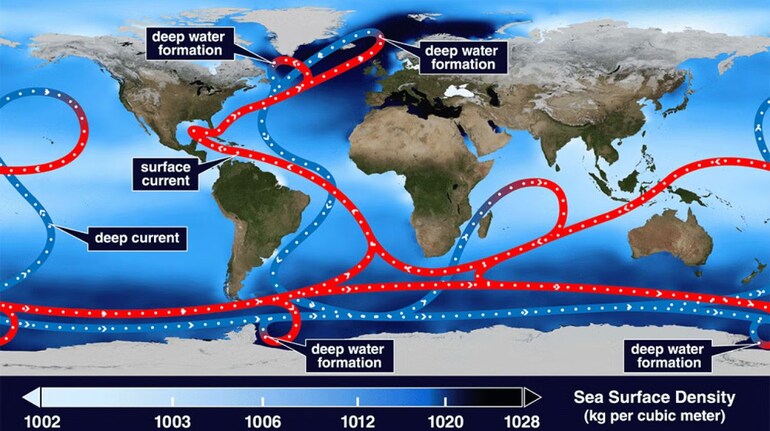
Ocean salinity is not just a scientific detail. It plays a major role in regulating Earth’s climate. Saltier water is heavier and sinks more easily. This movement helps drive global ocean currents. When water becomes fresher, it stays closer to the surface.
For India, this shift could matter. Changes in the Indian Ocean influence monsoon patterns, rainfall, marine fisheries and costal weather. Globally, altered currents may influence temperatures in Europe, Asia and Africa. What happens in one part of the ocean does not stay there. It spreads across the planet.
What Scientists Are Watching Next?
Scientists are now increasing their monitoring efforts. More ocean sensors are being deployed. New satellites are being launched and more research vessels are being sent into remote waters. Researchers are also studying how these changes interact with rising temperatures and ocean acidification. Long-term models are being updated to predict future scenarios.
Discover the latest Business News, Sensex, and Nifty updates. Obtain Personal Finance insights, tax queries, and expert opinions on Moneycontrol or download the Moneycontrol App to stay updated!
Find the best of Al News in one place, specially curated for you every weekend.
Stay on top of the latest tech trends and biggest startup news.