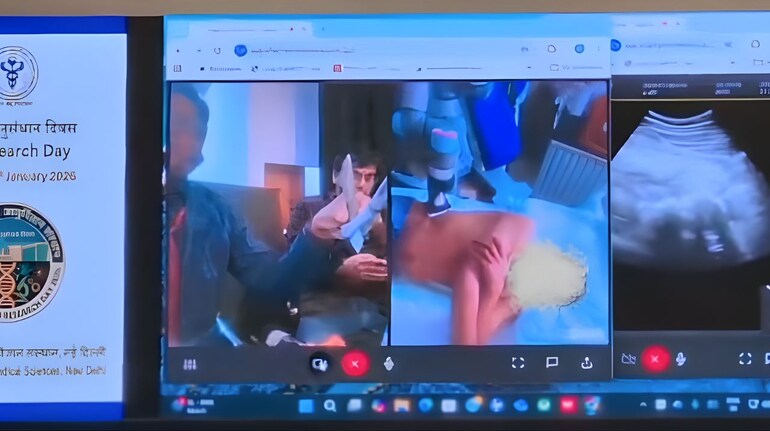

India has achieved a medical milestone in one of the harshest places on Earth. Doctors at All India Institute of Medical Sciences (AIIMS), New Delhi, have conducted the country’s first remote ultrasound in Antarctica. The patient was located at India’s Maitri Research Station. The distance between doctor and patient was more than 12,000 kilometres.
The breakthrough remote ultrasound was demonstrated in February 2026. This happened during AIIMS Research Day. This breakthrough was led by Dr. Chandrashekhara S.H.
During this event, doctors at AIIMS conducted the first live tele-ultrasound on volunteers located at India’s Maitri research station in Antarctica. Union Minister Dr Jitendra Singh witnessed a live demonstration of the technology in New Delhi.
Technical leadership in the project included scientists from different parts of science institutions who are working on AI and robotic systems. They are: -
Dr Subir Kumar Saha from IIT Delhi played a central role in developing and refining the tele-robotic system.
Researchers Udayan Banerjee and Siddharth Gupta, worked on installation, setup and system optimisation.
Clinicians like Dr Vikas Dogra from RGSSH helped envision the application at Indian Antarctic stations.
The procedure used an AI-powered tele-robotic ultrasound system. A specialist sitting in Delhi controlled a robotic arm holding an ultrasound probe in Antarctica. Movements were transmitted in real time and the pressure feedback was also relayed instantly. It was almost as if the doctor was physically present.
The technology was developed in collaboration with Indian Institute of Technology Delhi and the National Centre for Polar and Ocean Research. Artificial intelligence (AI) helped ensure precision and stability during scanning.
Medicine has just crossed one of Earth’s harshest frontiers. After AIIMS conducted its first-ever remote ultrasound in Antarctica, scientists believe that advanced diagnostics can travel anywhere. This experiment was not done in any hospital but in the continent.
Ultrasound machines usually require trained radiologists. But in Antarctica, specialists are not readily available. So, doctors in India guided personnel stationed in Antarctica in real time. They used telecommunication tools and portable imaging technology. This means diagnosis was possible without a radiologist physically present.
If ultrasound works in Antarctica, it could it work in space? Scientists believe the answer is yes. The space missions face similar challenges such as isolation, no emergency evacuation and limited medical staff. Astronauts already use guided ultrasound aboard spacecraft.
But this Antarctic test strengthens that possibility further. Antarctica is often called a “space analogue.” Conditions there simulate deep-space missions. If remote imaging works there, It could support future Moon and Mars missions. This breakthrough may quietly prepare humans for interplanetary travel.
Scientists see this as a turning point for telemedicine. They believe it proves three important things:
1. Complex imaging can be decentralised.
2. Remote experts can guide non-specialists effectively.
3. Technology can bridge geographical barriers.
Officials say the success of this demonstration highlights the feasibility of advanced healthcare delivery in remote or inaccessible locations. Beyond Antarctica, the technology could benefit people in high-altitude regions, disaster zones, rural areas and offshore platforms.
Discover the latest Business News, Sensex, and Nifty updates. Obtain Personal Finance insights, tax queries, and expert opinions on Moneycontrol or download the Moneycontrol App to stay updated!
Find the best of Al News in one place, specially curated for you every weekend.
Stay on top of the latest tech trends and biggest startup news.