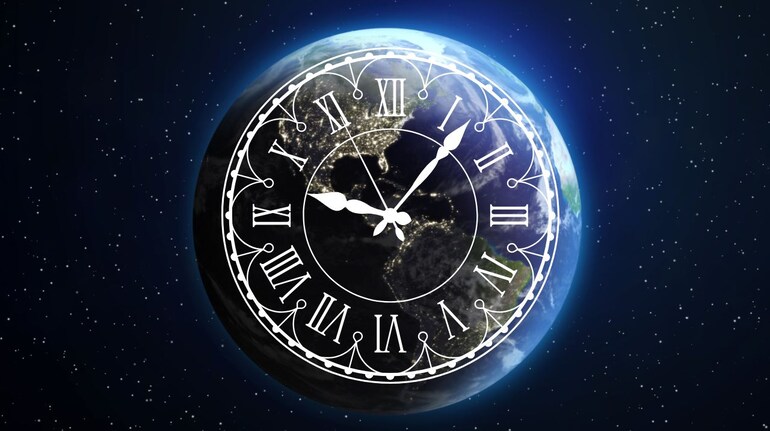
Scientists say Earth’s familiar 24-hour day is slowly changing. The shift is real, measurable, and already underway. Researchers stress the change is extremely gradual. Viral online claims have exaggerated the timeline recently. The science shows no immediate disruption to daily life. Instead, the planet’s rotation is imperceptibly slowing over time.
Earth’s rotation is slowing down
Scientists confirm Earth’s spin is gradually decreasing speed. This slowing means days are becoming longer over time. The process happens far too slowly for humans. Current clocks and calendars remain completely unaffected. Researchers say the trend spans hundreds of millions. A 25-hour day remains very distant in time.
Studies show Earth’s rotation lengthens about 1.7 milliseconds. This change occurs roughly every hundred years. The primary driver is tidal friction caused by Moon. The Moon’s gravity pulls Earth’s oceans constantly. This friction slows Earth while pushing Moon outward. Over time, these forces accumulate measurable effects.
Earth’s rotation does not slow at steady pace. Short-term changes can speed or slow spin slightly. Atmospheric pressure shifts affect how mass distributes globally. Melting glaciers move weight between land and oceans. These redistributions subtly influence rotational speed temporarily. Scientists track these changes using atomic clocks.
Why the Moon and Earth’s interior matter
The Moon plays the largest long-term role. Its gravitational pull creates ocean tides worldwide. These tides drag against Earth’s rotation continuously. Energy loss from friction slows planetary spin gradually. Meanwhile, the Moon drifts farther away annually.
Earth’s interior also affects rotation speed subtly. Molten iron moves within the outer core. Shifts inside redistribute Earth’s internal mass. Mantle changes also alter mass balance slightly. These internal movements influence rotational stability over time.
Climate systems contribute as well, scientists note. Large wind patterns exchange angular momentum globally. Seasonal changes can speed or slow rotation briefly. These effects remain minor compared with lunar tides. Combined forces shape Earth’s long-term rotational future.
What longer days could mean eventually
Scientists estimate a 25-hour day is distant. It could take roughly 200 million years. During dinosaur times, days lasted about 23 hours. Life on Earth adapted gradually to those changes. Evolution adjusted biological rhythms slowly across generations.
If days lengthened suddenly, impacts would be significant. Human circadian rhythms follow a 24-hour cycle. Sleep, hormones, and metabolism depend on this rhythm. Disruptions already cause health problems today. Jet lag and shift work show such effects clearly.
Researchers say long-term changes allow adaptation. Living organisms would likely evolve alongside longer days. The transition would be slow, not catastrophic. Scientists emphasise there is no urgency. Earth’s lengthening days remain a deep-time phenomenon.
For now, Earth keeps spinning much as before. The planet’s slowing rotation remains scientifically fascinating. Experts urge caution against misleading viral claims. The science points to change measured in millennia. Humanity will not notice any difference soon.
Discover the latest Business News, Sensex, and Nifty updates. Obtain Personal Finance insights, tax queries, and expert opinions on Moneycontrol or download the Moneycontrol App to stay updated!
Find the best of Al News in one place, specially curated for you every weekend.
Stay on top of the latest tech trends and biggest startup news.