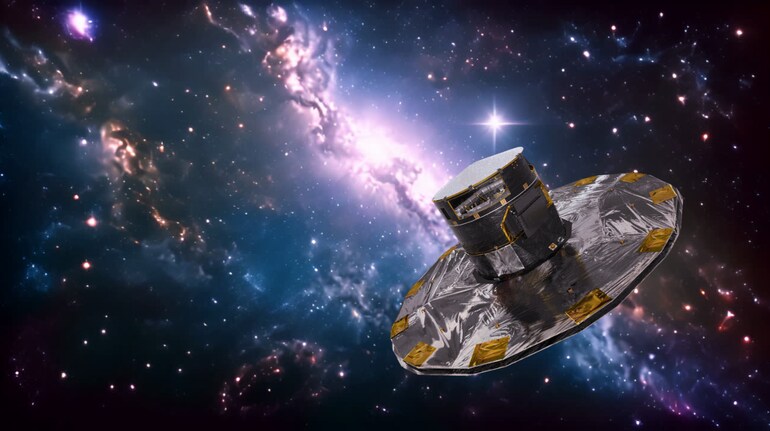
The European Space Agency’s Gaia spacecraft has officially ended its mission to map the Milky Way after 12 years of data collection. The spacecraft shut down its science operations on January 15, 2025, due to running low on propellant.
A Mission That Shaped Our Understanding of the CosmosLaunched in December 2013, Gaia spent years collecting vital data on almost 2 billion stars. The spacecraft’s mission was to create the largest 3D map of the Milky Way, providing insight into star motions, luminosities, and compositions.
 The best Milky Way map, by Gaia (Image: ESA)
The spacecraft’s final release of data is not far off. Gaia Data Release 4 (GR4) is expected by mid-2026. Scientists anticipate that GR4 will surpass previous releases in terms of data quality and volume. After all data is downloaded, scientists will begin processing for Gaia Data Release 5 (GR5), which will be released in the late 2020s.
Read Also: 'Hidden highways in space': Astronomers discover 'cosmic tunnels' linking galaxies and Solar SystemGaia’s Legacy ContinuesDespite ceasing its data-gathering phase, Gaia’s legacy is far from over. Researchers will continue to use Gaia's data for years to come. Topics such as binary stars and black holes will be explored using the data collected over a decade.
Read Also: Universe's earliest black holes found? NASA's James Webb spots three 12.8-billion-year-old 'mysterious red dots'In the meantime, Gaia will serve as a test subject to refine spacecraft control. It will remain in a stable orbit known as Lagrange point 2 (L2), where it will stay for several weeks before being moved to its final orbit. The spacecraft will then be placed in a position that will prevent interference with other missions.
Discover the latest Business News, Sensex, and Nifty updates. Obtain Personal Finance insights, tax queries, and expert opinions on Moneycontrol or download the Moneycontrol App to stay updated!
Find the best of Al News in one place, specially curated for you every weekend.
Stay on top of the latest tech trends and biggest startup news.