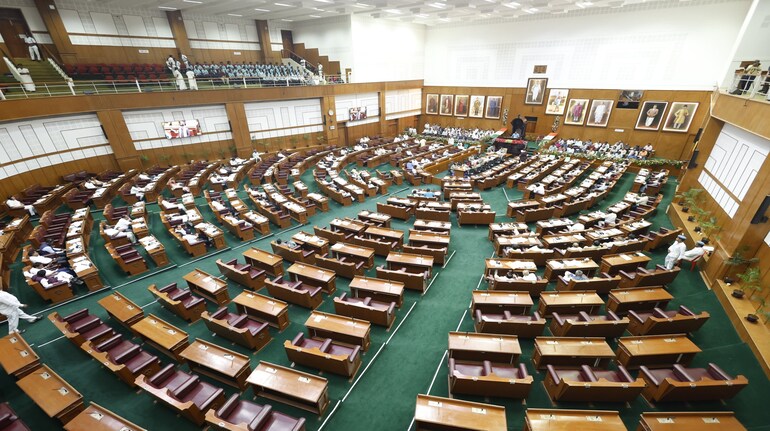
Congress-led Karnataka government on December 10 tabled the Karnataka Hate Speech and Hate Crimes (Prevention) Bill in the assembly amid opposition protests.
As reported by Moneycontrol on December 4, the bill enables the state to take preventive action against hate speech and impose prison terms of up to 10 years for repeat offenders. The legislation aims to curb the dissemination of hate speech, penalise offenders, and provide compensation to victims, covering acts in both physical and electronic domains. The bill also empowers designated officials to order the removal or blocking of hate content online.
 MC Explains
What is the stated purpose of the Bill?
The bill aims “to curb and prevent dissemination, publication or promotion of hate speech and crimes” that cause disharmony, hatred or ill will against individuals, groups, communities or organisations, and to provide punishment and compensation to victims. It is framed as a state-level law that will work in addition to existing central criminal and IT laws, not as a replacement.
How does the bill define ‘hate speech’?
“Hate speech” covers any expression - spoken, written, by signs, visible representations or electronic communication - made in public view with an intention to cause injury, disharmony, enmity, hatred or ill will. It applies when such expression targets a person (alive or dead), a class or group of persons, or a community, to serve any “prejudicial interest.”
What are ‘prejudicial interests’ under the law?
“Prejudicial interest” is defined broadly to include bias based on religion, race, caste or community, sex, gender, sexual orientation, place of birth, residence, language, disability or tribe. This list covers most constitutionally protected equality grounds and several additional identity markers.
What is a ‘hate crime’ in this Bill?
A “hate crime” is the act of communicating hate speech by making, publishing or circulating it, or by promoting, propagating, inciting, abetting or attempting such hate speech. The offence is triggered when these acts are carried out with the intent to cause disharmony, enmity, hatred or ill will against any person (dead or alive), group of persons or organisation.
What punishments does the Bill propose?
For a first offence, the Bill prescribes imprisonment of not less than one year, extendable to seven years, and a fine of Rs 50,000. For repeat offences, the jail term increases to a minimum of two years, extendable to 10 years, along with a fine of Rs 1,00,000.
Are these offences bailable?
No. The bill classifies these offences as cognisable and non-bailable, and makes them triable by a Judicial Magistrate First Class. This allows police to arrest without a warrant, while courts have discretion over bail.
Does the bill provide for victim compensation?
Yes. Courts may award compensation to victims based on the injury caused and the gravity of the crime’s impact. However, the Bill does not specify a formula or range for determining compensation.
Are any kinds of speech exempted?
Yes. The bill exempts material whose publication is proved to be justified for the public good, including in the interests of science, literature, art, learning or other matters of general concern. It also protects material kept or used for bona fide heritage or religious purposes.
What preventive powers does the bill give police and magistrates?
An Executive Magistrate, Special Executive Magistrate or a police officer not below the rank of Deputy Superintendent of Police may act preventively if they believe a person or group is likely to commit, or has threatened to commit, an offence under the Act. For this, they can invoke procedures under Chapter IX of the Bharatiya Nagarik Suraksha Sanhita, 2023, related to keeping the peace and maintaining good behaviour.
Can the government order online content to be taken down?
Yes. A designated officer authorised by the state government can direct any service provider, intermediary, person or entity to block or remove “hate crime materials,” including online content. This creates a state-level takedown mechanism alongside existing central IT rules.
How does the bill deal with organisations and institutions?
If an organisation commits an offence, every person in charge of its operations at the time is deemed guilty and may be punished. Such individuals can avoid liability only if they prove the offence occurred without their knowledge or that they exercised due diligence to prevent it.
Are public officials protected for actions under this law?
The bill protects public servants from legal proceedings for actions taken in good faith under the Act or its rules - a standard “good faith” shield seen in many laws.
Does this override existing central laws on speech?
The bill states that its provisions are in addition to, not in derogation of, other laws in force. It also incorporates definitions from central laws such as the Bharatiya Nyaya Sanhita and the Information Technology Act, 2000.
Also, read: New Karnataka bill to curb fake news, ban online content against feminism, Sanatan symbols
Current legal framework for hate speech
In the absence of a dedicated hate speech statute, enforcement agencies deploy several sections of the Bharatiya Nyaya Sanhita -- tools intended primarily to safeguard “public order.” Among these, Section 196 (earlier IPC Section 153A) is used most frequently, which penalises “promoting enmity between different groups on grounds of religion, race, place of birth, residence, language, etc., and doing acts prejudicial to maintenance of harmony.”
Section 299 of the BNS -- akin to IPC Section 295A -- is also commonly invoked, covering “deliberate and malicious acts” meant to insult a religion or outrage the religious feelings of any group. Beyond this, Section 353 addresses statements or misinformation that could provoke offences against the State or a community, or disturb public order.
Discover the latest Business News, Sensex, and Nifty updates. Obtain Personal Finance insights, tax queries, and expert opinions on Moneycontrol or download the Moneycontrol App to stay updated!
Find the best of Al News in one place, specially curated for you every weekend.
Stay on top of the latest tech trends and biggest startup news.