






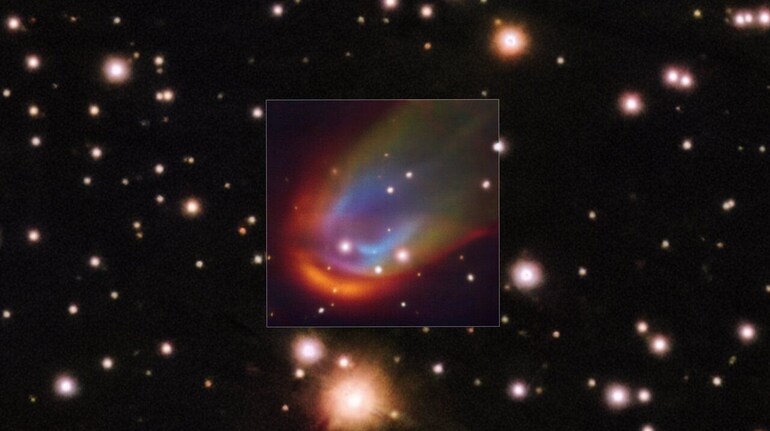

Astronomers have spotted a spectacular rainbow around a white dwarf. The star, RXJ0528+2838, lies 731 light-years away. It emits glowing gas forming a bow-shaped, colourful arc in space. No existing stellar models explain this unusual rainbow phenomenon.
The discovery challenges understanding of white dwarfs completely. Astronomers are studying its formation to understand this unexpected event.
Discovery of a Rainbow-Shaped Bow Shock
Researchers observed a glowing bow shock extending ahead of the white dwarf. Bow shocks occur when stellar winds collide with surrounding interstellar gas. Hydrogen, oxygen and nitrogen emissions create the vibrant, rainbow-like colours.
The star emits a strong outflow despite lacking a surrounding gas disk. This makes the bow shock unusually bright and well-defined for its type.
White Dwarfs Reveal Their Hidden Power
White dwarfs are remnants of Sun-like stars after nuclear fusion stops. They are extremely dense objects, slowly cooling over billions of years. Typically, they emit little energy and create no visible outflows.
RXJ0528+2838, however, defies expectations with its rainbow-shaped bow shock. Astronomers are revising ideas about how binary stars interact with space. RXJ0528+2838 provides a fresh perspective on stellar evolution processes.
The Colourful Glow Challenges Stellar Theories
Bow shocks typically require swirling disks to form and remain stable. RXJ0528+2838 creates a rainbow without the expected disk of gas. Strong magnetic fields appear to channel material from a companion star. This produces a directed outflow that forms the bow-shaped glow. The observation shows that magnetism can significantly shape stellar environments.
Why This Discovery Puzzled Scientists?
White dwarfs without disks are not supposed to form bow shocks. RXJ0528+2838 produces a rainbow glow despite lacking a swirling gas disk. Its bow-shaped shock resembles a cosmic rainbow in the surrounding space.
These challenges established models of dead stars and their interactions with the environment. Strong magnetic fields may be funneling material, creating the unexpected colourful display.
Does This Change Anything in Science?
Yes, it challenges existing theories about dead stars’ behaviour. It suggests magnetic fields may play a larger role than previously thought. Binary star systems may produce outflows without accretion disks.
Models of white dwarf evolution may require revision after this discovery. Future research may uncover similar rainbow bow shocks around other stars.
Discover the latest Business News, Sensex, and Nifty updates. Obtain Personal Finance insights, tax queries, and expert opinions on Moneycontrol or download the Moneycontrol App to stay updated!
Find the best of Al News in one place, specially curated for you every weekend.
Stay on top of the latest tech trends and biggest startup news.





