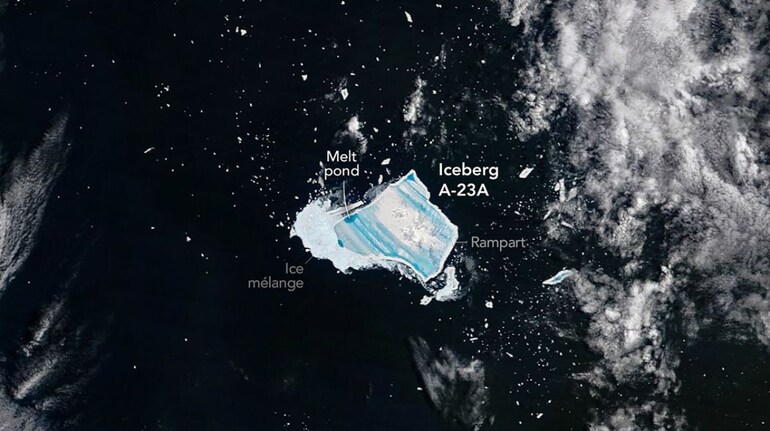

A colossal iceberg drifting off Antarctica has put on a rare, breathtaking show. Its surface now glows brilliant blue, signaling that it may be nearing the end of its journey. This is one of the largest and longest-lived bergs ever tracked by scientists.
Satellite images show that over the years, it has lost significant mass, shedding large chunks into the sea. After nearly 40 years, this iceberg is showing some major surface changes.
Why Is Iceberg A‑23A Turning Bright Blue?
Iceberg A-23A's surface has turned bright blue, sparking curiosity among scientists and space observers alike. But what is causing this striking colour? This iceberg broke off from the Filchner Ice Shelf in 1986.
For nearly 40 years, it has floated through the Southern Ocean. During this long journey, it has slowly lost mass and broken into smaller pieces. Now, meltwater pools have formed on its surface, giving it a vivid blue appearance.
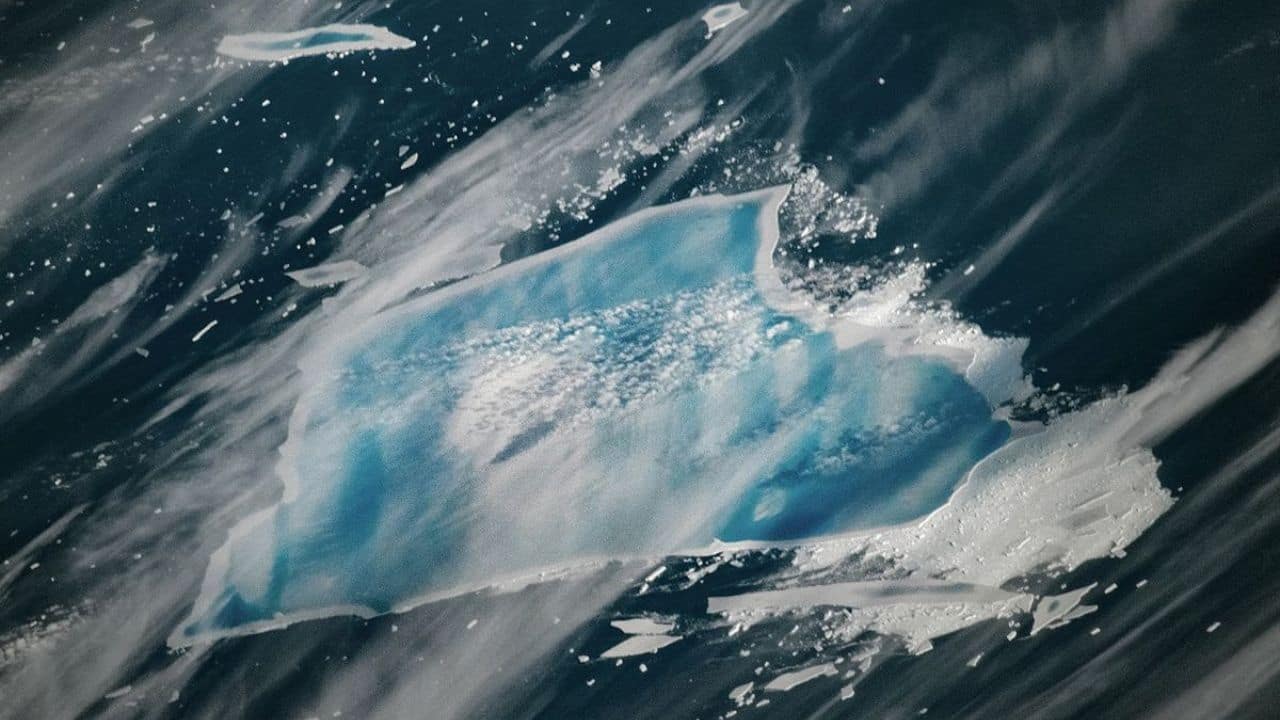 Iceberg A-23A's surface has turned bright blue, sparking curiosity among scientists. (Image: NASA)
How Do Meltwater Pools Form on Icebergs?
The blue areas are caused by pools of melted snow and ice collecting in shallow depressions on the iceberg’s surface. This phenomenon is not new, but A‑23A’s pools are unusually extensive. Ice absorbs sunlight differently depending on its density. Dense ice absorbs red and yellow light but reflects blue light, which is why these meltwaters pools appear intensely blue from above.
Why Are Scientists So Interested in Iceberg Melt?
Tracking surface melt on icebergs helps scientists predict how ice behaves in a warming climate. Meltwater can influence the speed at which ice breaks apart. Faster breakups mean more freshwater entering the oceans, affecting currents and sea level.
Icebergs like A‑23A serve as natural laboratories. Studying them will give scientists some insights about ice shelf stability, surface melting patterns and the effects of climate change on polar regions.
A Warning from Scientists
Scientists warn that A‑23A may disintegrate completely within weeks, particularly as it drifts into warmer waters. Monitoring the iceberg allows researchers to study the natural processes behind ice melt and fragmentation, which are crucial for understanding polar dynamics. A‑23A’s blue colour is a reminder that even the largest ice formations are vulnerable to environmental change.
Discover the latest Business News, Sensex, and Nifty updates. Obtain Personal Finance insights, tax queries, and expert opinions on Moneycontrol or download the Moneycontrol App to stay updated!
Find the best of Al News in one place, specially curated for you every weekend.
Stay on top of the latest tech trends and biggest startup news.