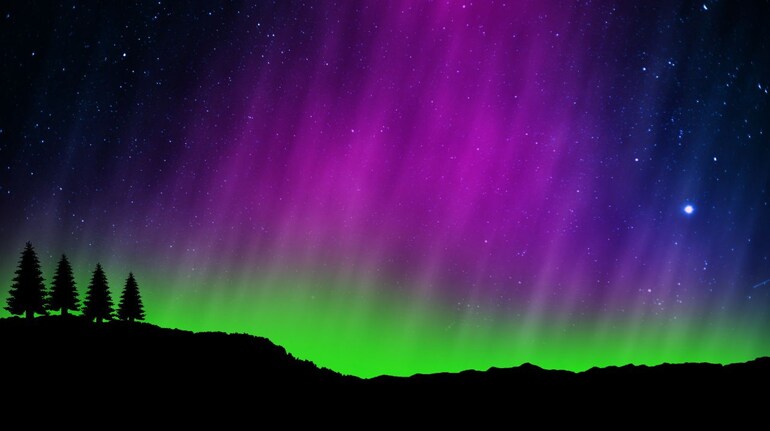
Stargazers are in for a celestial show this weekend as increased solar activity has led the National Oceanic and Atmospheric Administration (NOAA) Space Weather Prediction Center to issue a geomagnetic storm watch from 9 to 11 August. This timing aligns closely with the peak of the Perseid meteor shower, expected on 11 August and into the early hours of 12 August. According to NOAA, if the predicted G2 moderate storm conditions occur, the Northern Lights could be visible as far south as New York and Idaho.
Potential for Stunning Auroras
While geomagnetic storm warnings at this level are not uncommon, they are still potent enough to produce stunning auroral displays. A recent weaker G1 storm, for instance, managed to create breathtaking Northern Lights across the U.S. and Canada. Even if a full geomagnetic storm doesn't materialise, a powerful solar substorm could still generate impressive auroras.
Understanding Geomagnetic Storms and CMEs
NOAA classifies geomagnetic storms using a G-scale, which ranges from G1 (minor) to G5 (extreme). The current storm watch is rated as a G2-class event, triggered by three coronal mass ejections (CMEs)—eruptions of plasma and magnetic fields from the Sun. Two CMEs erupted on 7 August, followed by another on 8 August during an X-class solar flare. All three CMEs are expected to reach Earth late on 9 August and again around 11 August, although predicting their exact arrival times is challenging due to the unpredictable nature of space weather.
Aurora Visibility Depends on Magnetic Field Alignment
The potential for auroras depends on the magnetic field alignment within the incoming CMEs. If the CME's magnetic field connects with Earth's magnetosphere, it could result in a spectacular display of Northern Lights. However, if Earth's magnetosphere effectively "shuts the door" on the CME, aurora enthusiasts might be left disappointed.
Tracking Space Weather for Aurora Alerts
For those tracking space weather, it's crucial to monitor the Interplanetary Magnetic Field (IMF), particularly the Bz value, which indicates the direction of the IMF. A southward-oriented Bz is favourable for a strong connection with Earth's magnetosphere, increasing the likelihood of vivid auroras. Should the geomagnetic conditions align favourably, the CMEs could trigger striking mid-latitude auroras.
How CMEs Create Auroras
When CMEs collide with Earth's magnetosphere, they can cause geomagnetic storms. These storms occur when the electrically charged ions within the CMEs interact with gases in Earth's atmosphere, releasing energy in the form of light. This results in the aurora borealis, commonly known as the Northern Lights, in the Northern Hemisphere, and the aurora australis, or Southern Lights, in the Southern Hemisphere.
This weekend could offer a rare opportunity for skywatchers to witness both the Perseid meteor shower and the Northern Lights in a single night, making it a spectacle not to be missed.
Discover the latest Business News, Sensex, and Nifty updates. Obtain Personal Finance insights, tax queries, and expert opinions on Moneycontrol or download the Moneycontrol App to stay updated!
Find the best of Al News in one place, specially curated for you every weekend.
Stay on top of the latest tech trends and biggest startup news.